
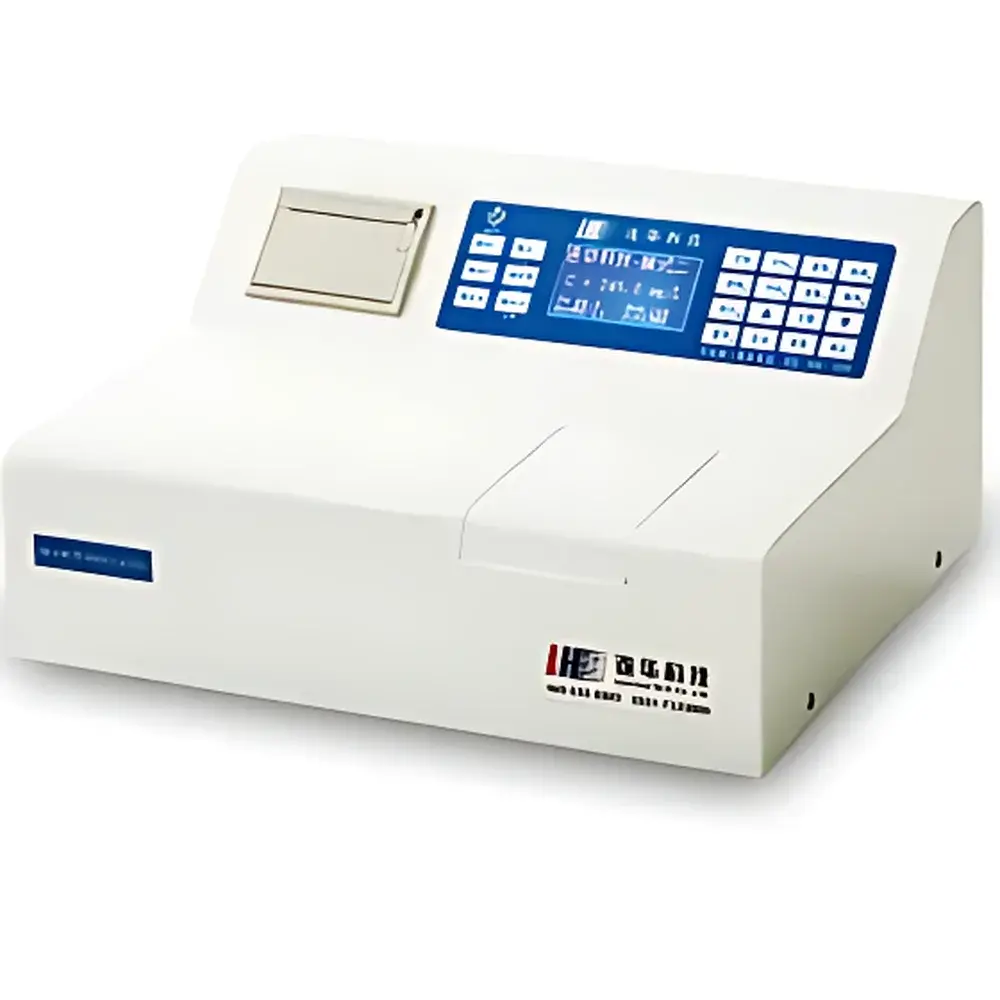
Heipu 5B-3B(H) V7 Multi-Parameter Water Quality Analyzer
| Brand | Heipu (Jinan Heipu Instrument Co., Ltd.) |
|---|---|
| Origin | Shandong, China |
| Model | 5B-3B(H) V7 |
| Detection Parameters | COD, Ammonia Nitrogen, Total Phosphorus, Turbidity |
| COD Range | 2–10,000 mg/L (multi-range), Ammonia Nitrogen Range: 0.02–60 mg/L (multi-range), Total Phosphorus Range: 0.002–5 mg/L (multi-range) |
| COD Accuracy | ≤±10% at <50 mg/L |
| Ammonia Nitrogen & Total Phosphorus Accuracy | ≤±5% |
| COD Measurement Time | 20 min |
| Ammonia Nitrogen | 10–15 min |
| Total Phosphorus | 35–50 min |
| Batch Capacity | 12 samples (COD & turbidity), 10 samples (ammonia nitrogen, expandable) |
| Light Source Lifetime | 100,000 hours |
| Chloride Interference Tolerance | [Cl⁻] < 1000 mg/L (standard) |
| Colorimetric Formats | Cuvette and test tube |
| Data Storage | 4000 records (timestamp, parameter ID, result) |
| Calibration Curves | 96 pre-stored or user-defined |
| Display | LCD |
| Interface | RS232 |
| Power Supply | AC 220 V ±10%, 50 Hz |
Overview
The Heipu 5B-3B(H) V7 Multi-Parameter Water Quality Analyzer is a benchtop spectrophotometric analyzer engineered for standardized, regulatory-compliant water quality testing in municipal, industrial, and environmental laboratory settings. It employs standardized colorimetric methods—principally the dichromate reflux method for COD (in accordance with HJ 828-2017 and ISO 6060), the Nesslerization method for ammonia nitrogen (HJ 535-2009), and the ammonium molybdate spectrophotometric method for total phosphorus (GB/T 11893-1989)—to deliver quantitative results traceable to national reference materials. Designed for routine compliance monitoring rather than research-grade metrology, the instrument integrates fixed-wavelength photometry (typically 420 nm, 610 nm, and 700 nm depending on assay) with temperature-controlled digestion modules for COD and total phosphorus, ensuring consistent reaction kinetics across batches. Its architecture prioritizes operational robustness, minimal maintenance intervals, and ease of method validation under GLP-aligned workflows.
Key Features
- Direct, simultaneous quantification of COD, ammonia nitrogen, total phosphorus, and turbidity—each with dedicated, pre-optimized optical and thermal protocols
- Automated parameter selection via intelligent key scanning: users select target analyte; instrument auto-configures wavelength, digestion time, and calibration curve
- Self-calibrating curve generation: instrument performs multi-point standardization using certified reference solutions and stores up to 96 unique calibration curves—including user-defined linear and polynomial fits
- High-capacity data management: stores 4000 measurement records with full metadata (date/time stamp, operator ID field, parameter name, raw absorbance, calculated concentration, digestion temperature)
- Dual-format sample handling: accommodates both 10 mm square cuvettes (for turbidity and low-range assays) and 16 mm round glass test tubes (for high-range COD digestion), reducing cross-contamination risk
- Extended light source longevity: solid-state LED array rated for 100,000 hours, minimizing photometric drift and recalibration frequency
- Chloride interference mitigation: baseline configuration tolerates [Cl⁻] up to 1000 mg/L without correction; optional high-chloride module extends tolerance to 4000 mg/L via mercury sulfate masking—aligned with HJ 399-2017 requirements
Sample Compatibility & Compliance
The 5B-3B(H) V7 accepts liquid aqueous samples within pH 4–10 and suspended solids content ≤500 mg/L (pre-filtration recommended for turbidity-sensitive assays). It supports standard EPA, ISO, and Chinese national methods (HJ, GB/T series) for wastewater, surface water, drinking water, and process water matrices. While not validated for FDA 21 CFR Part 11 compliance out-of-the-box, its audit-ready data log structure—including immutable timestamps and parameter-specific metadata—facilitates integration into LIMS environments compliant with ISO/IEC 17025 and CNAS accreditation requirements. All digestion protocols adhere to thermal profiles specified in HJ 828-2017 (COD), HJ 535-2009 (NH₃-N), and GB/T 11893-1989 (TP), enabling direct comparability with interlaboratory proficiency testing schemes.
Software & Data Management
Data export occurs via RS232 serial interface to Windows-based PC software (supplied), supporting CSV and Excel-compatible formats. The embedded firmware enforces write-once storage logic: once recorded, measurement entries cannot be edited or deleted—only appended with QA/QC annotations. Timestamps are hardware-synchronized and non-adjustable, satisfying basic ALCOA+ principles (Attributable, Legible, Contemporaneous, Original, Accurate). Curve validation reports include R² values, slope/intercept uncertainty estimates, and residual error plots—enabling method verification per ISO/IEC 17025 Clause 7.7. No cloud connectivity or remote access capabilities are included; all data remains resident on-device or locally exported, aligning with air-gapped laboratory security policies.
Applications
- Municipal wastewater treatment plants: daily influent/effluent monitoring for COD, NH₃-N, and TP to verify nitrification/denitrification and biological phosphorus removal efficiency
- Drinking water distribution systems: spot-checking of residual disinfectant byproducts (via indirect turbidity correlation) and source water nutrient loading assessment
- Industrial cooling tower management: tracking organic load (COD) and nutrient accumulation (TP/NH₃-N) to prevent biofilm formation and Legionella proliferation
- Rural water supply programs: field-deployable lab verification of decentralized treatment units where portable meters lack precision for regulatory reporting
- Aquaculture facility QC: rapid assessment of nitrogenous waste buildup and phosphate-driven algal bloom risk in recirculating aquaculture systems (RAS)
FAQ
Does the instrument comply with ISO 17025 for accredited testing?
It supports essential technical requirements (traceable calibration, documented uncertainty, controlled environment operation), but formal accreditation requires lab-specific validation per ISO/IEC 17025 Clause 7.2 and participation in proficiency testing.
Can calibration curves be transferred between instruments?
Yes—curves are exportable as encrypted .CUR files via RS232 and importable to other 5B-3B(H) V7 units, provided firmware versions match.
Is digestion temperature programmable?
No—digestion modules operate at fixed, method-specified temperatures (e.g., 165 °C for COD, 120 °C for TP) to ensure inter-laboratory reproducibility per cited standards.
What maintenance is required beyond lamp replacement?
Annual verification of photometric linearity (using neutral density filters) and quarterly cleaning of cuvette holders and digestion chamber seals are recommended per manufacturer service schedule.
Are reagents supplied with the instrument?
No—reagents must be procured separately as certified analytical grade kits conforming to HJ 828-2017, HJ 535-2009, and GB/T 11893-1989 specifications.







