
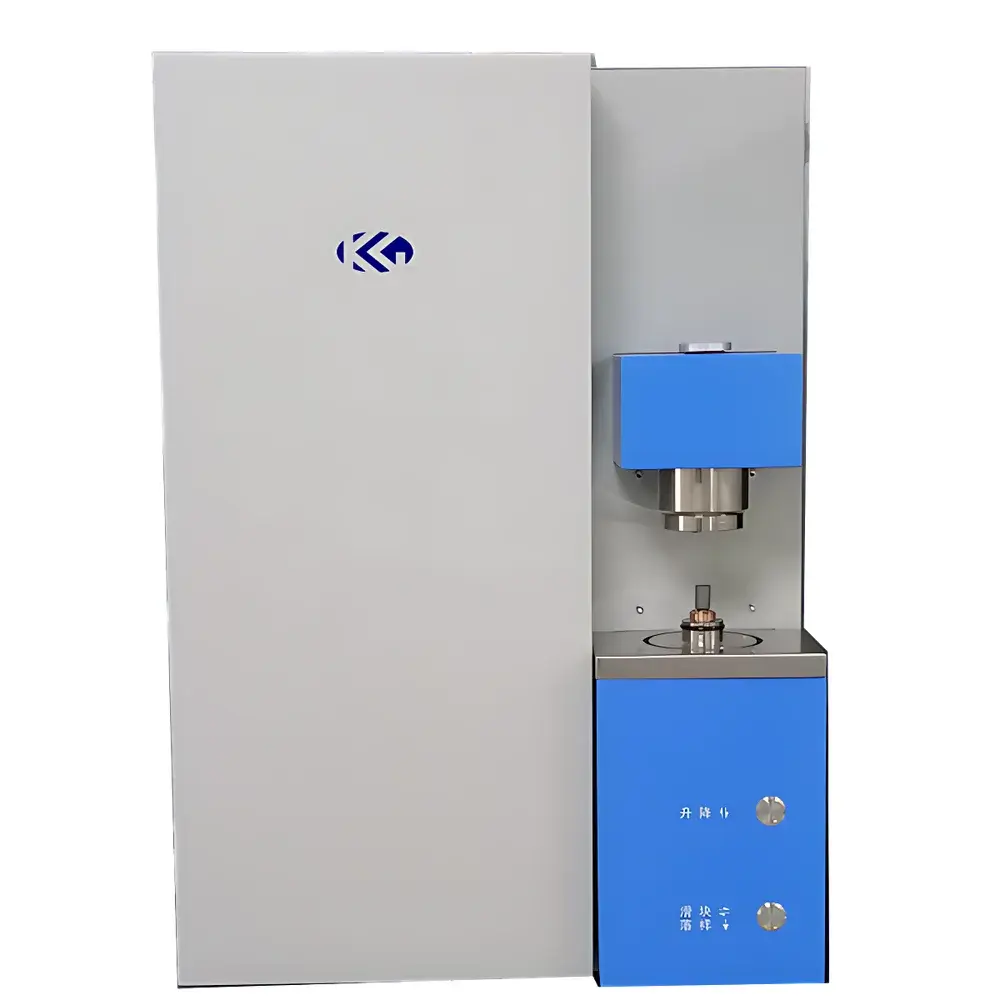
KEGUO O-500 Oxygen Analyzer (Inert Gas Fusion–NDIR)
| Brand | KEGUO |
|---|---|
| Origin | Shanghai, China |
| Model | O-500 |
| Oxygen Analysis Range | 0.1 ppm – 20% |
| Precision | RSD ≤ 1.0% (or ±1 ppm) |
| Sensitivity | 0.01 ppm |
| Analysis Time | ~120 s |
| Pulse Furnace Power | 8.5 kW |
| Detection Method | Non-Dispersive Infrared (NDIR) Absorption at 4.26 µm |
| Cooling System | External 2-PH Refrigerated Chiller (5200 W) |
| Operating Environment | 15–35 °C, 20–80% RH |
| Dimensions (W×D×H) | 600 × 700 × 900 mm |
| Weight | 160 kg |
| Power Supply | 220 V AC, 50 Hz, 50 A |
Overview
The KEGUO O-500 Oxygen Analyzer is a high-performance inert gas fusion–non-dispersive infrared (NDIR) system engineered for precise quantification of total oxygen in solid inorganic materials. It operates on the principle of high-temperature pulse furnace fusion under ultra-high-purity argon atmosphere (99.999%), where samples are thermally decomposed in a graphite crucible heated to up to 3000 °C. Oxygen in the sample reacts with carbon from the crucible to form CO and CO₂; the resulting gases are swept by carrier gas into a catalytic conversion furnace, where CO is fully oxidized to CO₂. The CO₂ concentration is then measured via NDIR detection at its fundamental absorption band centered at 4.26 µm—enabling highly selective, interference-resistant quantification. This method complies with established metallurgical and materials testing protocols including ASTM E1019, ISO 14284, and GB/T 11261, and is widely accepted for QC/QA in ferrous/non-ferrous metallurgy, rare-earth processing, advanced ceramics, and powder metallurgy laboratories.
Key Features
- High-stability pulse electrode furnace with closed-loop power feedback control (max. 8.5 kW, 3000 °C), ensuring reproducible thermal decomposition and minimal baseline drift
- Imported solid-state pyroelectric CO₂ detector (Germany) paired with platinum-filament IR source (USA) and precision narrow-band optical filter for long-term signal stability
- Integrated catalytic conversion furnace with quick-access quartz tube and replaceable CuO catalyst bed—designed for rapid maintenance without alignment recalibration
- Automated baseline compensation algorithm enabling stable analytical operation within 30 minutes after startup
- Intelligent gas management: low-flow argon purge during degassing mode reduces carrier gas consumption by ≥50% versus conventional systems
- Real-time monitoring of furnace temperature, cooling water temperature, and power output—with configurable alarm thresholds and data logging
- Modular hardware architecture with CAMOZZI (Italy) pneumatic components for valve actuation and gas flow control, ensuring reliability under continuous duty cycles
Sample Compatibility & Compliance
The O-500 accommodates diverse solid matrices including carbon steels, stainless steels, nickel-based superalloys, titanium and zirconium alloys, rare-earth metals and oxides, refractory ceramics, sintered powders, and geological silicates. Sample mass is adjustable (typically 0.1–1.0 g) to optimize sensitivity across the full dynamic range (0.1 ppm to 20 wt%). All consumables—including graphite crucibles (inner/outer), high-efficiency desiccants (anhydrous magnesium perchlorate), CO₂ absorbents (soda lime), and oxidation catalysts (rare-earth-doped copper oxide)—meet ASTM E1019 grade specifications. The system supports GLP-compliant operation through audit-trail-enabled software, electronic signature capability, and secure user access levels aligned with FDA 21 CFR Part 11 requirements when deployed with validated configurations.
Software & Data Management
The Windows-based analysis platform (compatible with Windows 7 and later) provides full instrument control, method development, and quantitative reporting. Key capabilities include programmable ramp-and-hold heating profiles (constant-power or linear-slope modes), auto-ranging between low- and high-concentration calibration curves, real-time baseline tracking with automatic correction, and multi-point calibration curve generation (linear, quadratic, or user-defined polynomial). All raw detector signals, furnace parameters, and gas flow logs are timestamped and stored in encrypted binary format. Export options include CSV, PDF, and XML for LIMS integration. Audit trail records all critical events—including method edits, calibration updates, user logins, and result approvals—with immutable timestamps and operator IDs.
Applications
- Quality control of oxygen-sensitive aerospace alloys (e.g., Ti-6Al-4V, Inconel 718) where interstitial O content directly impacts ductility and fatigue life
- Process validation in rare-earth metal production, particularly for cerium, lanthanum, and neodymium metals used in permanent magnets
- Trace oxygen quantification in high-purity silicon carbide and aluminum nitride substrates for semiconductor packaging
- Research-grade analysis of oxide dispersion strengthened (ODS) steels and nuclear fuel cladding materials
- Verification of deoxidation efficiency in secondary steelmaking and ladle refining operations
- Characterization of additive manufacturing feedstock powders (e.g., Ti-6Al-4V, CoCr, NiAl) per ASTM F3049 standards
FAQ
What carrier gas is required, and what purity is mandatory?
Ultra-high-purity argon (≥99.999%) at 0.20 MPa is required as the carrier gas. Nitrogen or filtered compressed air (0.35 MPa) serves as the motive gas for pneumatic actuators.
Is external cooling water necessary?
Yes—an external recirculating chiller (2-PH, 5200 W cooling capacity) is mandatory. Tap water cooling is not supported due to thermal stability and corrosion control requirements.
Can the instrument measure nitrogen simultaneously?
No—the O-500 is dedicated to oxygen analysis. For simultaneous O/N determination, a dual-channel fusion analyzer (e.g., O/N-500 configuration) is required.
What calibration standards are recommended?
Certified reference materials (CRMs) traceable to NIST or BCS standards—such as BCS-CRM 304a (steel), IRMM-016 (titanium), or custom-synthesized metal oxides—are recommended for initial calibration and periodic verification.
How often must the graphite crucibles be replaced?
Crucible lifetime depends on sample matrix and frequency of use; typical service life is 50–100 analyses for high-carbon steels and >200 analyses for pure metals. Replacement kits include both inner and outer crucibles with batch-certified geometry and density.
Related Products





