
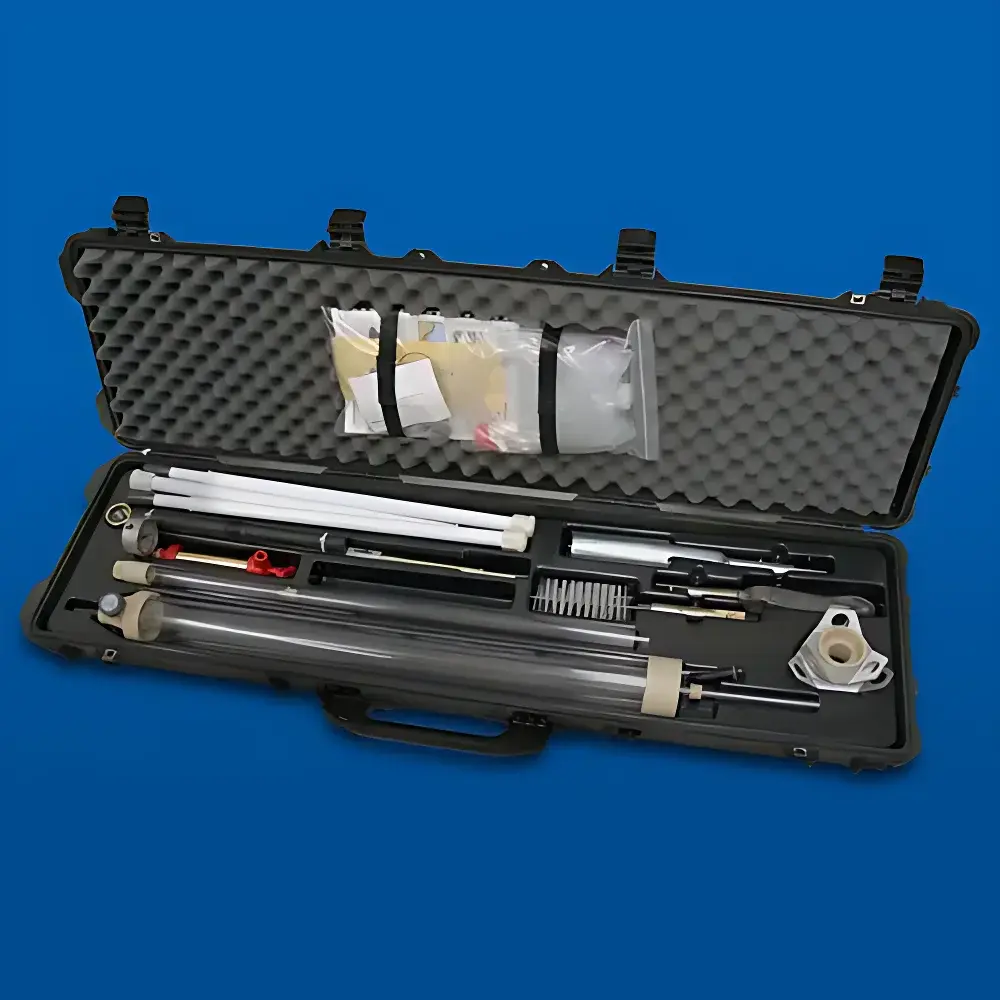
Guelph Permeameter by SEC (USA)
| Origin | USA |
|---|---|
| Manufacturer Type | Authorized Distributor |
| Origin Category | Imported |
| Model | Guelph |
| Price Range | USD 2,800 – 7,000 |
| Instrument Type | Soil Hydraulic Conductivity & Matric Potential Analyzer |
| Measurement Depth (Standard) | 15–75 cm |
| Extended Depth (with 2800K2) | up to 315 cm |
| Infiltrometer Tube Outer Cross-Sectional Area | 35.22 cm² |
| Inner Cross-Sectional Area | 2.16 cm² |
| Auger Diameter | 6.0 cm |
| Saturated Hydraulic Conductivity Range | 1.0 × 10⁻² – 1.0 × 10⁻⁵ cm/s |
| Transport Case Dimensions | 132.08 × 44.45 × 15.24 cm |
| Weight | 11 kg |
Overview
The Guelph Permeameter by SEC (USA) is a field-deployable, single-ring, constant-head infiltration instrument engineered for the rapid and precise determination of saturated hydraulic conductivity (Ksat) in unsaturated and near-saturated soils. Based on the principle of steady-state Darcy’s law under controlled head conditions, it quantifies the volumetric flow rate of water into the soil profile through a known cross-sectional area over time—enabling direct calculation of Ksat without reliance on empirical corrections or numerical inversion. Unlike double-ring infiltrometers, the Guelph design minimizes lateral flow divergence via its deep insertion geometry and integrated tension control options, yielding high reproducibility across heterogeneous textures—from coarse sands to structured clays. Its operational depth range (15–75 cm standard; extendable to 315 cm with the 2800K2 deep-probe kit) permits characterization of vertical hydraulic heterogeneity in the root zone and vadose zone, supporting hydrological modeling, irrigation scheduling, and contaminant transport assessment.
Key Features
- Field-portable modular architecture: All core components—including the precision-machined infiltrometer tube (6.0 cm auger diameter), field tripod, soil auger, hole conditioner, cleaning tools, collapsible water reservoir bag, and hand vacuum pump—are housed in a rugged, wheeled transit case (132 × 44 × 15 cm; 11 kg).
- Constant-head measurement mode: Maintains stable hydraulic head during infiltration using gravity-fed reservoir and manual vacuum regulation—eliminating need for external power or electronic controllers.
- Scalable depth capability: Standard configuration accesses 15–75 cm; optional 2800K2 extension kit enables measurements down to 315 cm, facilitating deep-profile Ksat profiling in layered soils and fractured bedrock interfaces.
- Configurable geometry: Compatible with 2805D10/20 annular infiltrometer attachments for 10 cm and 20 cm diameter ring configurations—supporting comparative studies of scale-dependent infiltration behavior per ASTM D3385 and ISO 28580.
- Tension-controlled operation: The 2825 Tension Adapter allows Ksat measurement under low-matric-potential conditions (e.g., < −10 kPa), extending applicability to fine-textured or compacted soils where traditional constant-head methods yield overestimates.
Sample Compatibility & Compliance
The Guelph Permeameter is validated for use in mineral soils, organic soils, and anthropogenically disturbed substrates (e.g., reclaimed mine spoils, bioswale media). It complies with methodological frameworks referenced in USDA-NRCS National Engineering Handbook Part 630, ASTM D3385-22 (Standard Test Method for Infiltration Rate of Soils in Field Using Double-Ring Infiltrometer), and ISO 28580:2021 (Soil quality — Determination of saturated hydraulic conductivity in situ). While not an electronic data logger, its manual protocol supports GLP-aligned documentation when paired with standardized field logs, calibrated timers, and traceable volumetric measurement tools. All stainless-steel and anodized aluminum components meet NSF/ANSI 61 requirements for contact with potable water systems.
Software & Data Management
The Guelph Permeameter operates as a standalone analog instrument and does not require proprietary software or firmware. Data acquisition follows manual protocols: users record elapsed time and cumulative infiltrated volume at defined intervals (e.g., every 30 s initially, then every 2–5 min as steady state approaches). Calculated Ksat values are derived using the standard equation Ksat = Q / (A × i), where Q is steady-state flow rate (cm³/s), A is inner cross-sectional area (2.16 cm²), and i is hydraulic gradient (dimensionless, assumed ≈ 1 under constant-head conditions). Field notes, raw timing/volume tables, and calculated results can be imported into spreadsheet-based QA/QC workflows or LIMS platforms compliant with 21 CFR Part 11 when electronic signatures and audit trails are applied externally.
Applications
- Site-specific irrigation system design and efficiency evaluation
- Vadose zone characterization for landfill liner performance monitoring
- Soil bioengineering assessments for slope stability and erosion control
- Calibration and validation of HYDRUS-1D and STANMOD numerical models
- Regulatory compliance testing for stormwater infiltration basins (EPA SWMM input parameterization)
- Long-term land-use change impact studies (e.g., forest-to-agriculture conversion)
FAQ
What is the minimum and maximum saturated hydraulic conductivity this instrument can reliably measure?
The Guelph Permeameter is validated for Ksat values ranging from 1.0 × 10⁻² cm/s (coarse sands) to 1.0 × 10⁻⁵ cm/s (heavy clays), provided appropriate pre-soaking and tension adaptation (via 2825 adapter) are applied for low-permeability conditions.
Can the instrument be used in rocky or gravelly soils?
Yes—when combined with the 2800K2 deep-probe kit and careful augering technique, it accommodates soils containing up to 30% gravels (< 7.5 cm diameter); however, Ksat interpretation requires verification against core-based laboratory measurements if macroporosity dominates flow paths.
Is calibration required before each use?
No routine calibration is needed—the system relies on geometric constants (known cross-section, measured depth) and time/volume measurements traceable to NIST-certified standards; users should verify auger diameter and tube inner area annually using calipers and micrometers.
Does SEC provide training or SOP documentation?
Yes—SEC supplies a comprehensive English-language Field Operations Manual (FOM), including step-by-step assembly instructions, troubleshooting flowcharts, sample calculation worksheets, and ASTM/ISO cross-referenced procedural checklists.
Related Products







