
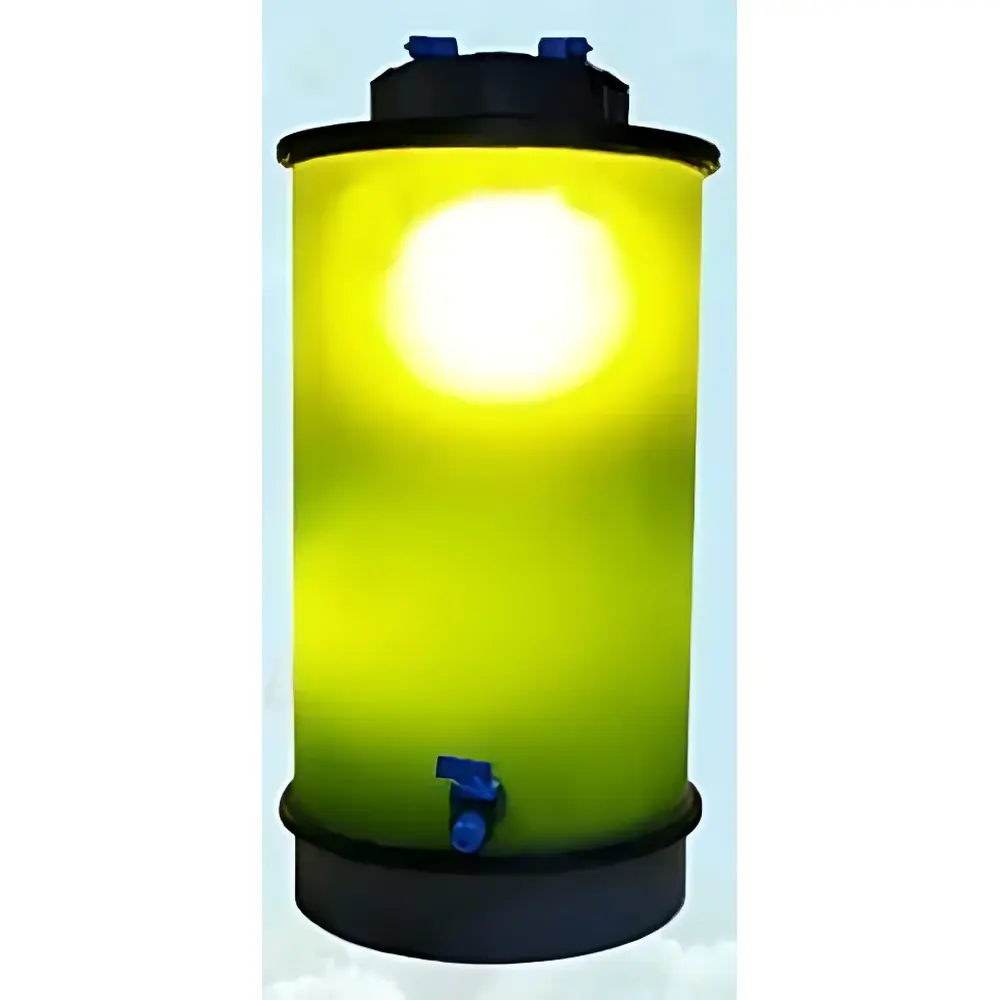
PB200 Phytoplankton Cultivation System
| Origin | Germany |
|---|---|
| Manufacturer Type | Authorized Distributor |
| Origin Category | Imported |
| Model | PB_200 |
| Pricing | Upon Request |
| Volume | 12 L |
| Inner Diameter | 200 mm |
| Height | 520 mm |
| Controller Dimensions | 220 mm × 80 mm × 70 mm |
| Input Voltage/Power | 85–250 VAC / 5 W |
Overview
The PB200 Phytoplankton Cultivation System is a laboratory-grade, benchtop photobioreactor engineered for controlled, reproducible growth of unicellular and colonial microalgae, cyanobacteria, and other photosynthetic planktonic organisms. Designed and manufactured in Germany, the system operates on a continuous or semi-continuous cultivation principle—enabling daily medium exchange at up to 30% volume replacement under standard operational conditions. Its core architecture integrates gas exchange, precise light delivery, magnetic stirring, and programmable environmental control into a single compact unit. The system employs a cylindrical, optically transparent cultivation vessel (12 L working volume, 200 mm inner diameter, 520 mm height) constructed from borosilicate glass or optical-grade polycarbonate—ensuring high UV transmission stability and chemical resistance to common algal media (e.g., f/2, BG-11, ASP-2). Unlike open pond or shake-flask methods, the PB200 provides closed-system sterility maintenance, minimizing contamination risk while enabling quantitative biomass monitoring and physiological parameter tracking over extended culture periods.
Key Features
- Optimized photobioreactor geometry: Cylindrical transparent vessel with uniform light path length and minimized wall adhesion effects for consistent photon flux distribution.
- Integrated high-efficiency LED illumination unit with adjustable spectral output (default: cool white, 400–700 nm PAR range), intensity control, and programmable on/off cycles synchronized with the controller.
- Non-invasive magnetic stirring mechanism ensuring gentle yet homogeneous suspension of motile and non-motile phytoplankton without shear-induced cell damage or impeller fouling.
- Dual-gas inlet system supporting air, ambient air enriched with CO₂, or custom gas mixtures—regulated via precision mass flow control (optional add-on) and integrated sterile filtration (0.2 µm).
- Modular PB200 Controller: A dedicated embedded microcontroller unit (220 × 80 × 70 mm, 5 W power draw, universal 85–250 VAC input) providing timed actuation of lighting, peristaltic nutrient dosing (via external pump interface), and air/gas supply sequencing.
- Threaded top cap design enables rapid, tool-free access for sampling, inoculation, or sensor insertion while maintaining pressure and sterility integrity.
Sample Compatibility & Compliance
The PB200 supports cultivation of diverse phytoplankton taxa including Chlamydomonas reinhardtii, Dunaliella salina, Phaeodactylum tricornutum, Nannochloropsis oceanica, and freshwater cyanobacteria such as Synechocystis sp. PCC 6803. Its materials comply with EU Directive 2002/72/EC for food-contact plastics (where applicable) and are autoclavable (glass vessel) or compatible with 70% ethanol and hydrogen peroxide vapor sterilization (polymer components). The system meets general biosafety Level 1 (BSL-1) containment requirements and is suitable for GLP-aligned experimental workflows. While not certified to ISO 13485 or FDA 21 CFR Part 11 out-of-the-box, its controller logging capability (via optional RS-485 or USB data export) supports audit-ready recordkeeping when integrated into validated laboratory information management systems (LIMS).
Software & Data Management
The PB200 operates via standalone hardware logic—no proprietary software installation required. All cultivation parameters (light schedule, pump activation windows, gas timing) are configured directly on the controller’s tactile keypad and LCD interface. Time-stamped event logs (power-on, lighting cycles, pump triggers) are retained in non-volatile memory for up to 30 days. For advanced integration, an optional digital I/O expansion module enables synchronization with external sensors (pH, DO, OD750) and data acquisition systems using Modbus RTU or analog 0–5 V outputs. Exported CSV log files conform to FAIR principles (Findable, Accessible, Interoperable, Reusable) and are compatible with MATLAB, Python (Pandas), and LabChart for downstream kinetic modeling and growth rate analysis.
Applications
- Physiological studies of photoacclimation, nutrient limitation (N/P/Si), and stress response (UV-B, oxidative, osmotic) under controlled diel cycles.
- Production of algal biomass for lipid extraction, pigment isolation (astaxanthin, fucoxanthin), or recombinant protein expression.
- Ecotoxicology assays: Standardized exposure testing of nanomaterials, pesticides, or pharmaceutical residues using Pseudokirchneriella subcapitata (OECD 201 guideline-compliant setup).
- Carbon capture and utilization (CCU) research: Quantification of CO₂ fixation rates under varying irradiance and gas composition.
- Teaching laboratories: Hands-on instruction in microbial physiology, bioreactor engineering, and sustainable biotechnology principles.
FAQ
Is the PB200 suitable for axenic cultures?
Yes—the closed, filter-sterilized gas inlet and threaded sealing cap support maintenance of axenic conditions when combined with appropriate aseptic technique and pre-sterilized medium.
Can the illumination spectrum be customized?
Standard units ship with full-spectrum white LEDs; narrowband modules (e.g., 450 nm blue, 660 nm red) are available as factory-configurable options.
What maintenance is required for long-term operation?
Routine cleaning with dilute citric acid or enzymatic detergent is recommended after each culture cycle; O-rings and tubing should be inspected quarterly and replaced annually under continuous use.
Does the system include temperature control?
No—temperature regulation requires external integration (e.g., water-jacketed enclosure or climate-controlled room), as the PB200 is designed for ambient temperature operation (18–28 °C).
Is remote monitoring supported?
Not natively—but the controller’s digital output port allows connection to third-party IoT gateways for cloud-based status reporting and alarm notification via MQTT or HTTP POST.



