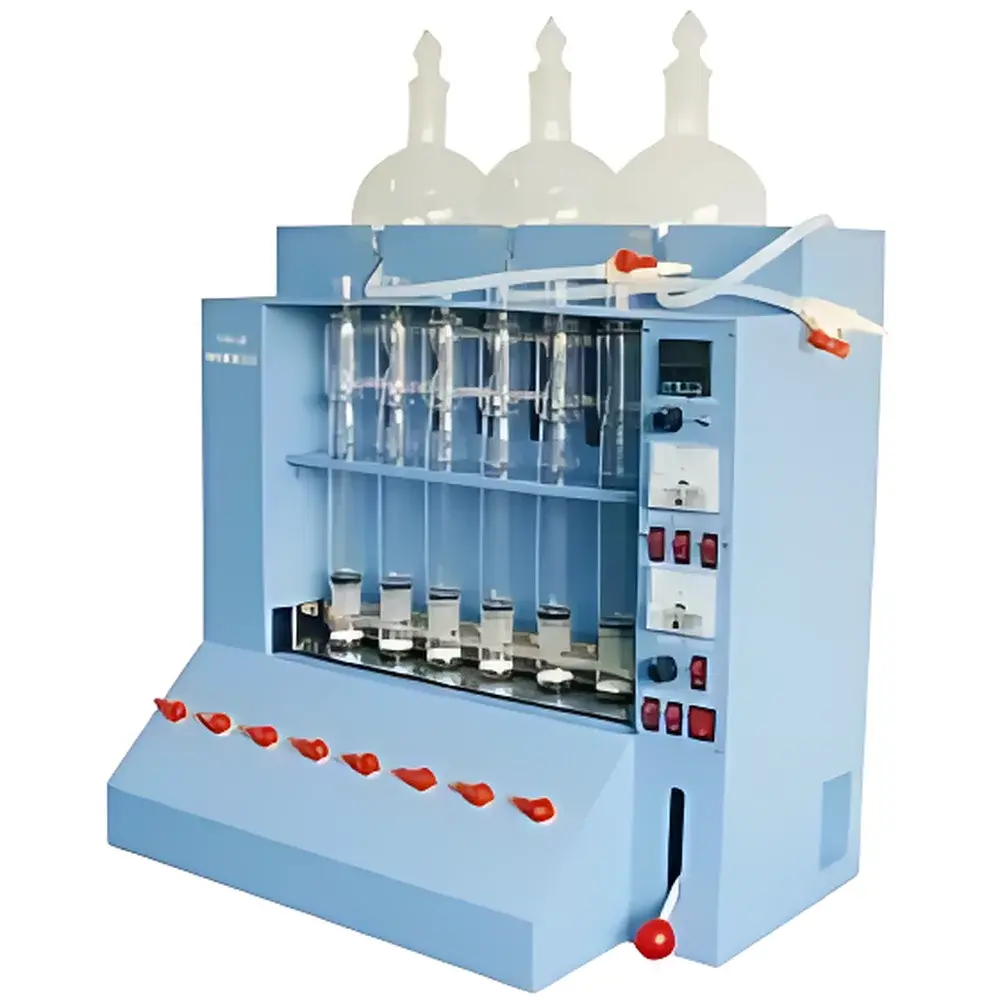
Jihepu JRXW-06 Gravimetric Crude Fiber Analyzer
| Brand | Jihepu |
|---|---|
| Origin | Shandong, China |
| Model | JRXW-06 |
| Sample Capacity | 6 positions |
| Sample Weight Range | 0.5–3 g |
| Measurement Range | 0.1–100% |
| Repeatability | ≤0.4 absolute for samples with crude fiber ≤10% |
| Cycle Time | ~90 min (acid digestion: 30 min |
| alkali digestion | 30 min |
| filtration & washing | ~30 min) |
| Power Supply | AC 220 V / 50 Hz |
| Rated Power | 3.3 kW |
| Dimensions (W×D×H) | 540 × 450 × 670 mm |
| Net Weight | 30 kg |
Overview
The Jihepu JRXW-06 Gravimetric Crude Fiber Analyzer is a dedicated laboratory instrument engineered for the standardized determination of crude fiber content in agricultural and animal feed matrices. It implements the classical gravimetric acid-alkali digestion method—fully aligned with AOAC Official Method 962.09, ISO 6865:2000, and GB/T 6434–2006—wherein samples undergo sequential boiling in sulfuric acid and sodium hydroxide solutions to solubilize non-fibrous components (e.g., starches, proteins, pectins, and sugars), followed by quantitative filtration, drying, and ashing to isolate the acid- and alkali-insoluble residue. This residue—comprising cellulose, lignin, and associated hemicellulose fractions—is reported as “crude fiber” after correction for ash content. The JRXW-06 automates critical thermal and fluid-handling steps while preserving full operator control over digestion timing, temperature ramp profiles, and wash volume—ensuring method fidelity across routine QC and regulatory-compliant testing environments.
Key Features
- Integrated six-position digestion manifold with independent temperature-controlled heating blocks, enabling parallel processing of up to six samples per run without cross-contamination.
- Precision-engineered glassware set—including borosilicate digestion cups, Gooch-type crucibles, and acid/alkali-resistant tubing—designed for long-term chemical stability under repeated exposure to 1.25 M H2SO4 and 1.25 M NaOH at reflux conditions (≈100 °C).
- Digital timer and dual-stage temperature regulation (acid stage: 98–102 °C; alkali stage: 98–102 °C) ensure strict adherence to AOAC-defined dwell times and thermal profiles.
- Vacuum-assisted filtration system with adjustable vacuum pressure (0–0.09 MPa) and integrated wash cycle controls for consistent residue recovery and minimized fiber loss during rinsing.
- Robust stainless-steel chassis with corrosion-resistant coating and ergonomic front-access design for safe handling of hot digestates and crucibles.
- Compliance-ready documentation support: includes calibration log templates, maintenance records, and method verification checklists compatible with GLP and feed safety audit requirements (e.g., FAMI-QS, ISO/IEC 17025).
Sample Compatibility & Compliance
The JRXW-06 accommodates heterogeneous solid matrices typical in animal nutrition analysis—including pelleted and mash feeds, cereal grains (corn, barley, wheat), oilseed meals (soybean, rapeseed), forage materials (alfalfa hay, silage), and processed food by-products. Its 0.5–3 g sample mass range balances analytical sensitivity with representative sampling for coarse particulates. All operational parameters conform to internationally recognized reference methods: AOAC 962.09 (Crude Fiber in Animal Feeds), ISO 6865:2000 (Animal feeding stuffs — Determination of crude fibre content), and Chinese National Standard GB/T 6434–2006. Instrument validation protocols include recovery testing with NIST-traceable cellulose/lignin reference materials and interlaboratory reproducibility assessment per ISO 5725-2.
Software & Data Management
The JRXW-06 operates as a standalone benchtop instrument with no embedded software or touchscreen interface—intentionally designed to minimize validation burden in regulated environments. All procedural parameters (digestion duration, temperature setpoints, vacuum thresholds) are manually configured via calibrated dials and analog timers, ensuring full traceability and eliminating electronic data integrity risks. Users maintain complete control over raw data recording in paper-based or LIMS-integrated electronic lab notebooks. For laboratories requiring 21 CFR Part 11 compliance, the system supports audit-trail documentation through external SOP-driven workflows, including analyst sign-offs, equipment usage logs, and raw weight entry verification (pre- and post-digestion, pre- and post-ashing). Calibration certificates for analytical balances and thermometers used in conjunction with the JRXW-06 are recommended annually per ISO/IEC 17025 clause 6.5.
Applications
- Quality control of compound feed formulations for poultry, swine, ruminants, and aquaculture species.
- Verification of crude fiber declarations on commercial feed labels per EU Regulation (EC) No 767/2009 and FDA Title 21 CFR Part 501.
- Research into dietary fiber–nutrient interactions in monogastric and ruminant digestion models.
- Raw material qualification for feed mills and premix manufacturers adhering to GMP+ B4 or FEFANA guidelines.
- Academic teaching labs conducting standardized proximate analysis according to FAO Feed Analysis Manual protocols.
FAQ
Does the JRXW-06 comply with AOAC and ISO crude fiber methods?
Yes—it is explicitly configured to execute AOAC 962.09 and ISO 6865:2000, including specified acid/alkali concentrations, reflux temperatures, and filtration criteria.
Can the instrument handle high-lignin forage samples such as straw or mature grass hay?
Yes, provided sample particle size is reduced to ≤1 mm prior to loading; extended alkali digestion (up to 60 min) may be manually applied for recalcitrant matrices.
Is ash correction performed automatically?
No—ash content must be determined separately using a muffle furnace (e.g., ISO 5984), and final crude fiber % calculated manually or via LIMS using the formula: CF (%) = [(Wresidue – Wash) / Wsample] × 100.
What maintenance is required for long-term reliability?
Monthly inspection of heating element continuity, quarterly replacement of silicone gaskets and vacuum tubing, and annual verification of temperature uniformity across all six digestion zones using NIST-traceable thermocouples.