
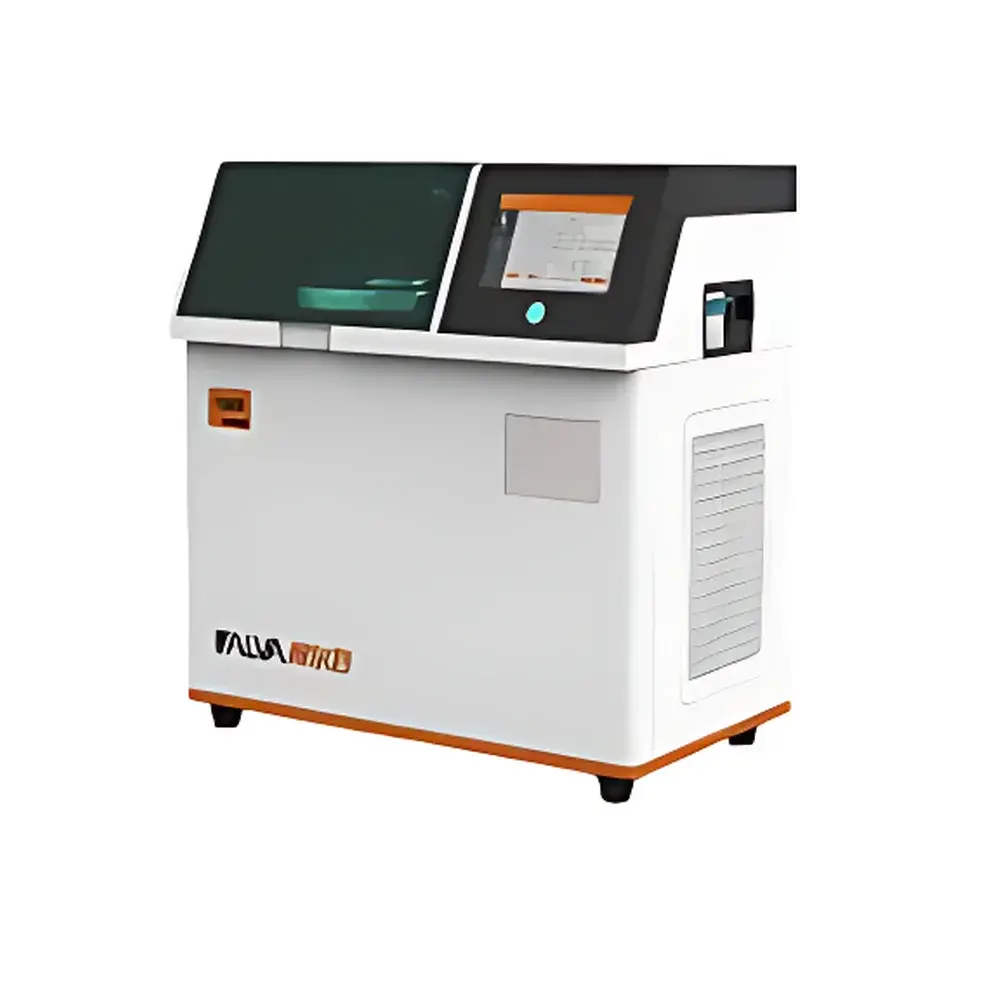
JIHEPU F1600 Semi-Automated Fiber Analyzer
| Brand | JIHEPU |
|---|---|
| Origin | Shandong, China |
| Model | F1600 |
| Temperature Range | Ambient to 100 °C |
| Sample Mass per Filter Bag | 0.5–1.5 g |
| Fiber Content Range | 0.1–100% |
| Digestion Time per Stage | 0–999 min |
| Batch Capacity | 1–24 samples |
| Daily Throughput (8-h shift) | 24–96 CF assays or 24–120 NDF/ADF/ADL assays |
| Repeatability | ≤5% RSD for fiber <10% |
| Temperature Control Accuracy | ±0.2 °C |
Overview
The JIHEPU F1600 Semi-Automated Fiber Analyzer is an engineered solution for standardized detergent fiber analysis in feed, food, dairy, and tobacco laboratories. It implements the gravimetric filter-bag digestion method—fully aligned with AOAC Official Methods 973.18, 962.09, and 978.10, as well as ASTM D5768 and ISO 13906—for the quantitative determination of Crude Fiber (CF), Neutral Detergent Fiber (NDF), Acid Detergent Fiber (ADF), and Acid Detergent Lignin (ADL). Unlike traditional crucible-based systems, the F1600 utilizes sealed, inert three-dimensional polyester filter bags to contain samples during high-temperature, solvent-driven hydrolysis. This eliminates manual transfer steps, minimizes analyst exposure to hot acids and detergents, and ensures consistent thermal and chemical exposure across all samples. The instrument operates without external cooling water, relying instead on a precisely controlled reflux condensation system that maintains reagents at micro-boiling conditions while retaining vapor within the reaction chamber—reducing evaporation loss, improving method reproducibility, and lowering infrastructure requirements.
Key Features
- Pre-programmed assay modes for CF, NDF, ADF, and ADL—each compliant with internationally recognized analytical protocols.
- Configurable experimental protocols: up to 50 user-defined methods stored onboard, supporting variable digestion temperatures, durations, agitation profiles, and reagent sequences.
- Intelligent experiment resumption: real-time process logging enables recovery from power interruption or reagent depletion—resuming exactly at the interrupted step without sample re-weighing or method restart.
- 16-bit true-color 7-inch capacitive touchscreen interface with intuitive icon-driven navigation and multilingual UI support (English, Spanish, French, Chinese).
- Dual authentication system: password-protected account login (up to 5 users) plus optional fingerprint enrollment per account for secure, audit-ready access control.
- Integrated thermal printer with embedded calculation engine—automatically computes and prints final fiber percentages upon assay completion using configurable formulas (e.g., moisture-corrected or ash-corrected results).
- Chemically resistant reaction chamber constructed from high-purity PTFE-coated stainless steel and reinforced silicone gaskets; designed for sustained operation at 100 °C under elevated pressure.
- Non-invasive magnetic stirring mechanism—eliminating shaft seals and potential leakage points associated with immersed agitators.
- Foam-suppressing reactor geometry optimized for NDF and ADF digestions, eliminating the need for octanol or other antifoaming agents—reducing reagent cost, operator handling, and volatile organic emissions.
Sample Compatibility & Compliance
The F1600 accommodates solid, semi-solid, and homogenized matrices including pelleted and mash feeds, forage grasses, cereal grains, bakery products, dairy powders, and cured tobacco leaves. Its 0.5–1.5 g sample capacity per bag supports both routine QC screening and research-grade precision. All hardware and firmware comply with ISO 9001:2015 quality management system requirements. Method outputs meet traceability and documentation standards required under GLP environments and are compatible with laboratory information management systems (LIMS) via optional RS-232 or USB data export. While not FDA 21 CFR Part 11–certified out-of-the-box, the audit trail functionality—including timestamped operator logins, method version tracking, and step-level execution records—provides foundational elements for Part 11 readiness when deployed within validated workflows.
Software & Data Management
The embedded operating system stores complete assay metadata: operator ID, start/end timestamps, temperature logs, reagent lot numbers (manually entered), and raw mass values before and after digestion. Data export is supported in CSV format for post-processing in Excel or statistical software. No proprietary software installation is required for basic operation; advanced reporting or remote monitoring may be enabled via optional Ethernet module and web-based dashboard (sold separately). Firmware updates are delivered via USB drive with version-controlled release notes and change logs.
Applications
Primary use cases include nutritional labeling compliance (e.g., EU Regulation (EU) No 1169/2011), feed formulation optimization, forage quality assessment (e.g., relative feed value, RFV), dairy ration balancing, and regulatory submissions to agencies such as the USDA, EFSA, or CFIA. The F1600 is routinely deployed in contract testing labs serving agricultural cooperatives, animal nutrition companies, and academic veterinary nutrition programs where throughput, method fidelity, and operator safety are prioritized over fully unattended automation.
FAQ
Does the F1600 require external cooling water?
No—the instrument uses a closed-loop reflux condensation system to retain vapor within the reaction chamber, enabling micro-boiling digestion without auxiliary chillers or tap water connections.
Can I modify digestion parameters for non-standard matrices?
Yes—users can create and save custom protocols with adjustable temperature ramps, hold times, agitation intensity, and multi-stage reagent addition sequences.
What consumables are required beyond the supplied filter bags?
Standard reagents (neutral detergent solution, acid detergent solution, sulfuric acid, acetone) and certified reference materials (e.g., NIST SRM 1846) are required; no proprietary cartridges or single-use kits are needed.
Is validation documentation provided?
A comprehensive user manual, factory calibration report, ISO 9001 certificate, and trademark registration documentation are included with shipment; IQ/OQ protocol templates are available upon request.
How is maintenance performed?
Routine cleaning involves wiping the reaction chamber with ethanol; annual verification of temperature sensor accuracy and seal integrity is recommended—service contracts include remote diagnostics and on-site technician support.







