
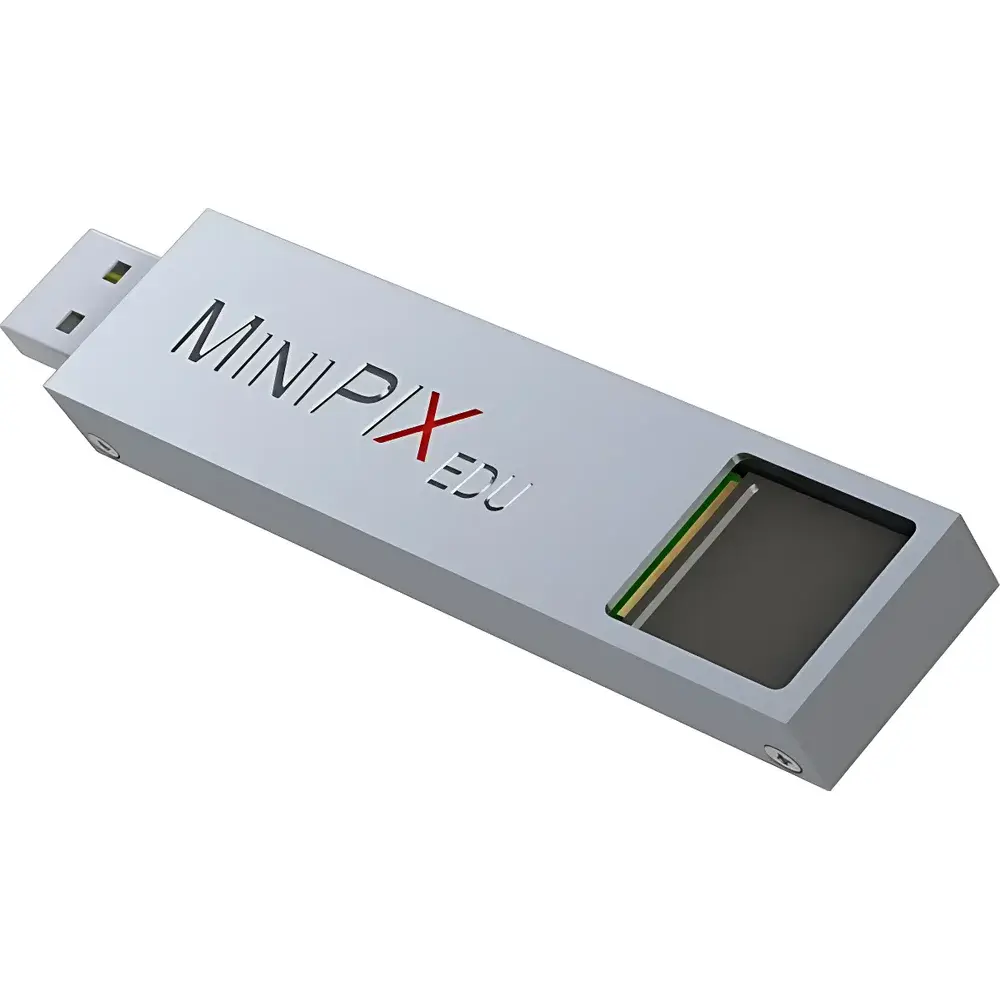
Advacam MiniPIX EDU Handheld Photon-Counting X-ray Detector
| Brand | Advacam |
|---|---|
| Origin | Czech Republic |
| Model | MiniPIX EDU |
| Sensor Chip | Timepix |
| Pixel Size | 55 × 55 µm |
| Sensor Resolution | 256 × 256 pixels |
| Dynamic Range per Frame | 11082 counts |
| Dark Current | Negligible |
| Interface | USB 2.0 |
| Max Frame Rate | 55 fps |
| Dimensions | 88.9 × 21 × 10 mm |
| Weight | 30 g |
| Operating Modes | Event (count), ToT (energy deposition), ToA (time-of-arrival) |
| OS Compatibility | Windows, macOS, Linux |
| Software | RadView (educational radiation visualization suite) |
Overview
The Advacam MiniPIX EDU is a compact, USB-powered photon-counting X-ray and ionizing radiation detector engineered specifically for undergraduate and graduate-level physics, nuclear science, and radiation safety education. Built around the CERN-developed Timepix hybrid pixel detector chip—fabricated on high-resistivity silicon—the MiniPIX EDU operates on the principle of single-photon and single-particle counting via charge-integration and time-over-threshold (ToT) measurement. Unlike integrating detectors or Geiger counters, it delivers spatially resolved, energy-sensitive event data at the pixel level (256 × 256 matrix, 55 µm pitch), enabling real-time discrimination and visualization of α particles, β−/β+ electrons, γ/X-ray photons, cosmic muons, and secondary δ-electrons. Its gapless sensor architecture eliminates dead zones common in tiled detectors, ensuring quantitative accuracy in low-flux environments—critical for classroom experiments involving natural background radiation, exempt radioactive sources, or environmental samples.
Key Features
- Handheld form factor (88.9 × 21 × 10 mm, 30 g) with integrated USB 2.0 interface—no external power supply or cooling required
- True photon-counting operation with three configurable readout modes: Event (particle count per pixel), ToT (energy deposition sum per pixel), and ToA (first-hit timestamp per pixel)
- 13-bit dynamic range per frame (up to 11,082 counts/pixel) and sub-keV energy threshold capability for low-intensity radiation detection
- Cross-platform compatibility: native drivers and acquisition software support Windows, macOS, and Linux
- Educational software suite RadView—designed for pedagogical clarity—with real-time particle classification, trajectory annotation, histogram-based spectral analysis, and exportable event logs (CSV, HDF5)
- No active cooling or high-voltage biasing—robust architecture suitable for repeated student handling and field deployment
Sample Compatibility & Compliance
The MiniPIX EDU is optimized for qualitative and semi-quantitative analysis of naturally occurring radioactive materials (NORM), such as potassium-40 in bananas or granite dust; low-activity exempt sources (e.g., 241Am smoke detector discs, 232Th lantern mantles); and ambient cosmic radiation. It complies with IEC 61547-1 for electromagnetic compatibility and meets CE marking requirements for educational electronic instrumentation. While not certified for clinical or industrial QA/QC use, its raw data output format adheres to FAIR principles (Findable, Accessible, Interoperable, Reusable), supporting reproducible lab reports aligned with university physics curriculum standards (e.g., AAPT recommended experiments). The device requires no regulatory licensing for classroom use under EU Directive 2013/59/Euratom Annex I exemptions.
Software & Data Management
RadView software provides a GUI-driven workflow for acquisition, real-time visualization, and post-processing without programming prerequisites. Each acquired frame retains full metadata—including timestamp, exposure duration, mode selection, and hardware configuration—for auditability. Event-level data supports temporal correlation analysis (e.g., muon flux vs. atmospheric pressure), spectral fitting using calibration curves (provided with NIST-traceable 55Fe and 241Am reference spectra), and comparative overlay of multiple datasets. Export functions include PNG/SVG image sequences, time-series CSV logs, and HDF5 archives compatible with Python (NumPy, SciPy, scikit-image) and MATLAB environments—enabling integration into computational physics labs and capstone projects. All software binaries and source documentation are distributed under MIT License, facilitating customization and open pedagogy initiatives.
Applications
- Radiation literacy labs: Mapping terrestrial background variation across building materials (concrete vs. wood), altitude-dependent muon flux, or shielding effectiveness of lead/aluminum/plastic
- Nuclear decay studies: Visualizing Poisson-distributed decay events from 238U series isotopes; verifying half-life via time-binned event counts
- Particle identification exercises: Distinguishing α (dense circular clusters), β (tortuous tracks), γ (isolated pixels), and μ (straight, penetrating lines) based on track morphology and energy deposition profiles
- Environmental monitoring modules: Quantifying radon progeny on air filters, detecting anthropogenic radioisotopes in urban dust, or characterizing cosmic ray showers
- Interdisciplinary projects: Correlating radiation maps with GIS data, developing machine learning classifiers for particle type recognition, or simulating detector response using GEANT4
FAQ
Is the MiniPIX EDU suitable for quantitative dosimetry?
No—it is not calibrated for dose rate (µSv/h) or absorbed dose reporting. It provides event-count and energy-deposition data suitable for relative comparisons and educational modeling, but not for regulatory compliance measurements.
Can it detect neutrons?
Not directly. However, when coupled with a borosilicate glass or 6LiF converter screen, secondary charged particles from neutron capture reactions become visible as localized event clusters.
What is the minimum detectable activity for a 40K source?
Under typical classroom conditions (20–25°C, no shielding), the system resolves ~0.1 Bq/cm² surface activity over 10-minute acquisitions—sufficient to image potassium-rich biological samples or mineral specimens.
Does RadView support automated particle tracking?
Yes—RadView includes a built-in track reconstruction algorithm that links adjacent pixel hits into linear or curved trajectories, with adjustable hit-connectivity thresholds and outlier rejection.
Is firmware upgradable in the field?
Yes—firmware updates are delivered via USB through the RadView updater utility, preserving user calibration settings and configuration profiles.
Related Products







