
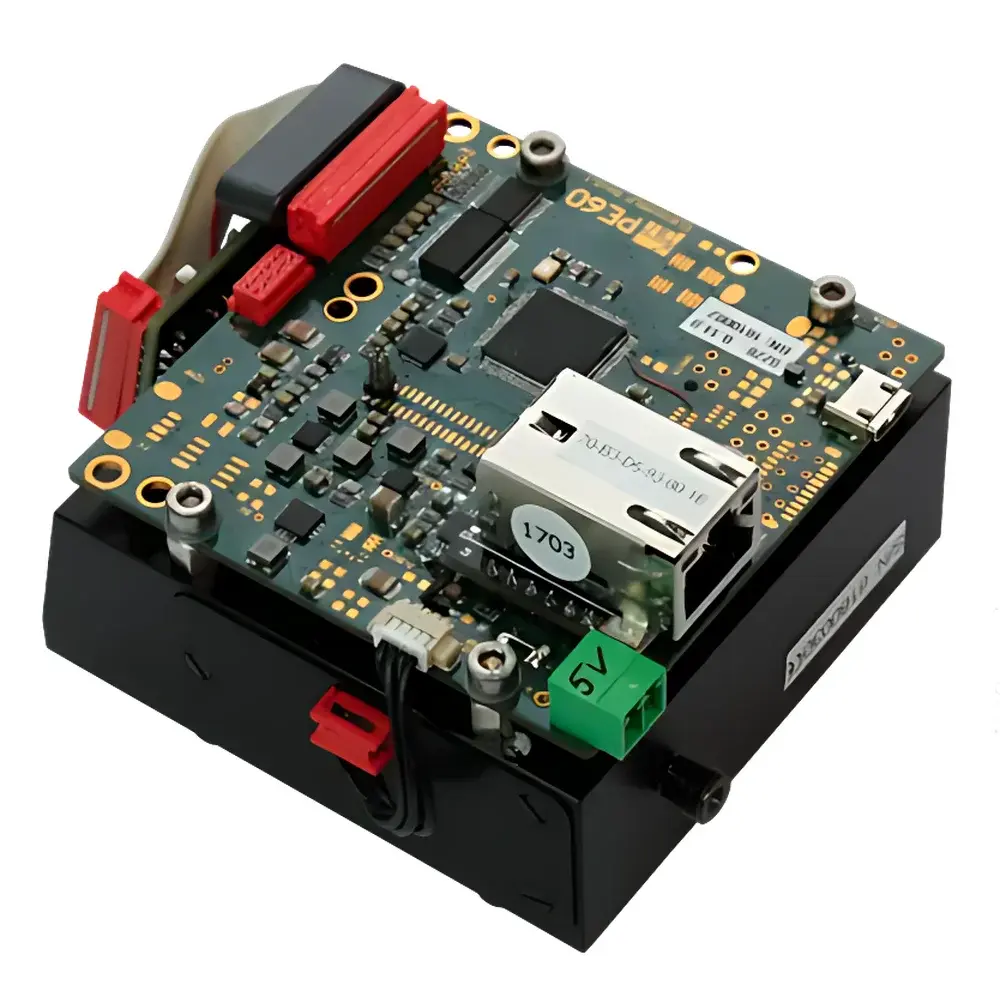
JETI RU60 Flat-Field Fiber Optic Spectrometer
| Origin | Germany |
|---|---|
| Manufacturer Type | Distributor |
| Import Status | Imported |
| Model | RU 60 |
| Spectral Range | 200–1000 nm |
| Detector | CMOS |
| Optical Resolution | < 4.5 nm (with 50 µm slit) |
| Sensitivity | 4 × 10¹⁵ counts/W·s @ 250 nm |
| Signal-to-Noise Ratio | 3000:1 |
| Dynamic Range | 10,000:1 |
| Stray Light | < 0.1 % (GG495 filter, measured at λ = 420 nm / 600 nm) |
Overview
The JETI RU60 is a high-performance flat-field fiber optic spectrometer engineered for precision spectral radiometry and photometry in industrial, R&D, and quality assurance environments. Based on Czerny–Turner optical architecture with an integrated imaging grating and proprietary astigmatism-compensating mirror, the RU60 delivers near-diffraction-limited imaging across its full 200–1000 nm spectral range. Unlike conventional flat-field designs, the RU60 incorporates a dedicated aberration-correction lens that significantly reduces astigmatism and field curvature—enabling uniform spectral line shape and intensity response from UV to NIR. Its optical path is optimized for minimal polarization dependence and high throughput, making it suitable for both pulsed and continuous light sources. The instrument is designed for OEM integration and operates as a self-contained spectral measurement module with on-board processing capabilities, eliminating dependency on external PCs for core calculations.
Key Features
- Flat-field imaging optics with integrated astigmatism compensation for consistent resolution and linearity across 200–1000 nm
- High-speed CMOS linear array detector with 2048 pixels, enabling frame rates up to 1 kHz (configurable)
- Onboard firmware supporting real-time spectral computations: dark offset correction, absolute irradiance calibration, transmittance/reflectance/absorbance derivation, and CIE color space conversion (x,y; u’,v’; L*a*b*)
- SCPI-compliant command interface for seamless integration into automated test systems (e.g., LabVIEW, Python, MATLAB, or PLC-based controllers)
- Internal non-volatile memory stores wavelength calibration coefficients, dark reference spectra, and user-defined correction matrices
- Optional mechanical or piezoelectric shutter for time-resolved measurements and stray-light suppression
- Compact housing (125 × 80 × 45 mm) with SMA 905 fiber input and standard mounting threads (M4)
Sample Compatibility & Compliance
The RU60 interfaces with standard 200–600 µm core optical fibers and supports free-space coupling via optional collimating optics. It is compatible with integrating spheres, goniophotometers, monochromators, and LED/laser characterization setups. The device meets CE marking requirements and conforms to IEC 61326-1 (EMC for laboratory equipment) and IEC 61000-4 series immunity standards. While not certified for medical or safety-critical applications, its spectral data output supports traceable calibration workflows aligned with ISO/IEC 17025-accredited laboratories. Firmware logging includes timestamped metadata required for GLP/GMP audit trails when used in regulated environments (e.g., display luminance verification per IEC 62341-6-3 or LED binning per JEDEC JESD78).
Software & Data Management
The RU60 operates without proprietary host software: all control and data acquisition are executed via ASCII SCPI commands over USB 2.0 (virtual COM port) or TTL-level UART. Each spectral scan includes embedded header information (integration time, temperature, shutter status, calibration ID). Raw and processed spectra are output in ASCII tab-delimited format, facilitating direct import into statistical analysis tools (e.g., JMP, Origin) or LIMS platforms. Internal averaging (up to 1024 scans), linear interpolation, and spectral smoothing (Savitzky–Golay) are firmware-executed to minimize host-side latency. Calibration files follow NIST-traceable conventions and support multi-point irradiance reference transfer using calibrated tungsten halogen or deuterium lamps.
Applications
- LED and OLED spectral power distribution (SPD) analysis for color rendering index (CRI), TM-30 metrics, and binning consistency
- In-line monitoring of UV curing lamp output stability and spectral drift in semiconductor and coating processes
- Reflectance and transmittance measurement of optical filters, anti-reflective coatings, and solar cell materials
- Fluorescence excitation/emission profiling in life science instrumentation and biosensor development
- Plasma emission spectroscopy in vacuum deposition and etching tool diagnostics
- Calibration transfer between reference and field-deployable spectroradiometers
FAQ
Does the RU60 support external triggering?
Yes — TTL-compatible trigger input (rising-edge) enables synchronization with pulsed light sources or motion stages.
Can wavelength calibration be updated in the field?
Yes — users may upload new calibration files via SCPI command “CAL:LOAD” without firmware reflash.
Is dark current compensation performed automatically?
Yes — dark reference acquisition is executed before each measurement sequence unless disabled via “DARK:STATE OFF”.
What is the thermal stability of the spectral axis?
The RU60 exhibits < ±0.1 nm drift over 0–40 °C ambient range, verified per ISO 17025-compliant thermal soak testing.
Are factory calibration certificates provided?
Each unit ships with a traceable calibration report referencing NIST SRM 2031 (UV-VIS) and 2032 (VIS-NIR), including uncertainty budgets per GUM guidelines.




