
HORIBA LAQUA WQ-310-K Single-Channel Multiparameter Water Quality Meter
| Brand | HORIBA |
|---|---|
| Origin | Japan |
| Model | WQ-310-K |
| Display | 3.5-inch color TFT-LCD (70 × 52 mm), backlight |
| Protection Rating | IP67 |
| Power | 4 × AA batteries or micro-USB供电 |
| Battery Life | >100 hours (display brightness level 3, no sensor connected) |
| Dimensions | 220 × 90 × 34 mm |
| Weight | ~400 g (with batteries), ~320 g (without) |
| Data Storage | 10,000 records with timestamp |
| Communication | micro-USB, wireless SD card, RS-232 printer port |
| Sensor Interface | Push-pull connector, BNC & phono-compatible |
| Operating Languages | English, Japanese, French, German, Spanish, Portuguese, Chinese |
| Calibration Alarms | Programmable (0–400 days) |
| Auto-off | Programmable (0–60 min) |
| Real-time clock | Yes |
| Environmental Compliance | RoHS-compliant housing (ABS/PC blend), shock-, scratch-, and slip-resistant |
Overview
The HORIBA LAQUA WQ-310-K is a rugged, single-channel multiparameter water quality meter engineered for field-deployable precision and laboratory-grade reliability in environmental monitoring, wastewater treatment, aquaculture, and regulatory compliance applications. Built upon HORIBA’s legacy in electrochemical sensor technology, the WQ-310-K employs potentiometric, conductometric, and thermometric measurement principles—supporting pH, ORP (redox), conductivity (EC), total dissolved solids (TDS), salinity, resistivity, and temperature via interchangeable smart sensors. Its core architecture integrates analog signal conditioning with high-resolution ADC conversion and real-time digital compensation for temperature, electrode drift, and junction potential—ensuring traceable accuracy across variable ambient conditions. Designed for GLP-aligned workflows, the instrument meets mechanical and environmental requirements per IEC 60529 (IP67), ISO 7810 (ID-1 card dimensions for accessory compatibility), and RoHS Directive 2011/65/EU. The absence of proprietary sensor adapters enables direct interfacing with industry-standard BNC and phono (mini-jack) electrodes—including legacy reference electrodes and industrial-grade conductivity cells—reducing operational overhead and extending equipment lifecycle.
Key Features
- Ruggedized IP67-rated enclosure constructed from impact-resistant ABS/polycarbonate blend with textured anti-slip surface and scratch-resistant display cover
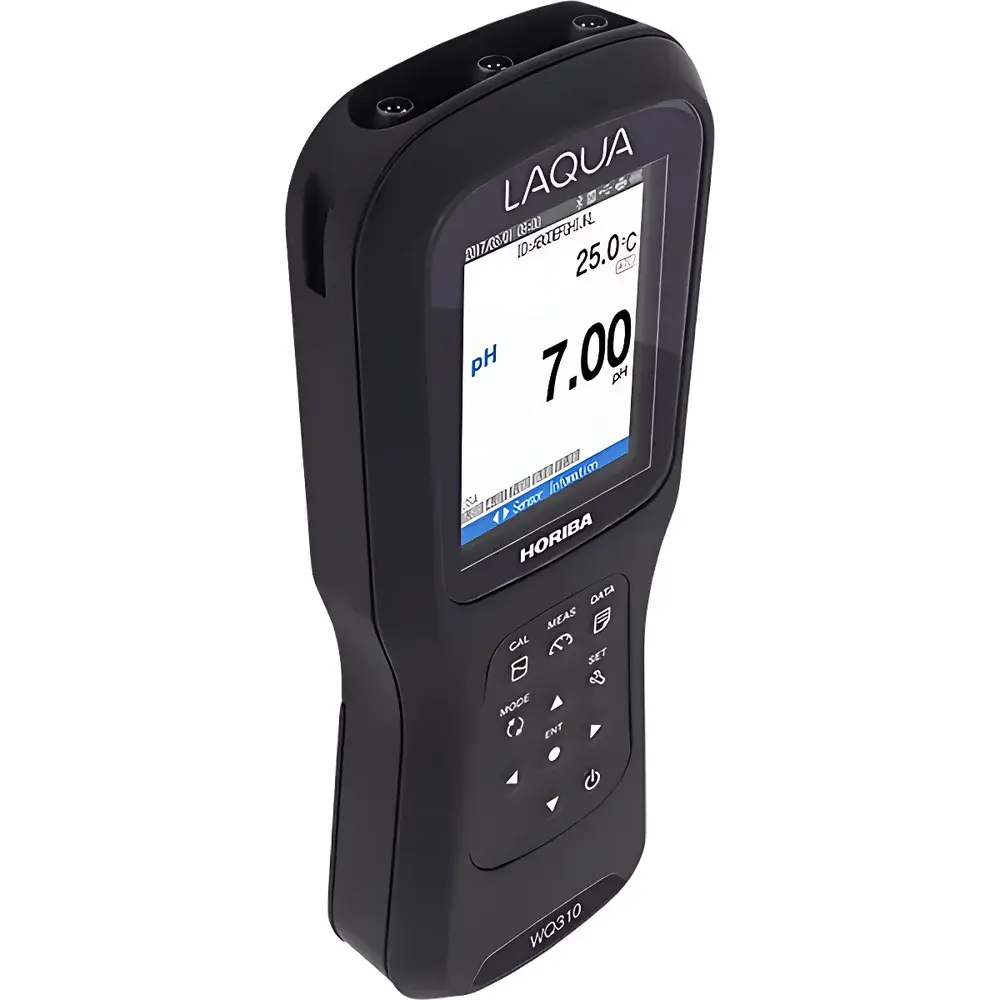
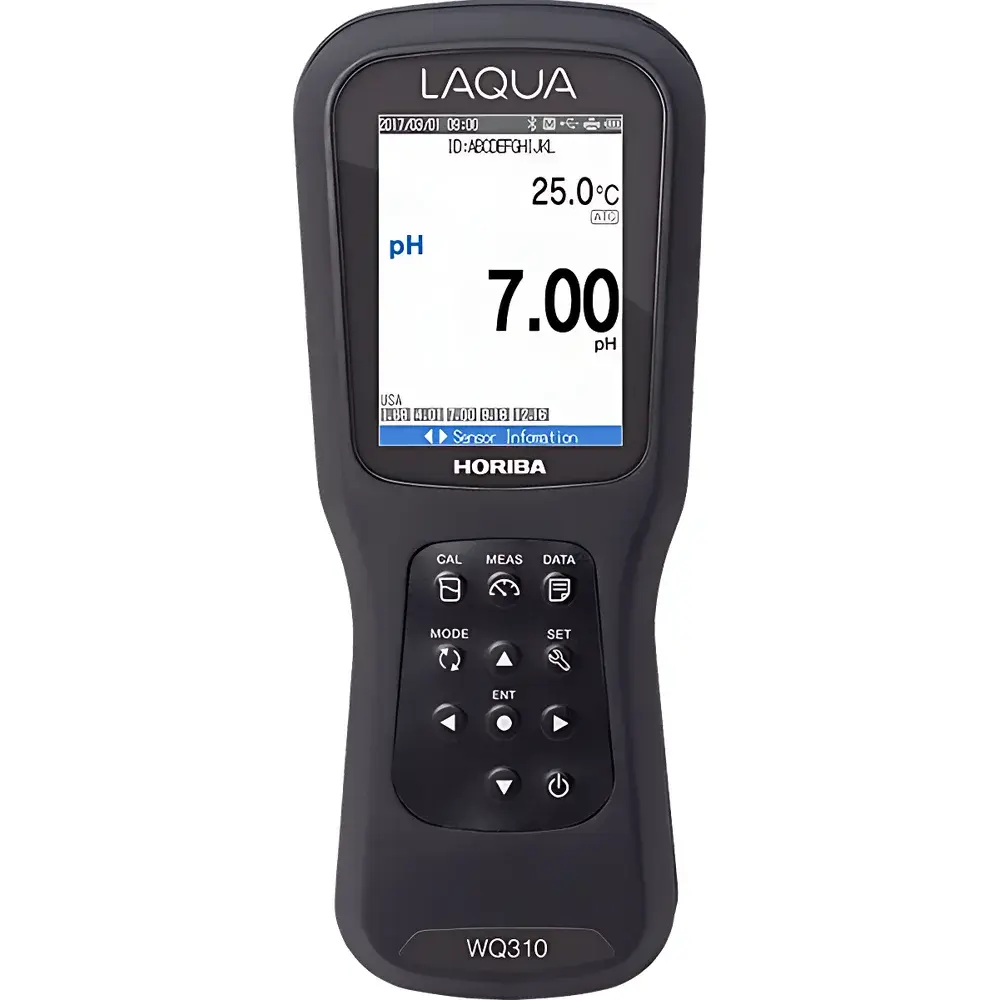
- 3.5-inch full-color TFT-LCD (70 × 52 mm active area) with adjustable backlight and adaptive contrast for outdoor readability under direct sunlight or low-light conditions
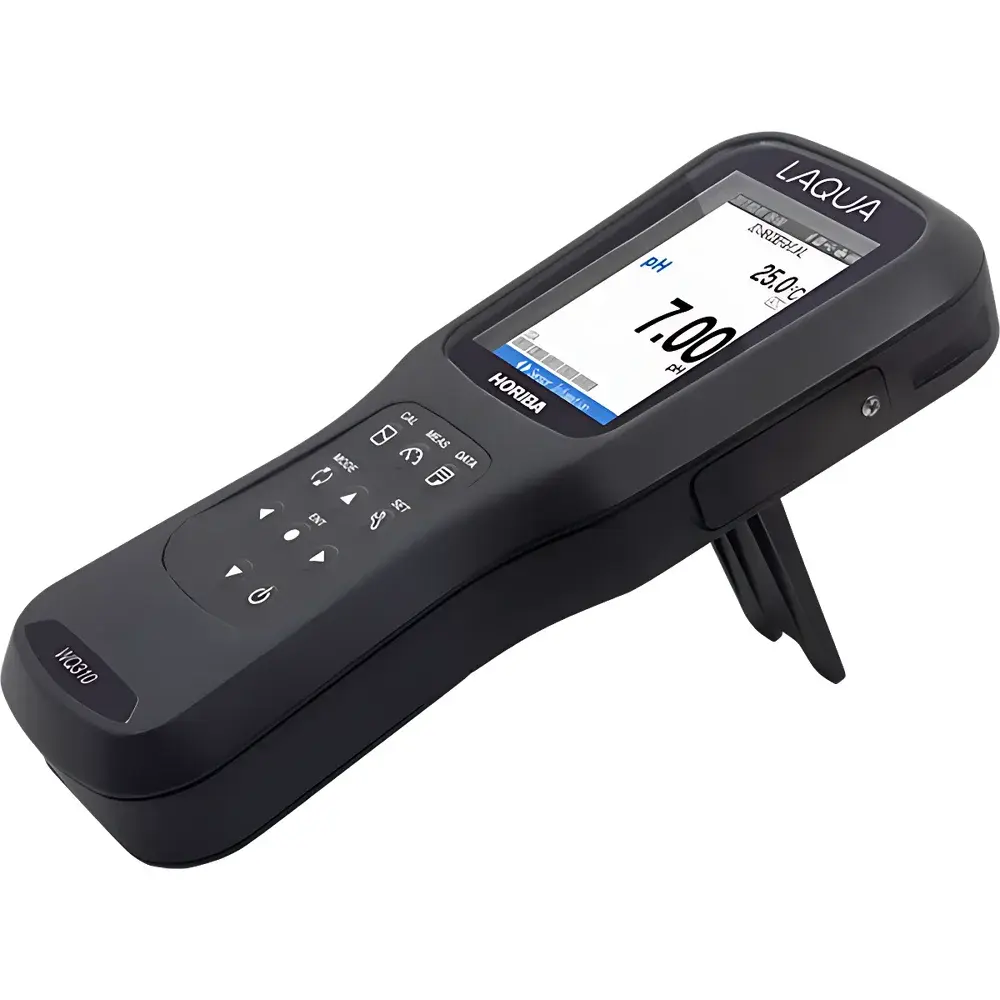
- Integrated foldable stand and ergonomic hand-grip design enabling stable benchtop operation or hands-free field measurements
- Push-pull sensor interface with automatic sensor identification—eliminating manual parameter configuration and minimizing user error during probe swaps
- Dual power architecture: 4× AA alkaline batteries (≥100 h runtime at brightness level 3, no sensor load) or continuous micro-USB bus power with charge management circuitry
- Real-time stability indicator: Dedicated LED on each connected sensor provides visual confirmation of signal convergence prior to data capture
- Three measurement modes: Auto-stabilize (user-defined threshold), Auto-hold (triggered at stability), and continuous real-time logging with configurable sampling intervals
Sample Compatibility & Compliance
The WQ-310-K supports aqueous samples across natural waters (rivers, lakes, groundwater), treated effluents, process streams, and saline environments up to seawater strength (≤55 mS/cm). Its sensor ecosystem complies with ASTM D1293 (pH of water), ASTM D5391 (conductivity of pure water), and ISO 7888 (electrical conductivity of natural waters). Temperature compensation follows NIST-traceable Pt1000 thermistor calibration curves (DIN EN 60751). All firmware and calibration routines are designed to support audit-ready documentation per EPA Method 150.1 (pH), 120.1 (conductivity), and USP (water for injection testing). Data integrity safeguards include timestamped records with millisecond resolution, non-volatile memory retention during power loss, and write-protection for archived calibration logs.
Software & Data Management
Data export is supported via micro-USB mass-storage mode (no driver required), wireless SD card (FAT32 formatted), or RS-232 serial output to legacy printers (25-pin D-sub). Files are saved in CSV format with UTF-8 encoding and ISO 8601 timestamps (YYYY-MM-DD HH:MM:SS), ensuring interoperability with LIMS platforms such as LabWare, STARLIMS, and Thermo Fisher SampleManager. The onboard memory stores up to 10,000 measurements with embedded metadata: sensor ID, calibration date, operator ID (user-definable), sample ID, and environmental flags (e.g., “field”, “lab”, “QA/QC”). Firmware updates are delivered through HORIBA’s LAQUA Connect desktop utility (Windows/macOS), which also enables batch calibration report generation compliant with ISO/IEC 17025 clause 7.7.
Applications
- Regulatory field monitoring per EU Water Framework Directive (WFD) Annex V and US Clean Water Act Section 304(h) protocols
- In-process verification in pharmaceutical water systems (PW, WFI, Purified Water) aligned with USP and EU GMP Annex 1
- Calibration validation of online analyzers in municipal wastewater plants using grab-sample correlation studies
- Educational use in university environmental science labs for sensor response kinetics and buffer standardization exercises
- Long-term deployment in remote hydrological stations with solar-charged USB power banks and scheduled auto-log intervals
FAQ
Does the WQ-310-K support Good Laboratory Practice (GLP) data traceability?
Yes—the instrument records calibration history, sensor serial numbers, operator IDs, and timestamps for every measurement, with immutable storage that satisfies FDA 21 CFR Part 11 electronic record requirements when used with validated procedures.
Can it interface with non-HORIBA conductivity or pH electrodes?
Yes—via standard BNC connectors for pH/ORP and phono (3.5 mm mini-jack) for analog conductivity cells; however, temperature compensation accuracy assumes use of the integrated Pt1000 thermistor or HORIBA’s dual-temperature probe.
Is wireless Bluetooth or Wi-Fi connectivity available?
No—the WQ-310-K uses micro-USB and RS-232 for wired communication and supports optional wireless SD cards for local file transfer; Bluetooth/Wi-Fi modules are not integrated due to electromagnetic interference concerns in industrial field environments.
What is the maximum cable length supported for external sensors?
Up to 15 meters for shielded BNC cables and 10 meters for phono-type conductivity leads, provided twisted-pair construction and proper grounding to maintain signal-to-noise ratio above 60 dB.
How often does the internal real-time clock require synchronization?
The RTC maintains ±2 seconds/month accuracy; synchronization is recommended weekly via USB connection to a time-synchronized host PC using LAQUA Connect software.




