
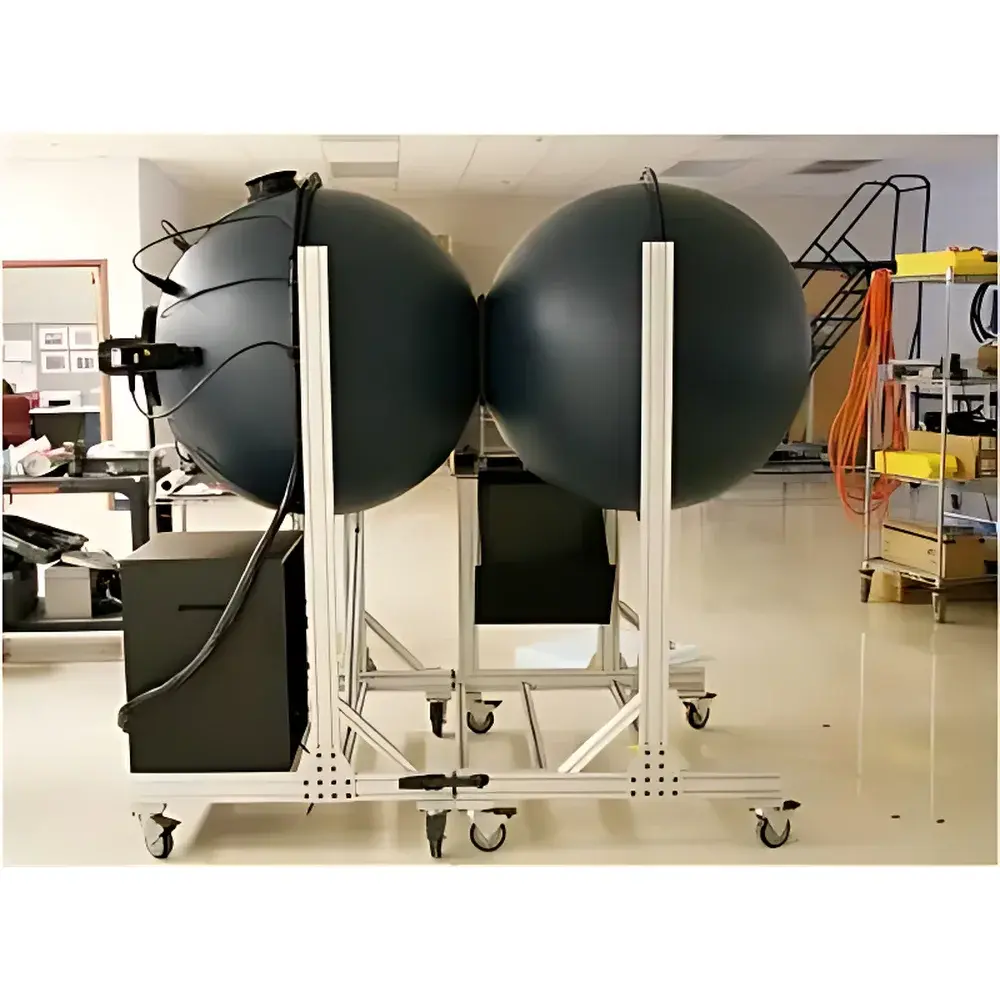
Stray Light & Glare Testing System 4000-VG
| Brand | Labsphere |
|---|---|
| Origin | USA |
| Model | 4000-VG |
| Configuration | Dual-integrating-sphere architecture with NIST-traceable calibration |
| Target disk | Interchangeable slide-in type |
| Illumination uniformity | >98% |
| Contrast ratio | >10,000:1 |
| Coating | Low-reflectance light trap |
| Adjustable output | Continuously variable from 0 to maximum |
Overview
The Labsphere 4000-VG Stray Light & Glare Testing System is a precision-engineered optical metrology platform designed for quantitative evaluation of stray light and veiling glare in imaging lenses, telescopes, camera modules, and other high-performance optical systems. It operates on the principle of controlled illumination and differential radiometric measurement using a dual-integrating-sphere configuration: one sphere serves as a uniform, spatially stable source (illuminator sphere), while the second functions as a high-dynamic-range detector sphere optimized for low-level signal capture. This architecture enables accurate isolation and quantification of off-axis scattered radiation—critical for assessing image fidelity degradation caused by internal reflections, surface scatter, and bulk material imperfections. The system supports optical apertures up to 40 inches (1016 mm), accommodating both compact mobile phone lenses and large-format astronomical optics, and is routinely deployed in R&D labs, production QA environments, and third-party metrology facilities requiring ISO/IEC 17025-compliant validation.
Key Features
- Dual-integrating-sphere design with independently controlled spheres for simultaneous source stability and detector sensitivity optimization
- Low-reflectance (<0.05% @ 400–1000 nm) light trap coating applied to inner surfaces of the detector sphere, ensuring minimal background contribution and enabling contrast ratios exceeding 10,000:1
- Uniform illumination field (>98% spatial uniformity across full aperture) generated via diffuser-stabilized halogen or LED-based broadband source, configurable for spectral range from UV to NIR
- Interchangeable slide-in target disk assembly allowing rapid switching between standardized test patterns (e.g., knife-edge, starburst, point-source arrays) without realignment or recalibration
- Continuously adjustable source intensity control (0–100% of maximum output) with analog feedback stabilization, supporting dynamic range extension and repeatable exposure protocols
- NIST-traceable calibration certificate included with each system, covering spectral irradiance, spatial uniformity, and stray light rejection performance at specified wavelengths
Sample Compatibility & Compliance
The 4000-VG accommodates optical devices ranging from miniature lens assemblies (≥5 mm clear aperture) to large-format objectives (up to 40-inch diameter). Mounting interfaces comply with standard optical rail systems (e.g., Thorlabs 30 mm and 60 mm rails) and feature kinematic alignment stages with ±5 arcmin angular adjustment. Mechanical adapters support C-mount, F-mount, M42, and custom flange configurations. All optical path components—including fiber-coupled illuminators and collimating optics—are compatible with Labsphere’s certified fiber-optic准直器 (FC/PC or FC/APC interface). The system meets requirements for ISO 9022-12 (optical instruments — environmental testing — stray light), ASTM E284 (standard terminology for optics), and supports documentation traceability aligned with FDA 21 CFR Part 11 and GLP/GMP audit readiness when integrated with validated software workflows.
Software & Data Management
Control and analysis are performed via Labsphere’s proprietary SpectraSuite™ v5.x software suite, which provides instrument orchestration, real-time radiometric logging, and standardized stray light metric computation (e.g., Relative Stray Light Index, Veiling Glare Index per ISO 9358). Raw data export is supported in CSV, HDF5, and XML formats, with metadata embedding including timestamp, calibration ID, operator ID, and environmental conditions (ambient temperature, humidity). Audit trail functionality records all parameter changes, measurement initiations, and report generations, satisfying electronic record integrity requirements under 21 CFR Part 11. Integration with LabVIEW, Python (via PyVISA), and MATLAB is available through documented APIs for automated test sequencing in high-throughput manufacturing environments.
Applications
- Quantitative stray light characterization of spaceborne telescope baffles and coronagraphs
- Veiling glare assessment of automotive ADAS camera lenses under varying luminance conditions
- Validation of anti-reflective coating performance on multi-element lens stacks
- Comparative analysis of scatter signatures across different polishing processes (e.g., magnetorheological finishing vs. ion beam figuring)
- Supporting MIL-STD-810H optical subsystem verification for defense electro-optical systems
- Root-cause analysis of contrast loss in medical endoscope imaging channels
FAQ
What optical parameters does the 4000-VG directly measure?
It measures absolute stray light power (in µW/sr), relative stray light ratio (as % of primary beam), veiling glare index (VGI), and spatial scatter distribution profiles—derived from calibrated radiometric signals acquired across defined field angles.
Is the system compatible with non-Labsphere detectors or spectrometers?
Yes; the detector sphere features a standardized SMA905 or FC port for integration with external photometers, CCD/CMOS radiometers, or monochromator-coupled spectroradiometers, provided they meet minimum sensitivity thresholds (≤1 pW/cm²).
Can the 4000-VG be used for ISO 18844 compliance testing?
Yes—the dual-sphere architecture, NIST-traceable calibration, and documented uncertainty budget align with the measurement methodology prescribed in ISO 18844:2019 for stray light evaluation of photographic lenses and imaging systems.
Does the system require periodic recalibration?
Labsphere recommends annual recalibration against NIST-traceable standards; a full calibration includes source stability verification, detector linearity assessment, and light trap reflectance validation using reference samples with certified BRDF values.
What safety certifications apply to the 4000-VG?
The system complies with IEC 61010-1 (safety requirements for electrical equipment for measurement, control, and laboratory use) and carries CE marking for EMC and LVD directives. Laser Class 1 operation is maintained when configured with optional filtered LED sources.





