
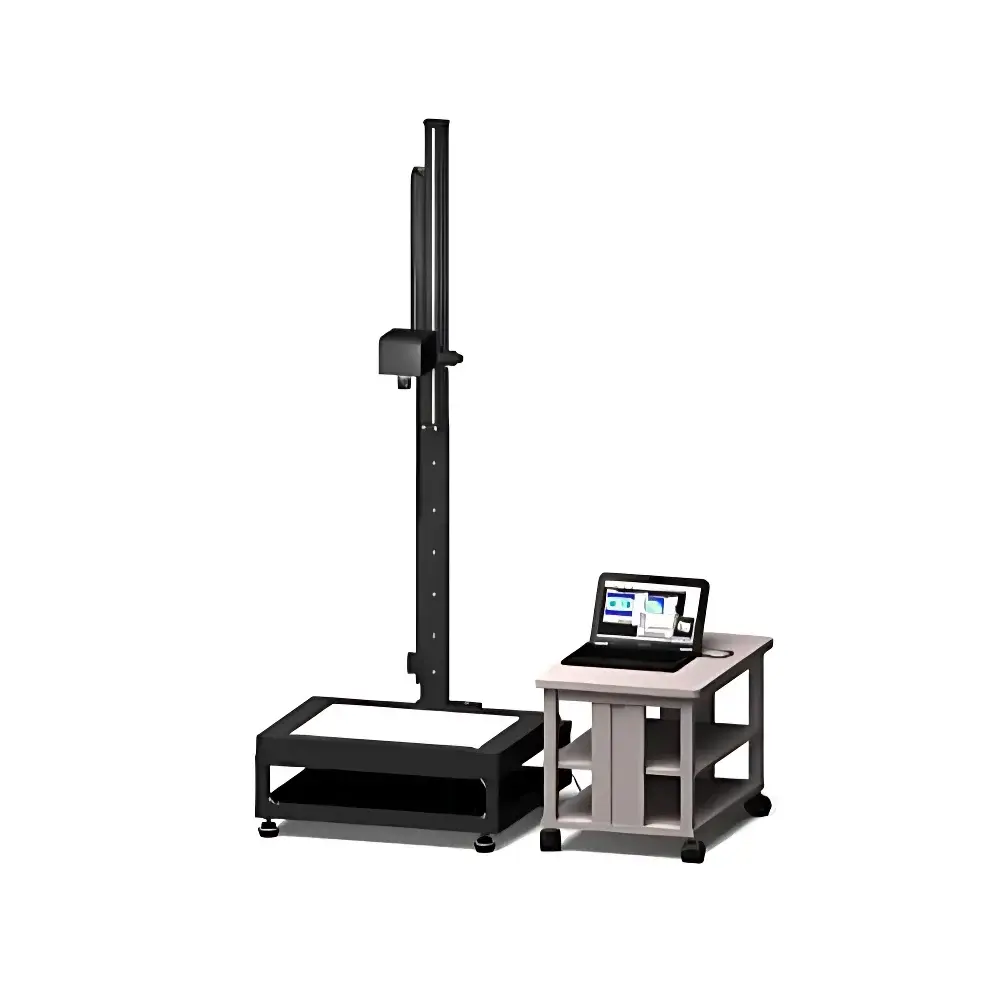
PA-300-XLSIC Sapphire-Specific Birefringence Analyzer
| Brand | Photonic Lattice |
|---|---|
| Origin | Japan |
| Model | PA-300-XLSIC |
| Measurement Principle | Full-field polarization imaging at 520 nm |
| Pixel Resolution | 2056 × 2464 |
| Birefringence Range | 0–130 nm |
| Minimum Resolution | 0.001 nm |
| Repeatability | <1 nm (σ) |
| Field of View | 40 × 48 mm to 240 × 320 mm (standard) |
| Output Parameters | Retardation (nm), Fast Axis Orientation (°), Stress-equivalent Retardation (MPa, optional) |
| Optional Modules | Real-time analysis software, Lens-specific analysis module, External control interface |
Overview
The PA-300-XLSIC Sapphire-Specific Birefringence Analyzer is a high-resolution, full-field polarization imaging system engineered for quantitative birefringence characterization of sapphire wafers, substrates, and optical components. Based on calibrated photoelastic imaging at a fixed wavelength of 520 nm, the instrument employs a high-sensitivity 2056 × 2464-pixel polarization camera with no moving optical filters—eliminating mechanical drift and enabling stable, repeatable measurements across large-area samples. Unlike scanning-based polarimeters or point-measurement ellipsometers, the PA-300-XLSIC captures spatially resolved retardation and fast-axis orientation data over the entire field of view in a single acquisition—typically completed within 3 seconds. This full-field capability ensures comprehensive defect mapping, stress distribution profiling, and uniformity assessment without interpolation or sampling bias. The system is purpose-built for sapphire—a material widely used in LED substrates, watch crystals, semiconductor packaging, and high-durability optical windows—where residual stress-induced birefringence directly correlates with crystal lattice distortion, thermal history, and mechanical processing integrity.
Key Features
- Full-field, single-shot birefringence imaging with no rotating optics—ensures long-term calibration stability and eliminates motion-induced artifacts.
- High spatial resolution: 2056 × 2464 pixel polarization camera optimized for 520 nm illumination, delivering sub-micron effective sampling density across standard FOVs (40 × 48 mm up to 240 × 320 mm).
- Quantitative output of three primary parameters per pixel: retardation (in nanometers), fast-axis orientation (in degrees), and optionally, stress-equivalent retardation (in MPa) via built-in photoelastic coefficient conversion for α-Al₂O₃.
- Measurement repeatability better than 1 nm (σ) under controlled environmental conditions—validated per ISO 10110-5 and ASTM E1792 protocols for optical stress evaluation.
- Modular software architecture supporting real-time visualization, batch processing, and automated pass/fail thresholding against user-defined specifications.
- No consumables or alignment-sensitive components; maintenance limited to periodic sensor calibration using NIST-traceable reference standards.
Sample Compatibility & Compliance
The PA-300-XLSIC is optimized for flat, transparent sapphire specimens ranging from 0.1 mm to 30 mm in thickness, including polished wafers (2″, 4″, 6″), shaped optical blanks, and finished watch crystals. It accommodates both air- and liquid-immersed configurations for refractive index matching where required. The system complies with ISO 10110-5 (optical component stress birefringence), JIS R 1632 (sapphire substrate quality), and supports audit-ready documentation for GLP and GMP environments. Data export formats (TIFF, CSV, HDF5) are compatible with enterprise QMS platforms, and optional software modules support 21 CFR Part 11-compliant electronic signatures and audit trails.
Software & Data Management
The analyzer runs on a dedicated Windows-based platform featuring three integrated software suites: Real-Time Analysis Engine for live image acquisition and dynamic range optimization; Lens-Specific Analysis Module for curvature-corrected birefringence mapping on convex/concave sapphire surfaces; and Data Processing Suite for statistical reporting (e.g., mean retardation, standard deviation, max-min differential, zone-based averaging). All software modules support scripting via Python API for integration into automated fabrication lines or metrology workflows. Raw polarization images are stored with embedded metadata—including timestamp, exposure settings, calibration ID, and environmental sensor logs (temperature/humidity)—ensuring traceability and reproducibility.
Applications
- Quality assurance of sapphire wafers for GaN-on-sapphire LED epitaxy—identifying localized stress anomalies that induce dislocation propagation.
- Post-polishing and post-annealing stress validation in sapphire substrates for microLED and RF device manufacturing.
- Non-destructive evaluation of sapphire watch crystals and optical domes for military/aerospace applications, per MIL-STD-810G mechanical stress screening requirements.
- R&D support for crystal growth process optimization—correlating Czochralski pull rate, annealing ramp profiles, and resulting birefringence gradients.
- Failure analysis of fractured sapphire components—mapping residual stress fields around crack tips and machining-induced damage zones.
FAQ
What is the measurement principle used in the PA-300-XLSIC?
It utilizes full-field polarization imaging based on four-state phase-resolved detection at 520 nm, eliminating the need for mechanical filter rotation.
Can the system measure curved sapphire parts?
Yes—the optional Lens-Specific Analysis Module applies surface geometry correction using imported CAD profiles or profilometer data.
Is stress quantification traceable to international standards?
Yes—stress conversion uses the published photoelastic coefficient of sapphire (C = 0.014 MPa⁻¹·nm) aligned with ISO 7884-11 and ASTM F2652 recommendations.
How is calibration maintained over time?
Calibration is performed using factory-characterized quartz waveplates and verified annually with NIST-traceable retardation standards; no user recalibration is required between verifications.
Does the system support integration into a cleanroom automation environment?
Yes—Ethernet-based remote control, TTL I/O triggers, and RESTful API enable seamless integration with SECS/GEM-compliant fabs and automated inspection stations.





