
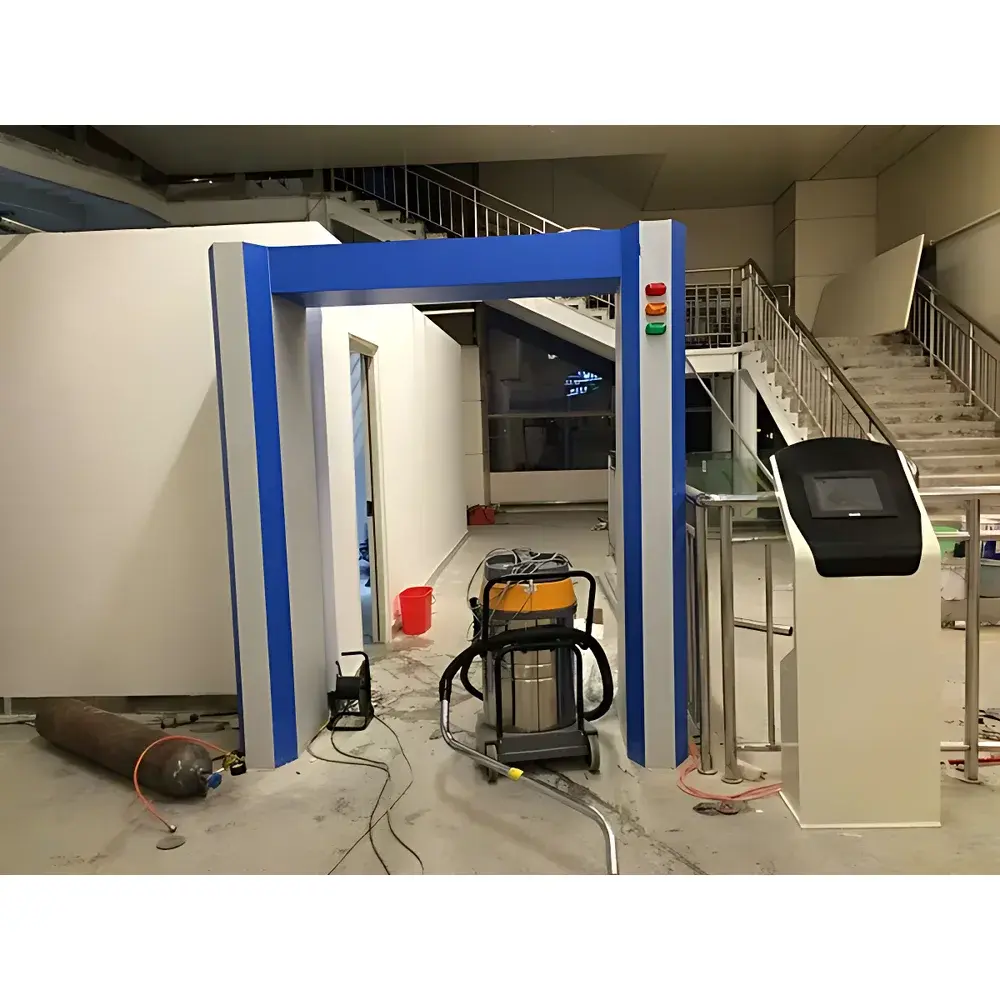
SMACH RC2010 Portal-Type Pedestrian & Vehicle Radiation Monitoring System
| Brand | SMACH |
|---|---|
| Origin | Fujian, China |
| Manufacturer Type | Authorized Distributor |
| Origin Category | Domestic |
| Model | RC2010 |
| Price Range | USD 7,000–14,000 (FOB) |
| Instrument Category | Radiation Dose Rate Meter |
| Instrument Type | Online Continuous Monitoring System |
| Measured Radiation | X-ray and Gamma (γ) Radiation |
| Detector Type | Plastic Scintillator (BC-408 or EJ-200 equivalent) |
| Detection Aperture | Height 0.1–2.0 m |
| Sensitivity | >24,000 cps per µSv/h (per detector unit) |
| Energy Response Range | 25 keV – 3 MeV |
| False Alarm Rate | ≤0.1% |
| Neutron Detection Option | Optional ³He tube (Φ25 mm × 600 mm), sensitivity ≥3,000 n/s |
| Dynamic Detection Threshold | ≥5×10⁵ Bq ¹³⁷Cs at walking speed (1.2 m/s) |
| Shielding on Non-Detection Faces | 5 mm lead equivalent |
| Artificial vs. Natural Radionuclide Discrimination | Enabled via spectral analysis and adaptive threshold algorithm |
| Compliance | Designed to meet IEC 62401:2010 (Radiation Protection Instruments – Portal Monitors for Radioactive Material), ANSI N42.35-2022 (Performance Criteria for Hand-Held Instruments and Portal Monitors for Detection of Radioactive Material), and supports GLP/GMP-aligned audit trail logging in optional software configuration |
Overview
The SMACH RC2010 Portal-Type Pedestrian & Vehicle Radiation Monitoring System is an online, real-time radiation surveillance solution engineered for continuous, unattended detection of illicit or elevated gamma-emitting radioactive materials carried by individuals, luggage, mail parcels, or light vehicles. Based on the principle of plastic scintillation detection coupled with pulse-height spectroscopy and dynamic background compensation, the RC2010 operates under the Couette-type passive screening paradigm, where incident photons interact with organic scintillator material (typically BC-408 or EJ-200), generating light pulses proportional to deposited energy. These signals are digitized and processed using multi-channel pulse analysis to distinguish anthropogenic radionuclides (e.g., ¹³⁷Cs, ⁶⁰Co, ²⁴¹Am) from naturally occurring radioactive material (NORM), such as ⁴⁰K or uranium/thorium decay-chain isotopes. The system is optimized for high-throughput environments requiring regulatory-grade sensitivity without compromising operational continuity—making it suitable for border control checkpoints, customs inspection lanes, international airports, seaports, postal sorting facilities, and nuclear emergency response staging areas.
Key Features
- Modular architecture enabling scalable deployment: base configuration supports pedestrian throughput; optional vehicle-mode expansion accommodates low-speed (<5 km/h) scanning of sedans and light vans.
- Dual-mode detection logic: simultaneous gross-count rate monitoring and energy-resolved spectral analysis for reliable artificial/natural nuclide discrimination.
- Adaptive dynamic threshold algorithm continuously recalibrates baseline count rates based on ambient background fluctuations, minimizing false positives during diurnal or weather-induced variations.
- Integrated optical motion sensing and lane occupancy detection ensures synchronized data acquisition only during valid passage events—reducing data noise and storage overhead.
- Patented stabilized HV supply for scintillation detectors ensures consistent gain stability over extended operation (>10,000 h MTBF).
- Front-panel LED status indicators and configurable audible/visual alarm outputs (strobe + siren) provide immediate local alerting upon exceedance of user-defined dose rate or nuclide-specific thresholds.
- Optional neutron detection module (³He proportional counter) extends capability to mixed-field environments where special nuclear materials (SNM) may be shielded.
Sample Compatibility & Compliance
The RC2010 is validated for detecting gamma-emitting radionuclides across a broad energy range (25 keV to 3 MeV), including low-energy emitters such as ²⁴¹Am (59.5 keV) and high-energy sources like ⁶⁰Co (1.17 & 1.33 MeV). Its 10-L plastic scintillator volume provides high geometric efficiency while maintaining fast signal decay time (<2.1 ns), supporting counting rates up to 500 kcps without significant pile-up distortion. The system complies with IEC 62401:2010 for portal monitor performance and meets functional requirements outlined in ANSI N42.35-2022 for alarm reliability, minimum detectable activity (MDA), and false alarm probability. All firmware and software modules are designed to support audit-ready operation under GLP and GMP frameworks, including timestamped event logs, operator authentication, and tamper-evident configuration history.
Software & Data Management
The RC2010 is operated via SMACH’s proprietary RAD-View™ monitoring suite, delivered as a Windows-based client-server application with embedded SQL database. Core functionalities include real-time dose rate mapping, spectral histogram overlay, nuclide identification confidence scoring (using library-matched peak fitting), and automated report generation (PDF/CSV). Remote access is supported via TLS-encrypted HTTP(S) interface, allowing centralized supervision across multiple portals through a unified command center. Optional FDA 21 CFR Part 11-compliant mode enables electronic signatures, role-based access control, and immutable audit trails for regulated environments. Software updates are delivered via secure OTA channel with cryptographic signature verification.
Applications
- Customs and Border Protection: Primary screening of pedestrians and hand-carried items at land border crossings and airport security checkpoints.
- Postal and Courier Logistics: High-volume mail and parcel screening at national sorting hubs to intercept radiological dispersal devices (RDDs) or illicit source material.
- Nuclear Emergency Response: Rapid deployment at incident perimeters to monitor personnel egress and detect contamination carryout.
- Government Infrastructure Security: Continuous surveillance at sensitive facilities including nuclear research centers, defense installations, and diplomatic compounds.
- Public Event Safety: Temporary installation at stadiums, convention centers, or mass gatherings requiring non-intrusive radiological threat assessment.
FAQ
What radiation types does the RC2010 detect?
The base configuration detects X-ray and gamma radiation. With optional neutron detection module, it supports mixed-field identification of thermal neutrons.
Can the system differentiate between natural and artificial radioactivity?
Yes—via real-time pulse-height analysis and spectral library matching, the RC2010 classifies alarms as either NORM or anthropogenic origin with configurable confidence thresholds.
Is calibration traceable to national standards?
Factory calibration uses NIST-traceable ¹³⁷Cs and ⁶⁰Co reference sources; field recalibration tools and procedures comply with ISO/IEC 17025 requirements when performed by accredited service providers.
How is data integrity ensured during long-term deployment?
All measurement events, configuration changes, and alarm triggers are logged with SHA-256 hashed timestamps and stored redundantly—locally on industrial SSD and remotely via encrypted HTTPS push.
Does the system support integration with existing security infrastructure?
Yes—RS-485, Modbus TCP, and ONVIF-compatible video trigger interfaces enable interoperability with access control systems, CCTV platforms, and central command-and-control dashboards.
Related Products







