
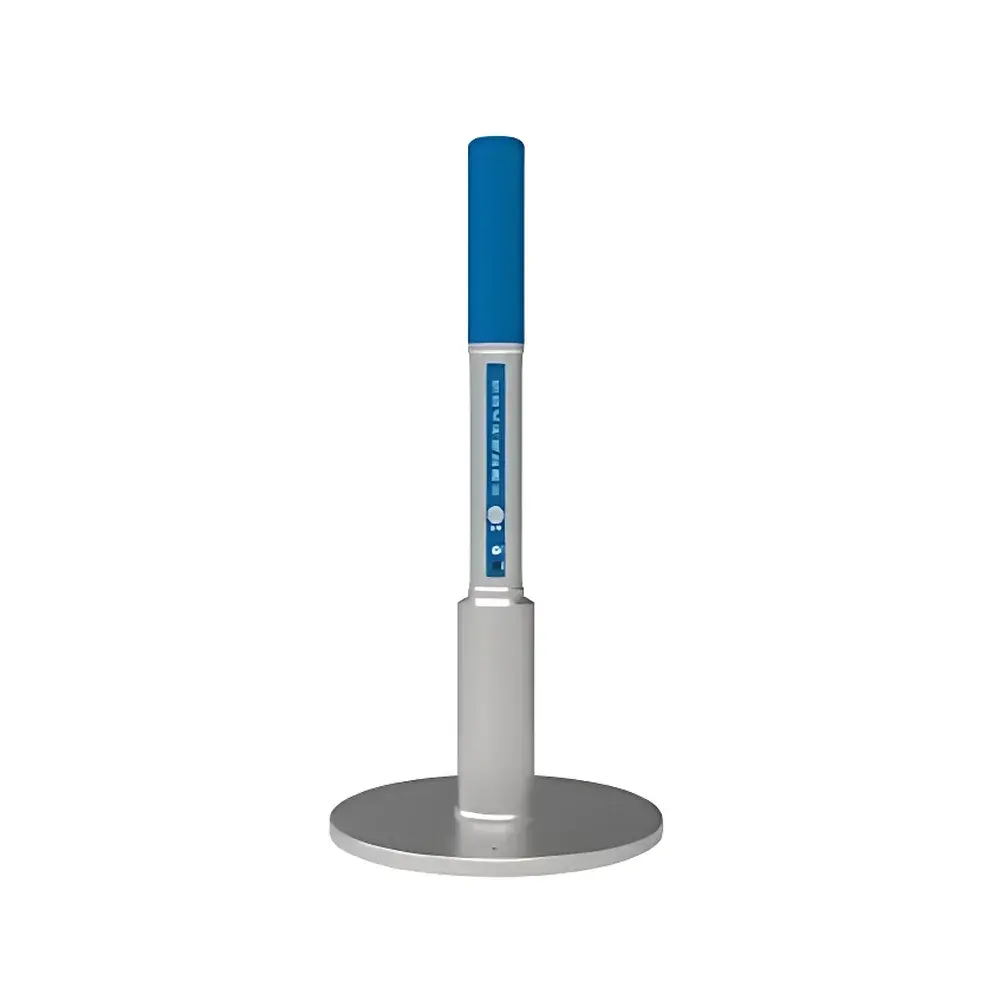
SMACH RD700 Deployable Radiation Dose Monitoring System
| Brand | SMACH |
|---|---|
| Origin | Fujian, China |
| Model | RD700 |
| Instrument Type | Online Dosimeter |
| Measurement Range | 0.01 µGy/h – 100 mGy/h |
| Detector Type | Dual Scintillation Detector |
| Radiation Types | X-ray and γ-ray |
| Sensitivity | 30 cps |
| Communication | 4G LTE (GPRS-based), Optional Emergency Radio Mode |
| Positioning | Dual-mode GNSS (GPS + BeiDou) |
| Environmental Rating | IP67 |
| Operating Temperature | −30 °C to +50 °C |
| Battery Life | Up to 20 days (480 h) on rechargeable battery |
| Data Upload Interval | Configurable from 30 s to 24 h |
| Compliance | Designed for IEC 60846-1:2014 (Radiation protection instrumentation — Dose rate meters and alarm dose rate meters for beta, X and gamma radiation) |
Overview
The SMACH RD700 Deployable Radiation Dose Monitoring System is an autonomous, field-deployable environmental dosimetry platform engineered for rapid-response radiological surveillance in emergency and routine monitoring scenarios. Based on dual scintillation detector architecture operating under the principle of pulse-height–based energy discrimination, the RD700 delivers continuous, real-time measurement of ambient dose equivalent rate H*(10) for X and γ radiation across six decades of dynamic range—from ultra-low background levels (0.01 µGy/h) up to high-intensity fields (100 mGy/h). Its modular design integrates radiation detection, meteorological sensing (temperature, humidity, wind speed/direction, barometric pressure), geospatial positioning, and bidirectional wireless telemetry into a single ruggedized enclosure. The system is purpose-built for unattended operation in remote or post-incident zones where infrastructure may be compromised—enabling immediate deployment via hand-carry, drone drop, or vehicle-mounted installation without external power or network dependency.
Key Features
- Dual-scintillator detection geometry: Two coaxially aligned scintillation detectors—optimized for low-dose sensitivity (large-volume crystal) and high-dose linearity (compact crystal)—with center-to-center spacing <30 mm, ensuring spatial consistency and eliminating angular response discontinuity per IEC 60846-1 Annex B.
- Integrated environmental compensation: On-board temperature, electric field, and magnetic field compensation algorithms maintain calibration stability across −30 °C to +50 °C and in electromagnetically noisy environments (e.g., near HV substations or radio transmitters).
- Self-contained multi-parameter sensing: Embedded micro-meteorological station conforms to WMO Class II specifications, enabling correlation of dose rate fluctuations with atmospheric dispersion conditions during source term analysis.
- Robust mechanical architecture: IP67-rated aluminum alloy housing with reinforced baseplate rated for static wind loading equivalent to Beaufort Scale 12 (≥32.7 m/s), validated per EN 60068-2-5 for outdoor exposure.
- Hybrid GNSS positioning: Simultaneous GPS + BeiDou acquisition with cold-start TTFF <45 s; position accuracy ≤5 m CEP (95%) under open-sky conditions; supports NMEA 0183 v4.10 output.
- Bidirectional 4G LTE telemetry: Supports remote reconfiguration of alarm thresholds, reporting intervals (30 s–24 h), device ID, and firmware updates over encrypted MQTT/TLS channels compliant with ISO/IEC 18013-3:2022 data integrity requirements.
Sample Compatibility & Compliance
The RD700 is designed for direct measurement of ambient photon radiation fields in air—requiring no sample preparation or media insertion. It meets the functional and performance criteria outlined in IEC 60846-1:2014 for portable dose rate meters used in environmental and emergency response applications. While not certified to IEC 62327 or ANSI N42.33 for spectroscopic identification, its dual-detector configuration provides improved energy response flatness (±25% from 60 keV to 1.5 MeV) compared to single-crystal alternatives. The system architecture supports audit-ready data logging with timestamped, digitally signed records traceable to UTC via GNSS time synchronization—facilitating compliance with national radiation protection regulations (e.g., China’s HJ 1157-2021, US EPA 40 CFR Part 190, EU Council Directive 2013/59/Euratom) and GLP-aligned field documentation workflows.
Software & Data Management
Data acquisition, storage, and transmission are managed by embedded Linux-based firmware (Yocto Project 4.0 LTS) with deterministic real-time scheduling. All measurements—including instantaneous dose rate, accumulated dose, meteorological parameters, GNSS coordinates, signal strength, and battery voltage—are logged locally in binary format with SHA-256 checksums. Remote access is enabled via secure RESTful API (OAuth 2.0) supporting JSON payloads compliant with ISO/IEC 11179 metadata registry conventions. Audit logs record all configuration changes with user ID, timestamp, and pre/post values—meeting FDA 21 CFR Part 11 electronic record/electronic signature (ERES) requirements when deployed in regulated nuclear facility perimeters. Optional cloud dashboard (hosted on AWS GovCloud) provides GIS-integrated visualization, automated anomaly detection (3σ outlier filtering), and export to CSV, NetCDF, or IAEA REMPAS-compatible XML schemas.
Applications
- Perimeter monitoring around nuclear power plants, research reactors, and fuel cycle facilities during normal operation and contingency drills.
- Rapid deployment following radiological dispersal device (RDD) incidents or nuclear facility accidents—supporting off-site consequence assessment per IAEA Safety Guide RS-G-1.8.
- Long-term environmental baseline studies in uranium mining districts, legacy waste sites, and naturally occurring radioactive material (NORM) processing zones.
- Mobile monitoring integrated into emergency response vehicles, UAV platforms, or fixed-grid sensor networks for early warning of anomalous radiation fields.
- Supporting international safeguards verification activities where tamper-evident, time-stamped, and georeferenced dose rate data are required for continuity-of-knowledge documentation.
FAQ
Does the RD700 require periodic calibration against a national standard?
Yes. Annual calibration traceable to primary standards (e.g., NIM China or PTB Germany) is recommended per ISO/IEC 17025:2017. Field verification using calibrated check sources (e.g., 137Cs, 60Co) is supported via built-in source-check mode.
Can the RD700 operate without cellular coverage?
Yes. The optional emergency radio communication module (UHF 400–470 MHz, 12.5 kHz channel spacing) enables point-to-point or mesh-network data relay up to 15 km line-of-sight, independent of public infrastructure.
Is raw spectral data accessible for offline analysis?
No. The RD700 performs on-board pulse-height integration and reports only derived quantities (dose rate, accumulated dose). It does not output pulse-height spectra or individual event timestamps.
What cybersecurity protocols are implemented?
Firmware updates are cryptographically signed (RSA-2048); TLS 1.3 is enforced for all remote connections; local USB interface is disabled by default and requires physical security key activation.
How is battery state-of-health monitored?
The system implements coulomb counting with temperature-compensated voltage profiling, providing remaining runtime estimates accurate to ±8% over the full −20 °C to +40 °C operational range.







