
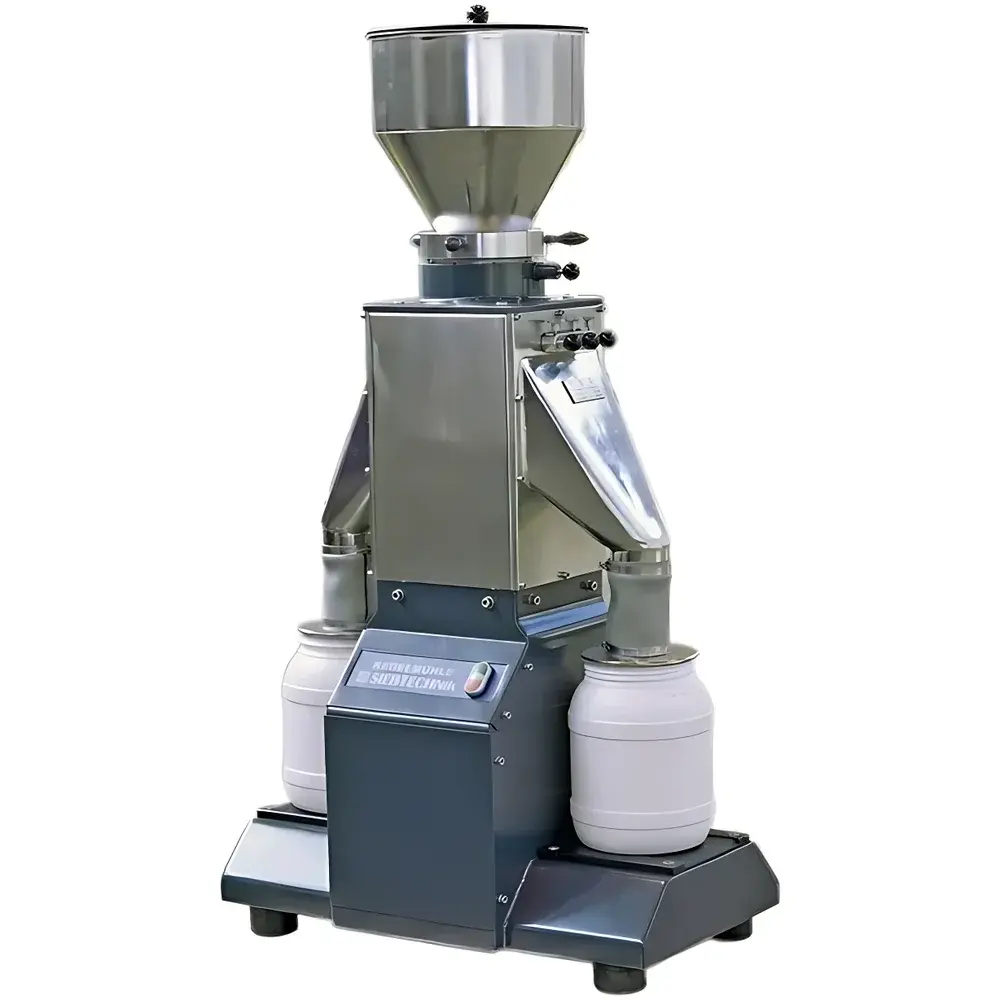
Siebtechnik KM65/KM170 Cone Crusher and Sample Divider
| Brand | Siebtechnik |
|---|---|
| Origin | Germany |
| Model | KM65 / KM170 |
| Maximum Feed Size | <25 mm |
| Final Particle Size Range | 2–10 mm (adjustable) |
| Throughput | KM65: 60 kg/h |
| KM170 | 200 kg/h |
| Rotor Speed | 158 rpm |
| Motor Power | 1.5 kW, 3-phase |
| Grinding Element Material | Tungsten Carbide |
| Sample Division Ratios | 1:2, 1:4, 1:8 |
| Compliance | CE-certified |
| Operating Mode | Grinding-only or Integrated Grinding + Division |
Overview
The Siebtechnik KM65 and KM170 Cone Crushers are precision-engineered laboratory and pilot-scale instruments designed for simultaneous size reduction and representative sample division of bulk solid materials. Based on the principle of controlled conical compression and shear between a rotating tungsten carbide rotor and a stationary grinding ring, these units deliver consistent, low-heat mechanical comminution without thermal degradation — making them especially suitable for heat-sensitive, brittle, or highly abrasive feedstocks such as iron ores, bauxite, quartz, ceramics, coke, slag, and metallurgical samples. Unlike high-speed impact mills, the cone crusher operates at a deliberately low rotational speed (158 rpm), minimizing particle amorphization, dust generation, and mechanical stress-induced phase changes. Its dual-function architecture enables direct integration of grinding and sample division in a single pass — eliminating intermediate handling, reducing operator exposure, and preserving sample integrity throughout the preparation workflow.
Key Features
- Tungsten carbide grinding elements — engineered for extreme wear resistance and chemical inertness, ensuring zero metallic contamination and extended service life when processing hard, abrasive, or reactive materials.
- Adjustable gap mechanism — precise axial positioning of the conical rotor relative to the fixed grinding ring allows continuous, repeatable control over final particle size (2–10 mm).
- Integrated sample division system — optional 1:2, 1:4, or 1:8 splitting ratios implemented via gravity-fed, mechanically synchronized splitter channels downstream of the grinding zone.
- Dual-mode operation — configurable for grinding-only or combined grinding-and-division workflows, supporting flexibility across method development, QA/QC, and regulatory-compliant sample prep protocols.
- CE-compliant safety architecture — including motor overload protection, emergency stop circuitry, and fully enclosed grinding chamber with interlocked access doors meeting EN 60204-1 and EN ISO 12100 requirements.
- Robust cast-iron frame and vibration-damped mounting — optimized for stable operation under continuous duty and compatible with standard laboratory floor anchoring or mobile cart integration.
Sample Compatibility & Compliance
The KM65/KM170 series accommodates a broad spectrum of inorganic and organic solids classified as hard, medium-hard, or brittle per ASTM D4292 and ISO 5084. Verified applications include metallurgical ores (hematite, magnetite, ilmenite), refractory raw materials (alumina, silicon carbide), coal and coke, industrial slags, ceramic powders, glass cullet, soil aggregates, and temperature-labile pharmaceutical excipients. All models comply with EU Machinery Directive 2006/42/EC and carry CE marking. The design supports traceability-critical workflows: grinding and division events can be logged manually or integrated into LIMS via external PLC triggers. While not inherently 21 CFR Part 11 compliant, the unit’s mechanical repeatability and documented parameter settings (gap, speed, ratio) support GLP/GMP-aligned validation protocols when paired with SOP-controlled operation and calibration records.
Software & Data Management
The KM65/KM170 operates as a standalone electromechanical system with no embedded firmware or digital interface. Parameter settings — including rotor-to-ring gap, division ratio selection, and run duration — are set manually via calibrated mechanical dials and locking mechanisms. This analog architecture ensures long-term reliability, eliminates software obsolescence risk, and simplifies qualification (IQ/OQ/PQ) in regulated environments. For laboratories requiring electronic audit trails, optional third-party sensors (e.g., load cells, rotary encoders, or time-stamped photoelectric gates) may be installed upstream/downstream to capture throughput, cycle count, or division event timing — data which can then be exported to validated LIMS or ELN platforms.
Applications
- Preparation of homogenized feed material for XRF, XRD, and ICP-OES analysis — where particle shape uniformity and absence of preferential segregation are critical.
- Reduction of oversized mineral samples prior to sieve analysis (ISO 2591-1, ASTM E11) or automated image-based particle characterization.
- Production of cuboidal granules for bulk density, angle of repose, and flowability testing per ASTM D6393 and ISO 4401.
- Method development for ISO 13320-compliant laser diffraction analysis, where narrow size distribution and minimal fines generation improve measurement reproducibility.
- Regulatory sample subdivision for ISO 3082-compliant reference material certification and proficiency testing programs.
FAQ
Can the KM65/KM170 process wet or sticky materials?
No — the instrument is strictly designed for dry, free-flowing solids. Moisture content exceeding 1% w/w may cause clogging or inconsistent division due to adhesion within the conical grinding zone.
Is calibration required before use?
Yes — initial gap calibration using certified gauge blocks is mandatory to ensure target particle size accuracy. Annual recalibration is recommended per ISO/IEC 17025 Annex A.3 guidelines.
What maintenance intervals are advised?
Tungsten carbide components require inspection every 200 operating hours; lubrication of drive bearings every 500 hours; and full alignment verification annually or after any impact event.
Does Siebtechnik provide application support for method transfer?
Yes — technical documentation includes gap–size correlation charts, throughput vs. hardness curves, and division ratio validation templates aligned with ISO 3082 Annex B.
Are replacement parts available globally?
All wear parts — including rotors, rings, splitter chutes, and adjustment spindles — are stocked by Siebtechnik’s regional distributors and shipped with serialized traceability documentation.



