
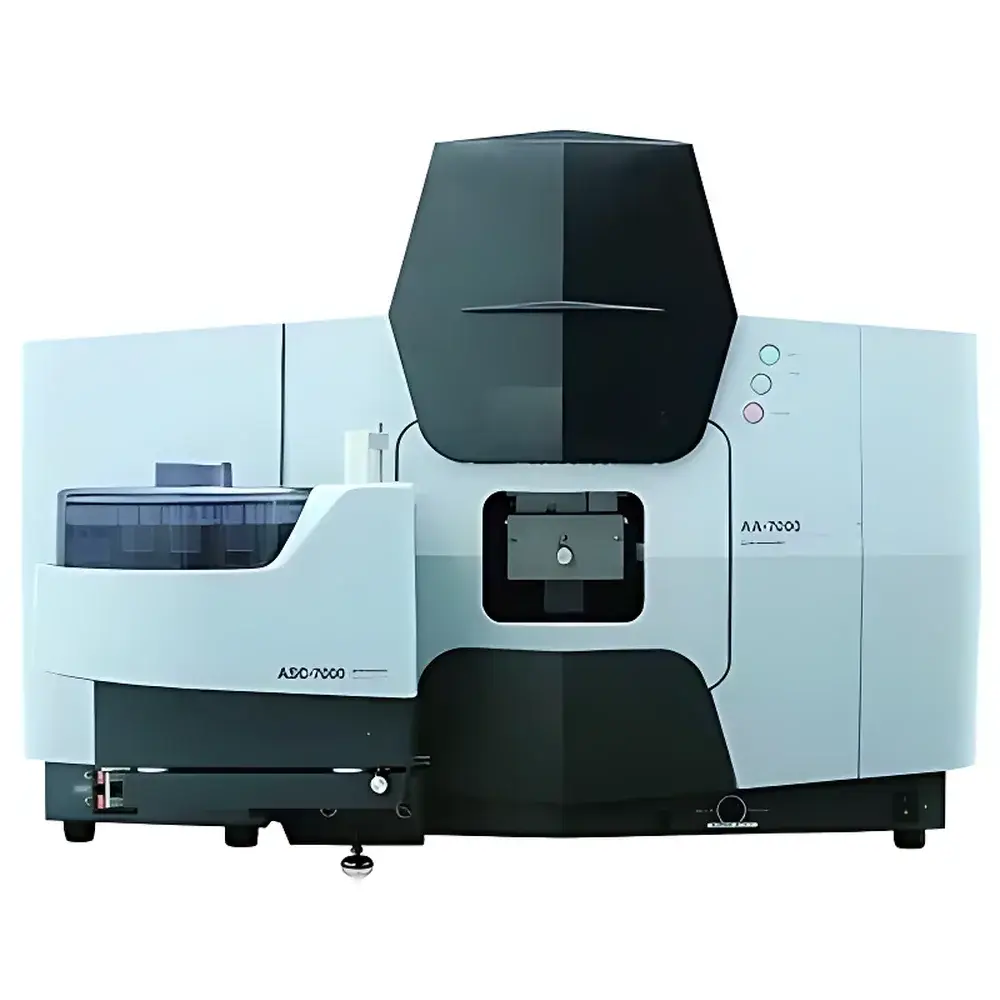
Shimadzu AA-7000 Flame and Graphite Furnace Atomic Absorption Spectrophotometer
| Brand | Shimadzu |
|---|---|
| Origin | Japan |
| Manufacturer Type | Original Equipment Manufacturer (OEM) |
| Instrument Type | Flame and Graphite Furnace AAS |
| Wavelength Range | 185–900 nm |
| Monochromator | Czerny-Turner with 1800 grooves/mm grating |
| Spectral Bandwidth | 0.2, 0.7, 1.3, 2.0 nm (4-step automatic switching) |
| Optical System | Dual-beam for flame mode |
| Detector | Photomultiplier tube (PMT) |
| Background Correction | Simultaneous deuterium lamp (BGC-D₂, 185–430 nm) and fast self-reversal (BGC-SR, 185–900 nm) |
| Lamp Holder | 6-position, dual-lamp operation (1 pre-heating) |
| Dimensions (AA-7000F) | 700 × 588 × 714 mm, 72 kg |
| Dimensions (AA-7000G) | 700 × 580 × 538 mm, 65 kg |
| Power Supply | AC 220 V ±10%, 50/60 Hz |
| Operating Environment | 10–35 °C, 20–80% RH (≤70% above 30 °C) |
Overview
The Shimadzu AA-7000 is a high-performance, integrated flame and graphite furnace atomic absorption spectrophotometer engineered for trace elemental analysis in regulated and research-intensive laboratories. It operates on the fundamental principle of atomic absorption spectroscopy (AAS), where ground-state free atoms in a gaseous state absorb characteristic radiation emitted by hollow cathode lamps. The instrument employs two distinct atomization methods—flame nebulization and electrothermal graphite furnace vaporization—each optimized for specific concentration ranges and matrix complexities. Its dual-atomizer architecture enables fully automated, software-controlled switching between flame and furnace modes without manual reconfiguration, minimizing downtime and operator intervention. The optical system features a Czerny-Turner monochromator with an 1800 grooves/mm holographic grating, delivering high spectral resolution across the full operational wavelength range of 185–900 nm. Flame analysis utilizes a true dual-beam optical path to compensate for source intensity drift and lamp aging, ensuring long-term baseline stability. In graphite furnace mode, a high-throughput single-beam configuration maximizes radiant energy delivery to the graphite tube, enhancing detection sensitivity for sub-pg-level analytes.
Key Features
- Integrated flame/graphite furnace platform with automatic, software-driven atomizer switching—eliminates mechanical realignment and reduces cross-contamination risk.
- Dual background correction capability: Fast deuterium lamp (BGC-D₂) for wavelengths up to 430 nm and rapid self-reversal (BGC-SR) across the full 185–900 nm range—enabling accurate correction of structured and continuous backgrounds.
- 6-lamp turret with simultaneous dual-lamp operation (one actively measuring, one pre-heated)—reduces lamp warm-up delays and improves multi-element workflow efficiency.
- Three-dimensional optical path design in graphite furnace mode increases photon throughput and signal-to-noise ratio, contributing to industry-leading detection limits for volatile and refractory elements.
- Vibration-sensing safety system—automatically terminates heating and extinguishes flame upon detecting mechanical disturbance, meeting ISO 22000 and laboratory safety best practices.
- Multi-stage gas leak detection—monitors acetylene, nitrous oxide, and argon pressure differentials before ignition and during operation, enforcing interlocked shutdown protocols per OSHA 1910.101 and EN 61000-6-4 compliance.
- Flame head and furnace chamber constructed from UL94 V-0 rated flame-retardant polymer composites—ensures passive fire containment and meets IEC 61010-1 electrical safety requirements.
Sample Compatibility & Compliance
The AA-7000 supports aqueous, organic, and digested solid samples across environmental, clinical, pharmaceutical, food, and geological applications. Flame mode accommodates sample introduction via pneumatic nebulization (standard or micro-concentric), while graphite furnace mode accepts direct liquid injection (5–100 µL), slurry analysis, and solid sampling with appropriate modifiers. The system complies with ASTM D1688 (copper in water), EPA Method 7000B (metals in wastewater), ISO 11885 (water quality), and USP (heavy metals in pharmaceuticals). Hardware and firmware are validated against FDA 21 CFR Part 11 requirements, including electronic signature enforcement, role-based user access control (administrator/operator/analyst), audit-trail logging of all method changes and result modifications, and immutable data archiving. All QA/QC parameters—including ICV, ICB, CCV, CCB, LCS, SPK, PDS, DUP, and %RSD—are automatically calculated and reported in accordance with GLP and GMP documentation standards.
Software & Data Management
WizAArd software provides a modular, guided interface for method development, eliminating reliance on expert-level spectroscopic knowledge. Each analytical step—from lamp selection and wavelength optimization to background correction strategy and calibration model selection—is implemented as a configurable “Wizard Block.” Calibration options include linear, quadratic, and cubic curve fitting, standard addition (single-point and simplified variants), and multi-point interpolation. Signal processing supports peak-height and peak-area integration with customizable time windows and baseline drift compensation algorithms. Raw and processed data are stored in encrypted SQLite databases with SHA-256 hashing; export formats include CSV, PDF, and XML for LIMS integration. Electronic records retain full metadata: analyst ID, timestamp, instrument configuration snapshot, raw spectra, and audit trail entries—all compliant with ALCOA+ principles (Attributable, Legible, Contemporaneous, Original, Accurate, Complete, Consistent, Enduring, Available).
Applications
The AA-7000 delivers robust performance in routine and regulatory testing environments. In environmental labs, it quantifies Pb, Cd, As, and Hg in drinking water at sub-pptr levels using graphite furnace analysis with Zeeman background correction. In pharmaceutical QC, it verifies catalyst residues (e.g., Pd, Ni, Ru) in active pharmaceutical ingredients per ICH Q2(R2). Food safety applications include Na, K, Ca, Mg profiling in infant formula (AOAC 985.35) and Cr, Mn, Fe determination in fortified cereals (ISO 15550). Clinical laboratories employ it for serum Zn, Cu, and Se measurement following CLIA-waived protocols. Geological sample digestion extracts (HF/HNO₃/HClO₄) are analyzed for rare earth elements (La, Ce, Nd) with matrix-matched calibration and internal standardization.
FAQ
What atomization techniques does the AA-7000 support?
It supports both flame atomization (using air-acetylene or nitrous oxide-acetylene flames) and electrothermal graphite furnace atomization—switched automatically via software command.
Is the AA-7000 compliant with FDA 21 CFR Part 11?
Yes—its WizAArd software includes electronic signatures, role-based permissions, tamper-evident audit trails, and secure data archiving aligned with Part 11 Subpart B requirements.
How does background correction work across the full wavelength range?
Deuterium lamp correction is applied from 185–430 nm; self-reversal correction covers 185–900 nm—both executed in real time with sub-millisecond switching latency.
Can the AA-7000 perform automated dilution of unknown samples?
Yes—when paired with the Shimadzu ASC-7000 autosampler, it executes intelligent dilution based on preliminary screening results and predefined concentration thresholds.
What safety certifications apply to the AA-7000 hardware?
It conforms to IEC 61010-1 (electrical safety), ISO 13857 (mechanical safeguarding), and EN 61326-1 (EMC), with built-in vibration sensing, gas leak interlocks, and flame-out suppression logic.



