
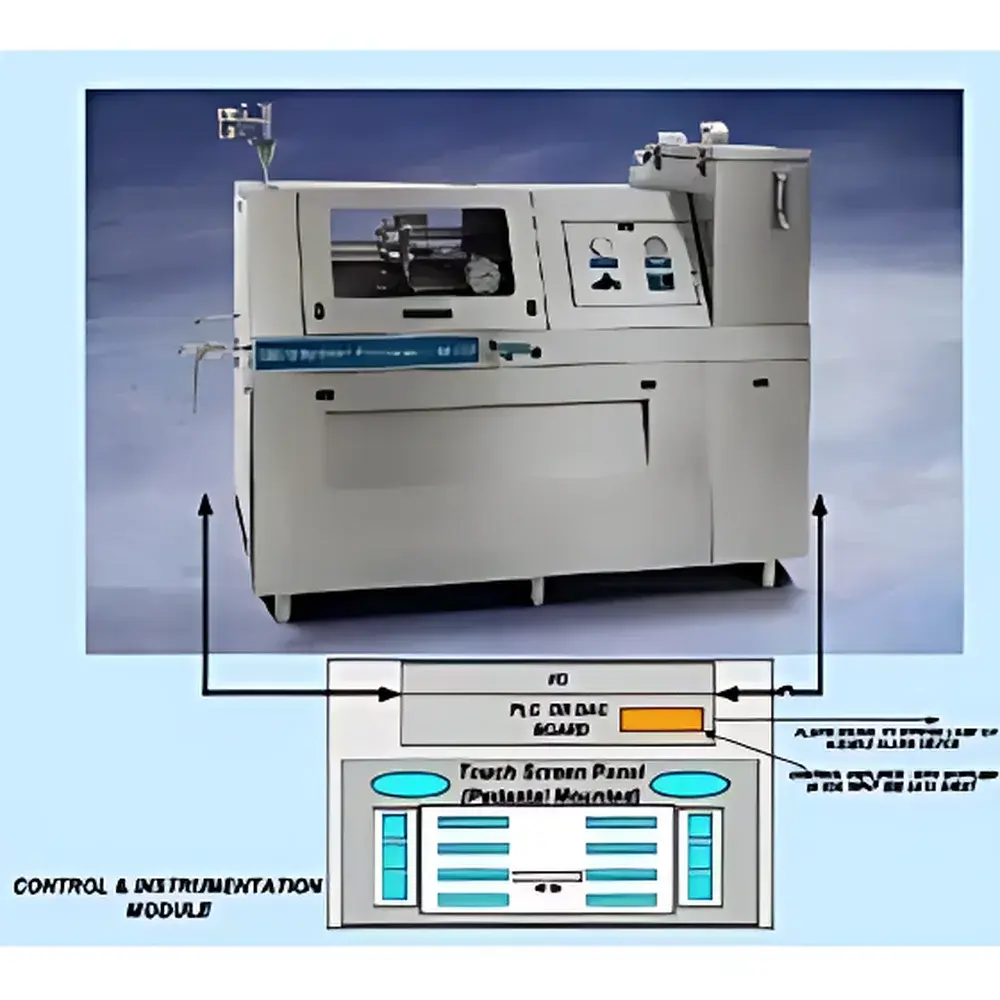
MFIC M-700 Series High-Pressure Microfluidizer Nanosizer
| Origin | USA |
|---|---|
| Manufacturer Type | Authorized Distributor |
| Origin Category | Imported |
| Model | M-700 Series |
| Instrument Type | High-Pressure Cell Disruptor |
| Max Operating Pressure | 40,000 psi |
| Max Flow Rate | 15.6 L/min |
| Inlet Temperature Range | Up to 75 °C |
| Power Supply | 3-Phase, 380 V, 15–50 HP |
| Air Supply | 50–150 psi, 1 SCFM @ 50 psi, Dew Point: 0–35 °F |
| Dimensions | 74 × 180 × 145 cm |
| Weight | 675–900 kg |
| Chamber Material | Diamond-Embedded Stainless Steel |
| Construction | Fully 316L Stainless Steel |
Overview
The MFIC M-700 Series High-Pressure Microfluidizer Nanosizer is an industrial-scale, hydraulically driven microfluidization system engineered for reproducible, scalable nanoscale particle and droplet size reduction in demanding biopharmaceutical and chemical manufacturing environments. Unlike conventional homogenizers relying on shear or impact mechanisms, the M-700 employs a patented fixed-geometry interaction chamber—fabricated with diamond-reinforced stainless steel—to subject fluid streams to controlled, ultra-high-pressure (up to 40,000 psi) microjet impingement within precisely defined microchannels. This process generates intense, uniform turbulent energy dissipation and cavitation, enabling consistent sub-200 nm particle size distributions in liposomes, lipid nanoparticles (LNPs), nanoemulsions, polymeric micelles, and cell lysates. Its design conforms to principles outlined in USP , ISO 13320 (laser diffraction), and ASTM D7857 (nanoparticle dispersion stability), supporting process validation under cGMP and GLP frameworks.
Key Features
- Diamond-embedded interaction chamber with invariant geometry—ensures long-term dimensional stability, minimal wear, and batch-to-batch reproducibility without recalibration.
- Three scalable configurations (M-7115, M-7125, M-7250) delivering 15 HP / 4.74 L/min, 25 HP / 7.78 L/min, and 50 HP / 15.6 L/min nominal throughput respectively—optimized for R&D, pilot, and commercial manufacturing.
- Integrated, programmable temperature control system maintains inlet fluid temperature ≤75 °C, critical for thermolabile biologics including mRNA-LNPs and protein-based therapeutics.
- Full Clean-in-Place (CIP) and Steam-in-Place (SIP) capability—validated per ASME BPE-2022 standards—with no disassembly required between batches.
- Hydraulic powertrain with redundant pressure monitoring and real-time feedback control ensures stable operation across full pressure range (5,000–40,000 psi) and flow rates.
- Entire wetted path constructed from electropolished 316L stainless steel meeting FDA 21 CFR Part 11-compliant material traceability requirements.
Sample Compatibility & Compliance
The M-700 Series processes aqueous and organic-phase suspensions, emulsions, and colloidal dispersions with viscosities up to 5,000 cP. It is routinely applied to liposomal doxorubicin formulations, siRNA-loaded LNPs, vaccine adjuvant emulsions (e.g., MF59 analogs), microbial cell disruption (E. coli, yeast), and polymer nanoparticle synthesis. All models comply with IEC 61000-6-2/6-4 electromagnetic compatibility standards and carry CE marking for machinery safety (2006/42/EC). Documentation packages support audit readiness for FDA pre-approval inspections, EMA Annex 15, and WHO TRS 961 validation protocols. Pressure transducers are NIST-traceable; calibration certificates are supplied with each unit.
Software & Data Management
Control is managed via a validated Windows-based HMI with dual-channel pressure and temperature logging at 10 Hz resolution. The system records time-stamped operational parameters—including setpoint pressure, actual pressure, flow rate, inlet/outlet temperature, hydraulic oil temperature, and total processed volume—for full electronic batch record generation. Audit trails meet FDA 21 CFR Part 11 requirements, featuring role-based user access, digital signatures, and immutable data storage. Optional integration with MES/SCADA platforms (OPC UA v1.04 compliant) enables real-time SPC charting and automated deviation alerts aligned with ISO 9001 quality management systems.
Applications
- Preparation of sterile, GMP-grade lipid nanoparticles for nucleic acid delivery (mRNA, siRNA, CRISPR ribonucleoproteins).
- Scalable manufacturing of uniform liposomes (e.g., PEGylated, pH-sensitive, or ligand-targeted) with narrow PDI (<0.1) as verified by DLS and TEM.
- Cell lysis of Gram-negative and Gram-positive bacteria, mammalian cells, and spores—preserving intracellular enzyme activity and antigen integrity.
- Stabilization of nanoemulsions for topical, oral, and parenteral drug delivery—reducing Ostwald ripening and phase separation over 24-month shelf life.
- Particle size refinement of insoluble APIs (e.g., paclitaxel, itraconazole) into nanosuspensions meeting USP dissolution criteria.
- Homogenization of vaccine antigens and adjuvants to enhance immunogenicity and dose-sparing efficacy.
FAQ
What regulatory documentation is provided with the M-700 Series?
A complete validation package—including FAT/SAT reports, IQ/OQ protocols, material certifications (EN 10204 3.1), and pressure vessel compliance documentation—is delivered with each system.
Can the M-700 be integrated into an existing cleanroom utility infrastructure?
Yes. Standard interfaces include 1.5″ tri-clamp inlet/outlet ports, ¾” compressed air connections (ISO 8573-1 Class 2), and 304 stainless steel utility skids compatible with Grade A/B/C HVAC and WFI distribution networks.
Is remote diagnostics supported?
The embedded controller supports secure, encrypted remote access via TLS 1.2 for troubleshooting and firmware updates—subject to site-specific cybersecurity policies.
What maintenance intervals are recommended?
Diamond chambers require inspection every 500 operating hours; hydraulic oil analysis is performed quarterly; full preventive maintenance is scheduled annually per MFIC Service Bulletin SB-M700-2023.
Does MFIC offer application development support?
Yes. MFIC’s Application Science Team provides protocol optimization, DOE-based parameter mapping, and comparability studies for tech transfer to commercial scale—under NDA-protected collaboration agreements.





