
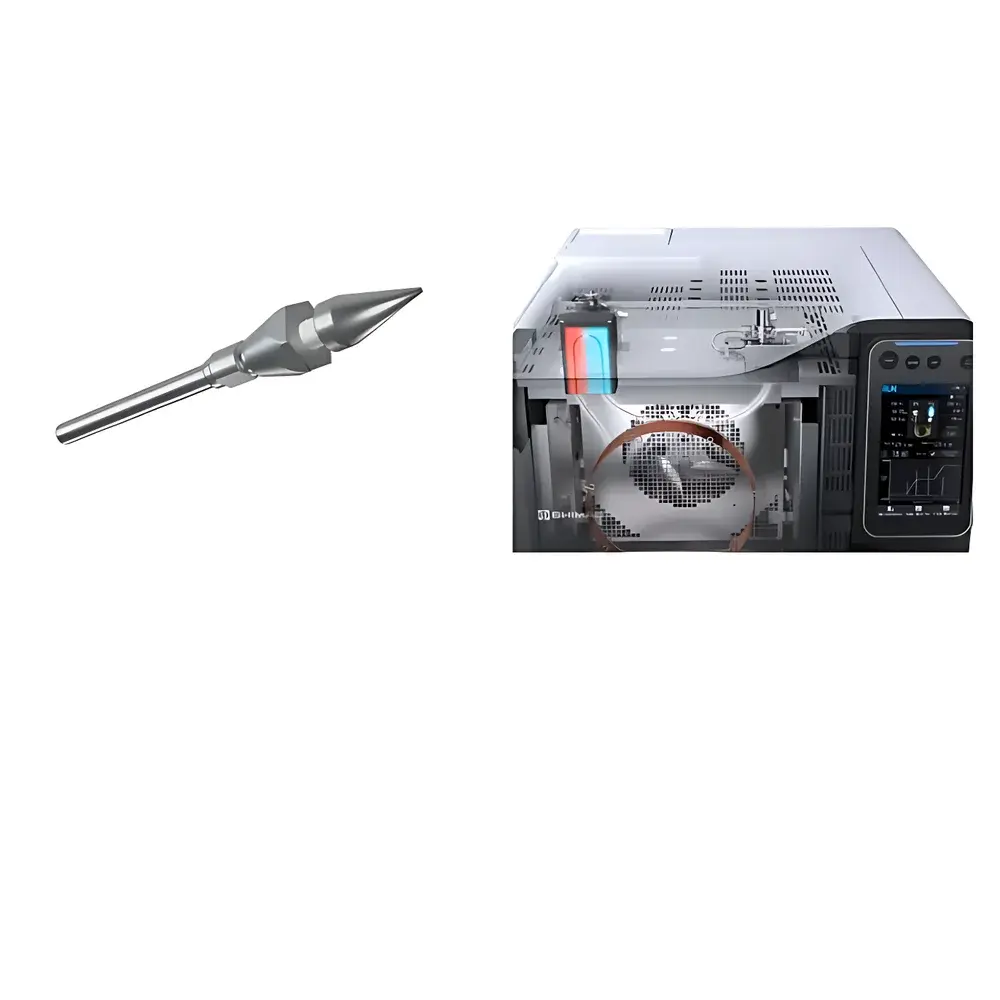
Shimadzu Micro Methanizer for GC-FID
| Brand | Shimadzu |
|---|---|
| Origin | Japan |
| Manufacturer Type | Original Equipment Manufacturer (OEM) |
| Product Category | Imported Instrument |
| Model | Micro Methanizer |
| Instrument Type | Laboratory Gas Chromatograph Accessory |
| Application Scope | Universal for Carbon-Containing Compound Analysis |
| Core Configuration | FID-Integrated Catalytic Converter (Jetanizer & Polyarc Reactor Options) |
| Catalyst Chemistry | Nickel-Free for Jetanizer |
| Linear Dynamic Range | ppm to % (CO/CO₂) |
| Installation Time | <5 min (FID nozzle replacement only) |
| Oxygen Tolerance | Up to 21% O₂ in carrier gas stream |
| Sulfur Resistance | Stable operation with ≤100 ppb H₂S |
| Conversion Efficiency | ≥99% for >200 carbon-containing species including aldehydes, carboxylic acids, halocarbons, and heteroatom-containing compounds |
| Regulatory Alignment | Compatible with USP <621>, ASTM D1945, ISO 8573-5, and GLP-compliant data integrity workflows |
Overview
The Shimadzu Micro Methanizer is a precision-engineered, FID-integrated catalytic converter designed to extend the quantitative capabilities of gas chromatography–flame ionization detection (GC-FID) systems. Unlike conventional methanation furnaces requiring external hydrogen supply, dedicated power, and complex plumbing, this micro-scale device operates directly within the FID nozzle assembly—leveraging two distinct catalytic architectures: the Jetanizer (for selective CO/CO₂ conversion) and the Polyarc reactor (for universal total carbon conversion). Both variants rely on proprietary, nickel-free catalyst formulations engineered for high thermal stability, oxygen tolerance, and resistance to common poisons such as sulfur, chlorine, and nitrogen compounds. The underlying principle is catalytic hydrogenation under controlled stoichiometric conditions: CO and CO₂ are reduced to CH₄ using trace hydrogen generated in situ or co-introduced at sub-stoichiometric levels, enabling FID detection with uniform response factors across diverse analytes.
Key Features
- FID nozzle–level integration: Eliminates need for auxiliary reactors, separate H₂ lines, or additional power supplies—reducing system footprint and failure points.
- Dual-mode catalytic architecture: Jetanizer variant optimized for high-fidelity CO/CO₂ quantification; Polyarc variant enables universal carbon response for broad-spectrum organic analysis.
- Nickel-free catalyst formulation: Avoids deactivation by sulfur-containing compounds and eliminates background methane generation from catalyst degradation.
- Ultra-fast deployment: Installs as direct replacement for standard FID nozzle—typical setup time under 5 minutes with no GC column or detector recalibration required.
- Extended linear dynamic range: Measures CO and CO₂ from low-ppm to percent-level concentrations with R² ≥ 0.9999 across 6 orders of magnitude.
- Oxygen-compatible operation: Functions reliably with air-diluted carrier gases or ambient-air matrix samples without catalyst oxidation or signal drift.
- High-conversion fidelity: Polyarc achieves ≥99.2% conversion efficiency for over 200 validated compounds—including formaldehyde, formic acid, chloroform, carbon tetrachloride, acetonitrile, and thiophene—per ASTM D7217 validation protocols.
Sample Compatibility & Compliance
The Micro Methanizer supports analysis of gaseous, headspace, and purge-and-trap extracts containing carbon monoxide, carbon dioxide, volatile organic compounds (VOCs), semi-volatile organic compounds (SVOCs), and halogenated organics. It is compatible with all major GC platforms operating helium, hydrogen, or nitrogen carrier gases (including split/splitless, PTV, and cold-on-column inlets). Method development aligns with regulatory frameworks including USP for residual solvent analysis, ASTM D1945 for natural gas composition, ISO 8573-5 for compressed air purity testing, and EPA Method TO-15 amendments for ambient air VOC profiling. Its design meets hardware prerequisites for 21 CFR Part 11–compliant environments when paired with Shimadzu LabSolutions GC software featuring electronic signatures, audit trails, and user-access controls.
Software & Data Management
When used with Shimadzu LabSolutions GC ver. 5.9 or later, the Micro Methanizer enables automated calibration curve generation using single-component standards for multi-analyte quantification—particularly valuable for unknown or complex matrices where reference standards are unavailable. Software modules support response factor normalization across compound classes, real-time conversion efficiency monitoring via internal reference peaks, and automatic correction for baseline shifts induced by catalyst aging. All acquisition and processing parameters are stored with full metadata (instrument configuration, catalyst batch ID, installation date), satisfying GLP/GMP documentation requirements for method validation and instrument qualification reports.
Applications
- Environmental monitoring: Quantification of CO/CO₂ in stack emissions, landfill gas, and biogas—without interference from O₂-rich flue streams.
- Pharmaceutical QC: Residual solvent analysis per ICH Q2(R2), especially for low-response compounds like chloromethane or formaldehyde in API intermediates.
- Petrochemical QA: Total hydrocarbon analysis in refinery off-gases, including olefins, aromatics, and oxygenates with consistent FID response.
- Food & beverage safety: Headspace analysis of packaging leachables (e.g., ethylene oxide residuals, acetaldehyde migration) with improved sensitivity and reduced calibration burden.
- Research laboratories: Method development for non-targeted screening where compound identification precedes quantification—enabling carbon-mass-balanced calculations without prior knowledge of individual response factors.
FAQ
Does the Micro Methanizer require external hydrogen supply?
No—hydrogen is either generated in situ via catalytic recombination of carrier gas impurities or introduced at trace levels (<1 mL/min) sufficient for stoichiometric conversion without compromising FID stability.
Can it be used with nitrogen carrier gas?
Yes—validated for helium, hydrogen, and nitrogen carriers; nitrogen operation requires minor optimization of FID air-to-hydrogen ratio to maintain optimal flame chemistry.
How often does the catalyst require replacement?
Under normal use (≤8 hrs/day, clean sample matrices), Jetanizer and Polyarc catalysts maintain ≥95% conversion efficiency for ≥18 months; lifetime is extended with integrated particulate filtration and sulfur scrubbing upstream.
Is method transfer between GC systems supported?
Yes—catalyst performance is platform-agnostic; retention times and peak shapes remain consistent across Shimadzu, Agilent, and Thermo GC systems when using identical column dimensions and temperature programs.
What validation documentation is provided?
Each unit ships with Certificate of Conformance, catalyst batch-specific performance test report (including CO/CO₂ linearity, conversion efficiency vs. 25 reference compounds, and O₂ tolerance verification), and IQ/OQ protocol templates compliant with ISO/IEC 17025.





