
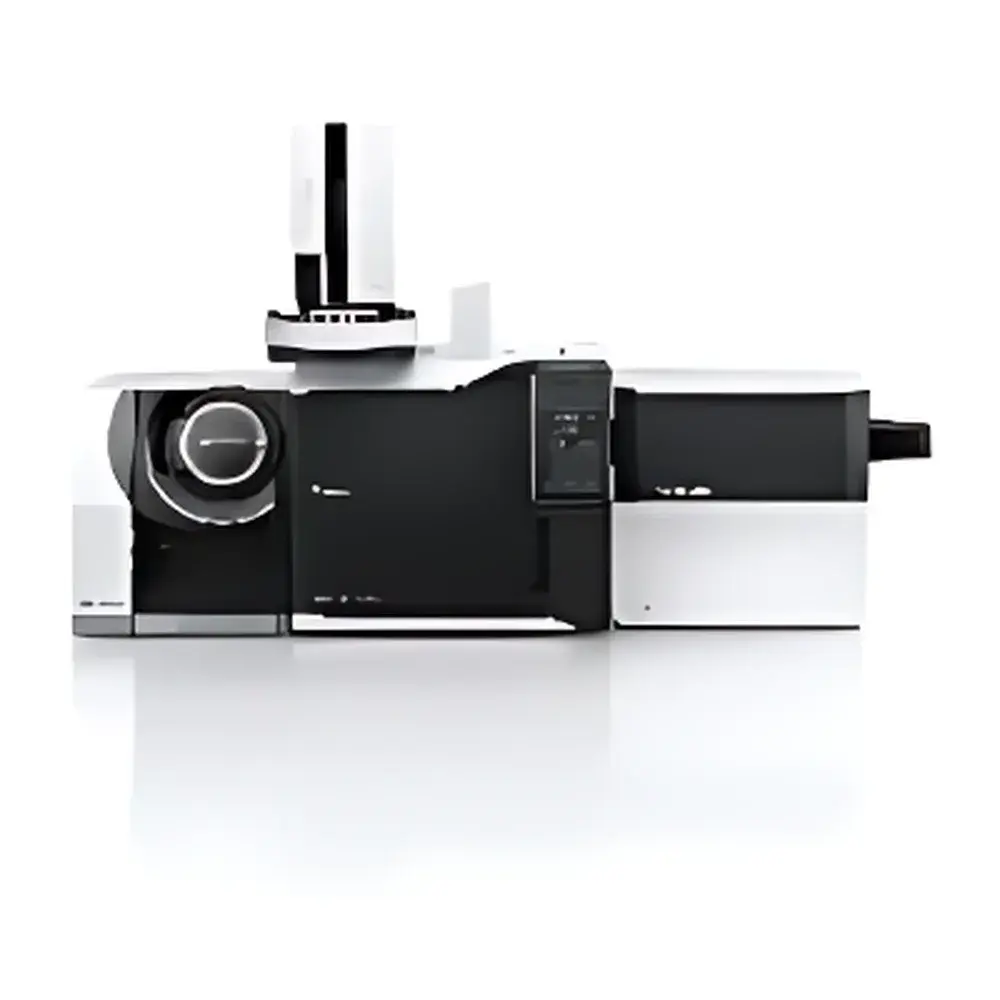
Shimadzu ELEM-SPOT Organic Speciation Analyzer
| Brand | Shimadzu |
|---|---|
| Origin | Japan |
| Manufacturer | Shimadzu Corporation |
| Instrument Type | Single Quadrupole Mass Spectrometer |
| GC Configuration | Conventional Gas Chromatography-Mass Spectrometry (GC-MS) |
| Mass Range | m/z 1.5–1090 |
| Resolution | 0.4–2.0 u (FWHM) |
| Scan Speed | 20,000 u/sec |
| Mass Accuracy | ±0.1 u over 48 h |
| Oven Ramp Rate | Up to 250 °C/min |
| Detector | Electron Multiplier Mass Spectrometer |
| Pressure Control Precision | 0–150 psi |
Overview
The Shimadzu ELEM-SPOT Organic Speciation Analyzer is an integrated analytical platform engineered for the selective identification and quantification of oxygen- and nitrogen-containing organic compounds in complex hydrocarbon matrices. It combines the Shimadzu GCMS-QP2020NX single quadrupole gas chromatography–mass spectrometry system with the EL-30 selective combustion module—a dedicated high-temperature pyrolysis unit optimized for element-specific carbon functional group discrimination. Unlike conventional GC-MS systems, the ELEM-SPOT architecture implements a two-stage separation and detection strategy: first, chromatographic resolution of volatile and semi-volatile organics under precisely controlled thermal gradients; second, real-time, element-selective combustion followed by mass-resolved detection of characteristic fragment ions (e.g., CO+, NO+, HCN+) derived exclusively from O- or N-functionalized moieties. This dual-path design enables unambiguous speciation—distinguishing, for example, carbonyls from ethers, or pyridines from nitriles—without reliance on reference standards or spectral library matching alone.
Key Features
- Integrated EL-30 selective combustion interface: Operates at programmable temperatures up to 1100 °C with <100 ms residence time, ensuring quantitative conversion of target heteroatom functionalities into diagnostic ions while minimizing secondary cracking artifacts.
- GCMS-QP2020NX core platform: Features a high-efficiency ion source with low-energy electron impact (70 eV standard, adjustable 10–100 eV), active vacuum pressure regulation (0–150 psi range), and real-time pressure feedback control for retention time stability across multi-day sequences.
- Ultra-fast scanning capability (20,000 u/sec) synchronized with high-speed oven ramping (up to 250 °C/min), enabling sharp peak capture for co-eluting polar species in fast-gradient analyses of bio-oils and pyrolysis condensates.
- Mass accuracy maintained at ±0.1 u over 48-hour continuous operation—validated per ASTM D7896-21 Annex A3 for long-term instrument stability in regulated environmental testing workflows.
- Rugged quadrupole mass filter with resolution tunable from 0.4 to 2.0 u (FWHM), supporting both full-scan sensitivity and targeted SIM/SCAN hybrid acquisition for trace-level heteroatom compound detection down to sub-ng levels.
Sample Compatibility & Compliance
The ELEM-SPOT is validated for direct injection and split/splitless analysis of neat liquid samples—including crude bio-oils, catalytic fast pyrolysis condensates, plastic-derived hydrocarbon mixtures, and refinery intermediate streams. Solid samples require solvent extraction (e.g., dichloromethane or toluene) prior to analysis; no derivatization is needed for native O/N-species detection. The system complies with ISO 17025:2017 requirements for test method validation, supports GLP-compliant audit trails via LabSolutions GCMS software, and meets FDA 21 CFR Part 11 data integrity criteria when deployed with electronic signature-enabled network configurations. Method development aligns with EPA Method 8270E (semivolatile organics) and ASTM D7359-22 (elemental speciation in fuels) frameworks.
Software & Data Management
Controlled exclusively through Shimadzu LabSolutions GCMS ver. 5.9 or later, the ELEM-SPOT provides synchronized acquisition of chromatographic, combustion interface, and mass spectral data streams within a unified project environment. The software includes built-in elemental ion ratio algorithms (e.g., CO+/C2H4+, NO+/C3H6+) for automated O/N-class assignment, customizable retention index libraries for compound class indexing, and batch-processing tools compliant with ISO/IEC 17025 documentation requirements. Raw data files (.qgd) are stored in vendor-neutral format and support third-party spectral deconvolution (e.g., AMDIS) and chemometric analysis (PCA, PLS-DA) via open API integration.
Applications
- Speciation of oxygenates (e.g., phenols, furans, carboxylic acids) in lignocellulosic bio-oils for catalyst deactivation studies.
- Quantitative profiling of nitrogen bases (indoles, carbazoles, quinolines) in heavy fuel oils per ISO 8217 Annex D.
- Tracking heteroatom removal efficiency during hydrotreatment of waste-plastic-derived hydrocarbons.
- Identification of thermally labile N-heterocycles in coal tar fractions without prior fractionation.
- Supporting ASTM D7545-23 (speciation of oxygenated compounds in aviation turbine fuels) and USP impurity profiling guidelines.
FAQ
What sample preparation is required for solid biomass feedstocks?
Extract with refluxing dichloromethane (60 min), filter through 0.45 µm PTFE, and concentrate to 1 mL under gentle N2 stream. No silylation or methylation is necessary.
Can the EL-30 module be used independently of the GCMS-QP2020NX?
No—the EL-30 is a dedicated interface designed exclusively for coupling to Shimadzu GC-MS platforms with proprietary pneumatic and data synchronization protocols.
Is method transfer possible between ELEM-SPOT and other Shimadzu GC-MS systems?
Retention time indices and ion ratio thresholds are transferable; however, combustion interface parameters (temperature ramp, O2 flow, residence time) must be re-optimized on each ELEM-SPOT installation due to hardware-specific calibration.
Does the system support isotopic labeling studies (e.g., 15N or 18O tracking)?
Yes—high mass accuracy (±0.1 u) and narrow peak width enable baseline resolution of 15N/14N and 18O/16O isotopologues in targeted SIM mode, provided chromatographic separation resolves isotopic clusters.
How is detector saturation avoided during high-concentration sample runs?
The system employs automatic gain control (AGC) with dynamic EM voltage adjustment and optional attenuation grids; additionally, the EL-30’s variable combustion zone residence time allows dilution-free linear response extension across four orders of magnitude.



