
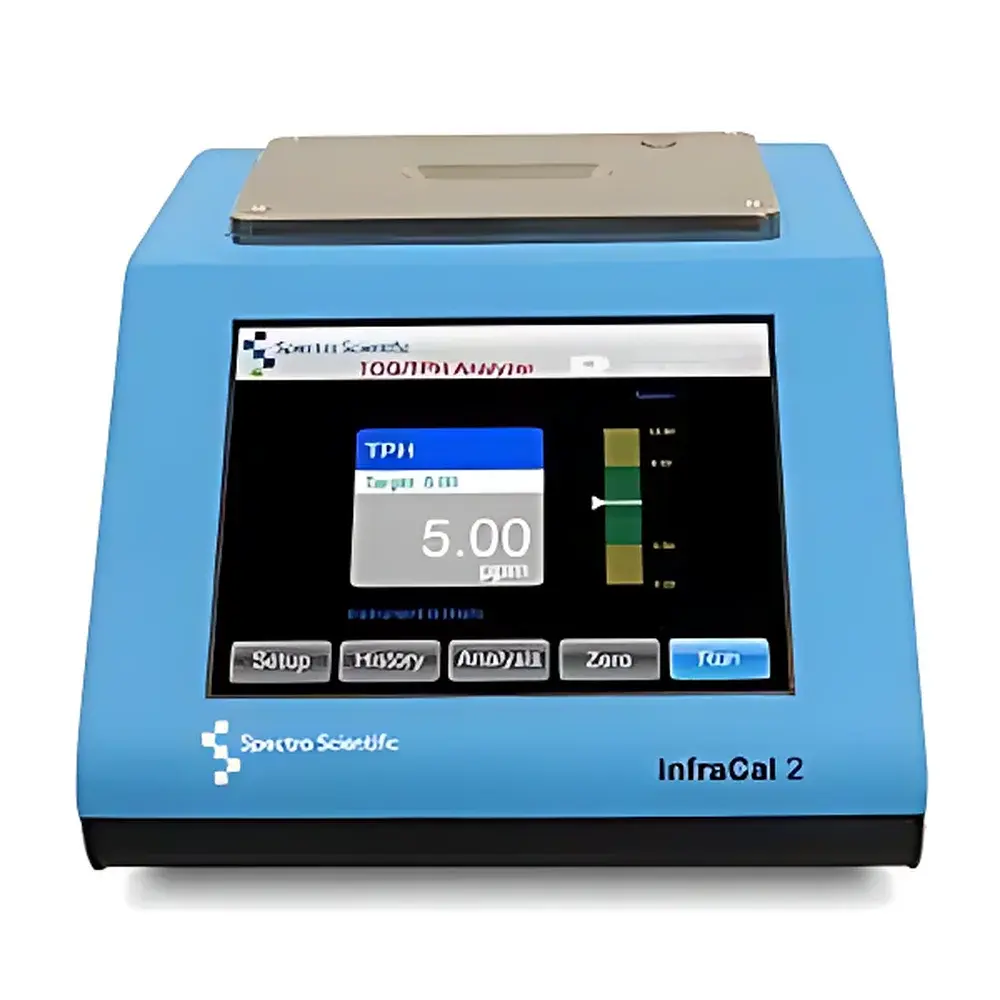
Spectro Scientific InfraCal 2 Oil-in-Soil Analyzer
| Brand | Spectro Scientific |
|---|---|
| Model | InfraCal 2 |
| Origin | USA |
| Detection Principle | Infrared Absorption (C–H Stretch Band at ~2960 cm⁻¹) |
| Compliance | ASTM D7066 (Transmission Method), EPA Method 1664 (Reflectance Mode Equivalent) |
| Power | Rechargeable Lithium-ion Battery |
| Interface | Touchscreen Display |
| Calibration | Multi-curve Internal Library |
| Data Management | Onboard Storage & USB Export |
| Security | Password-Protected User Settings & Calibration Curves |
| Alarm | Configurable Threshold Alerts |
| Environmental Rating | Industrial-Grade Enclosure for Workshop & Cleanroom-Adjacent Use |
Overview
The Spectro Scientific InfraCal 2 Oil-in-Soil Analyzer is a field-deployable, infrared-based analytical instrument engineered for rapid, quantitative determination of residual hydrocarbon contamination—such as lubricating oils, greases, cutting fluids, mold release agents, and surfactants—on metal and non-porous component surfaces. It operates on the fundamental principle of mid-infrared absorption spectroscopy, specifically targeting the aliphatic C–H stretching vibration band near 2960 cm⁻¹, where hydrocarbons exhibit strong, characteristic absorbance. Unlike gravimetric or fluorescence-based screening methods, the InfraCal 2 delivers trace-level quantification (down to sub-mg/m² sensitivity depending on extraction efficiency) with high reproducibility across diverse substrate geometries. Its design addresses a critical quality control gap in precision manufacturing: verifying post-cleaning surface cleanliness prior to coating, plating, bonding, or assembly—where even nanogram-level residues can induce adhesion failure, solder voiding, or particulate shedding in high-reliability applications.
Key Features
- Optimized dual-mode optical path supporting both transmission (ASTM D7066-compliant) and reflectance configurations, enabling compatibility with solvent extracts (e.g., n-hexane, Freon alternatives) and direct surface wipe analysis.
- Ruggedized industrial housing rated for operation in ambient temperatures from 5 °C to 40 °C and relative humidity up to 85% non-condensing—suitable for production floor, QC lab, and maintenance bay environments.
- Capacitive touchscreen interface with intuitive workflow navigation; no external PC required for routine measurements.
- Embedded calibration library supporting ≥10 user-defined curves, including pre-loaded reference curves for common industrial oils (ISO VG 32, MIL-PRF-23699, synthetic esters) and custom solvent matrices.
- On-device data logging (≥10,000 test records) with timestamp, operator ID, lot/batch tag, and alarm status; export via USB 2.0 to CSV or PDF reports compliant with internal audit requirements.
- Configurable pass/fail thresholds with visual and audible alerts; password-protected access levels for operator, supervisor, and administrator roles to maintain data integrity and method control.
Sample Compatibility & Compliance
The InfraCal 2 accommodates standard solvent extraction protocols per ISO 16232 (Cleanliness of Components in Hydraulic Fluid Power Systems), VDA 19.1 (Automotive Component Cleanliness), and USP (Analytical Instrument Qualification). It accepts samples prepared using common extraction solvents—including n-hexane, cyclohexane, and chlorinated alternatives meeting EPA 1664 substitution guidelines—and supports both filter membrane (e.g., glass fiber, PTFE) and swab-based collection media. All measurement outputs are traceable to NIST-traceable hydrocarbon standards and fully align with regulatory expectations for GMP/GLP environments. The analyzer’s firmware includes audit trail functionality (user actions, calibration events, result modifications) satisfying FDA 21 CFR Part 11 requirements when deployed within validated workflows.
Software & Data Management
No proprietary desktop software is required for basic operation; however, optional SpectroLink™ Desktop Suite enables advanced data trending, SPC charting (X̄/R, Cpk), multi-instrument fleet monitoring, and integration with LIMS via HL7 or ASTM E1384 interfaces. Raw spectral data (absorbance vs. wavenumber) is stored alongside quantitative results, facilitating root-cause analysis during process investigations. All calibration parameters—including baseline correction coefficients, pathlength compensation factors, and solvent blank offsets—are digitally signed and version-controlled to prevent unauthorized modification.
Applications
- Automotive powertrain components (fuel injectors, valve bodies, transmission gears) undergoing aqueous or solvent cleaning prior to electroplating.
- Semiconductor equipment parts (chuck plates, wafer carriers) requiring ultra-low hydrocarbon limits (<10 µg/cm²) to prevent photoresist contamination.
- MEDICAL device implants and surgical instruments where residual lubricant may trigger inflammatory response or interfere with sterilization efficacy.
- Aerospace hydraulic manifolds and actuator housings subject to stringent NAS 1638 or SAE AS4059 cleanliness classifications.
- Electronics assembly fixtures and stencil cleaners monitored for flux residue carryover affecting solder paste volume consistency.
FAQ
What extraction solvents are validated for use with the InfraCal 2?
n-Hexane, cyclohexane, and isooctane are fully supported per ASTM D7066. Chlorinated solvents (e.g., Freon-113 replacements) may be used if certified for IR transparency in the 2960 cm⁻¹ region and validated against primary standards.
Can the InfraCal 2 differentiate between oil types (e.g., mineral vs. synthetic)?
No—it quantifies total extractable hydrocarbons based on C–H bond density. Discrimination requires GC-MS or FTIR spectral deconvolution, which falls outside its design scope.
Is routine verification with certified reference standards required?
Yes. Daily system suitability testing using a NIST-traceable oil-in-solvent standard (e.g., 100 mg/L mineral oil in n-hexane) is recommended before sample analysis to confirm photometric stability and calibration fidelity.
How does the instrument handle particulate-laden extracts?
Samples must be filtered through 0.45 µm membrane filters prior to analysis to prevent optical path obstruction and scattering artifacts.
Does the InfraCal 2 support IQ/OQ/PQ documentation packages?
Yes—Spectro Scientific provides GxP-aligned qualification templates, including installation checklist, operational range verification, and performance qualification protocols aligned with ISO/IEC 17025 and ASTM E2500.



