
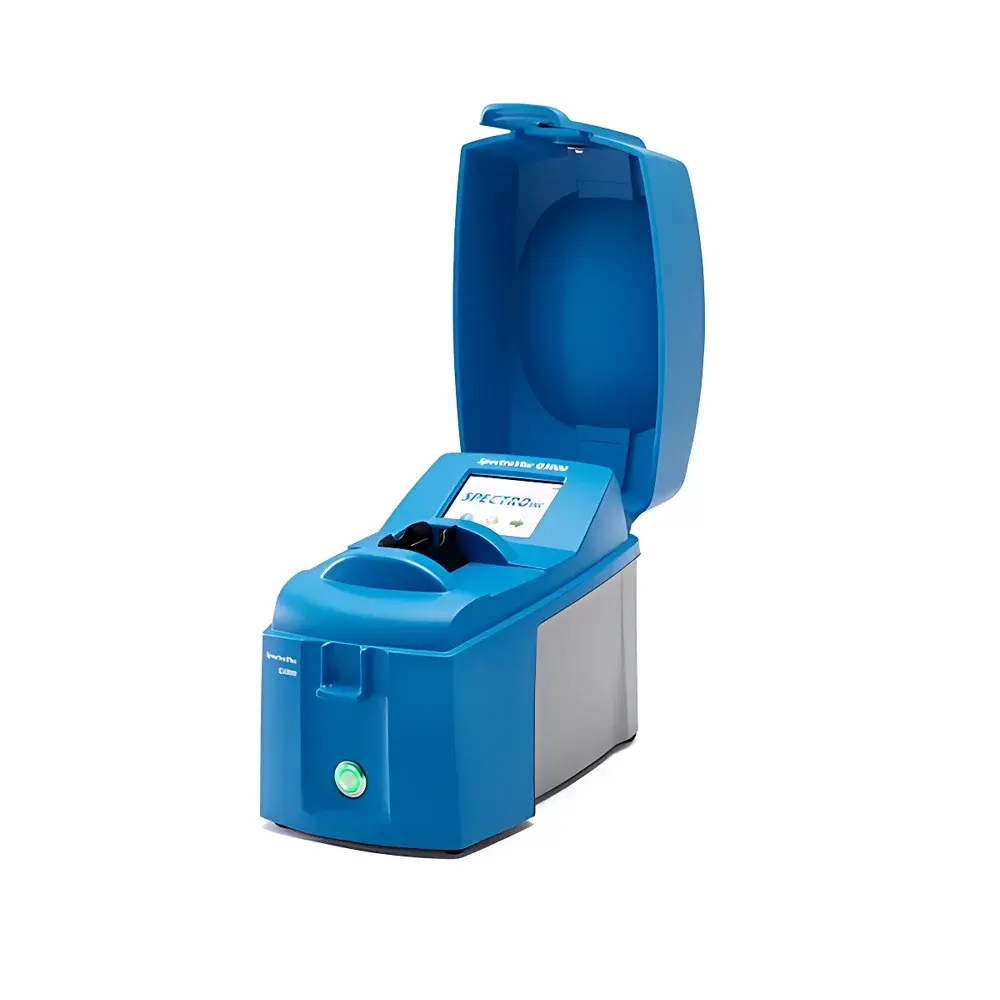
Spectro Scientific MiniVisc 3050 Portable Kinematic Viscosity Analyzer
| Brand | Spectro Scientific |
|---|---|
| Origin | USA |
| Manufacturer Type | Authorized Distributor |
| Origin Category | Imported |
| Model | MiniVisc 3050 |
| Pricing | Available Upon Request |
Overview
The Spectro Scientific MiniVisc 3050 Portable Kinematic Viscosity Analyzer is a field-deployable, solvent-free instrument engineered for precise kinematic viscosity measurement of lubricating oils and hydraulic fluids at 40 °C—per ASTM D445 and ISO 3104 standards. It operates on the principle of gravity-driven capillary flow through a patented split-cell viscometer, eliminating reliance on density determination or external temperature calibration. Unlike traditional U-tube capillary viscometers requiring manual timing and lab-controlled bath immersion, the MiniVisc 3050 integrates a thermally stabilized dual-panel sample cell, high-resolution infrared flow detection, and embedded microprocessor control to deliver laboratory-grade accuracy in a handheld format. Its core function is to quantify changes in kinematic viscosity induced by oxidation, thermal degradation, contamination (e.g., soot, glycol, fuel dilution), or base oil mixing—critical indicators for predictive maintenance of turbines, compressors, gearboxes, and hydraulic systems.
Key Features
- Patented split-cell capillary design enables rapid loading, minimal sample consumption (60 µL), and tool-free cleaning with lint-free tissue—no solvents required.
- Integrated Peltier-based thermal regulation maintains sample cell temperature at 40 °C ± 0.1 °C throughout measurement; no pre-conditioning or external bath needed.
- Self-contained operation: rechargeable Li-ion battery (≥6 hours runtime), built-in 7-inch capacitive touchscreen interface, and onboard data storage eliminate dependency on PCs or network infrastructure.
- Wide dynamic range: 2–700 mm²/s (cSt) at 40 °C, with algorithmic extrapolation to equivalent 100 °C values per ASTM D341 viscosity-temperature correlation.
- Optically agnostic measurement: capable of analyzing opaque, heavily sooted, or dark-colored oils without signal attenuation or pre-filtration.
- Ruggedized aluminum housing (1.8 kg), IP54-rated enclosure, and shock-absorbing elastomer bumpers ensure operational reliability in industrial field environments.
Sample Compatibility & Compliance
The MiniVisc 3050 is validated for use with mineral, synthetic, and bio-based lubricants—including turbine oils, engine oils, hydraulic fluids, gear oils, and compressor oils—regardless of color, opacity, or particulate load. It complies with the fundamental physical principles of kinematic viscosity determination defined in ASTM D445 (Standard Test Method for Kinematic Viscosity of Transparent and Opaque Liquids), ISO 3104 (Petroleum Products — Determination of Kinematic Viscosity and Calculation of Dynamic Viscosity), and ISO 2909 (Petroleum Products — Calibration of Glass Capillary Kinematic Viscometers). While not a GLP-certified instrument per se, its audit-ready measurement logs—including timestamp, temperature trace, flow duration, and raw sensor output—support traceability requirements under ISO/IEC 17025-accredited laboratories and internal quality management systems aligned with API RP 545 and OEM lubricant surveillance protocols.
Software & Data Management
The embedded firmware supports multilingual UI (including English and Chinese), guided workflow navigation, and real-time pass/fail flagging against user-defined viscosity limits. All measurements are stored locally with metadata (date/time, operator ID, sample ID, ambient temperature, battery level). Data export is supported via USB-C to CSV or PDF report formats compatible with LIMS integration. Optional SpectroVision™ desktop software provides trend analysis, statistical process control (SPC) charting, historical comparison across fleets, and automated reporting compliant with ISO 55001 asset management frameworks. Audit trail functionality records all configuration changes and user actions—meeting documentation rigor expected in regulated industries operating under FDA 21 CFR Part 11 or ISO 9001 quality systems.
Applications
- On-site condition monitoring of critical rotating equipment during routine inspections or outage windows.
- Rapid verification of oil change intervals based on viscosity drift beyond OEM thresholds (e.g., +15% or –10% from new oil baseline).
- Field triage of suspected fluid contamination events—such as diesel fuel dilution in crankcase oil or coolant ingress in hydraulic systems.
- Verification of lubricant compatibility prior to mixed-oil top-ups or retrofits.
- Supporting ISO 4406 particle count programs by correlating viscosity shifts with oxidative stability loss or additive depletion.
- Training and demonstration tool for maintenance technicians in remote locations lacking access to centralized labs.
FAQ
Does the MiniVisc 3050 require calibration with certified reference oils?
Yes—initial factory calibration is traceable to NIST standards, and users must perform periodic verification using ASTM D445-certified reference oils (e.g., Cannon Standard Viscosity Oils) at least quarterly or after 100 measurements.
Can it measure viscosity at temperatures other than 40 °C?
No—the instrument is fixed at 40 °C per design; however, it calculates an estimated 100 °C value using the ASTM D341 equation and user-input viscosity index (VI) or default VI assumptions.
Is the split-cell capillary replaceable in the field?
Yes—the capillary module is a user-serviceable consumable part with standardized replacement kits available directly from Spectro Scientific authorized distributors.
How does it handle water-contaminated oil samples?
Water droplets may disrupt laminar flow in the capillary; therefore, samples with >500 ppm free water should be centrifuged or filtered prior to analysis to avoid erroneous readings.
Does it meet MIL-STD-810G environmental testing requirements?
It is designed to operate within −10 °C to +50 °C ambient range and withstand vibration per MIL-STD-810G Method 514.6, Category 4, but full certification documentation is available upon request from Spectro Scientific’s technical support team.






