
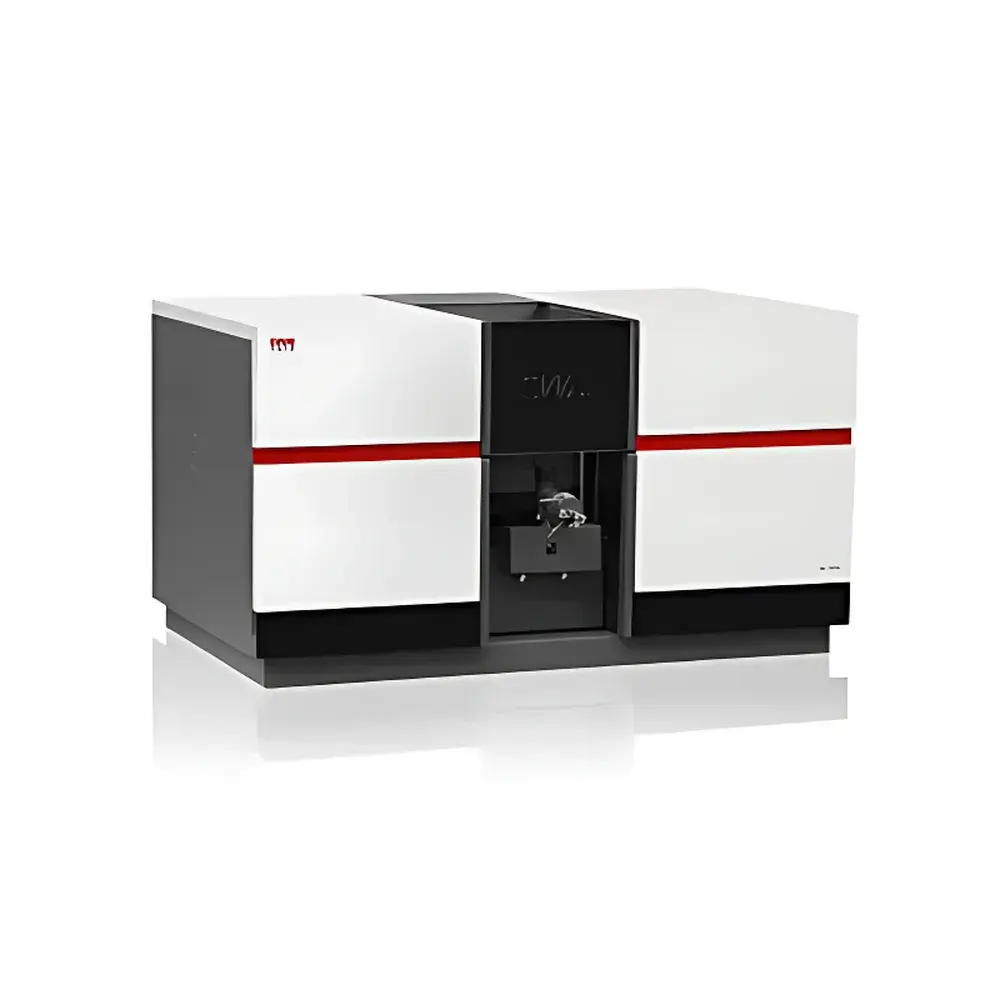
PerkinElmer AA-7090 Flame and Graphite Furnace Atomic Absorption Spectrometer
| Brand | PerkinElmer |
|---|---|
| Origin | Beijing, China |
| Manufacturer Type | Direct Manufacturer |
| Instrument Type | Dual-Mode Flame/GF-AAS |
| Monochromator | Plane Grating |
| Detector | Photomultiplier Tube (PMT) |
| Background Correction | D₂ Lamp + AC Zeeman |
| Spectral Resolution | 0.1 nm |
| Sensitivity | Flame (Cu): ≤0.02 µg/mL |
| GF-AAS (Cd) | ≤5.0×10⁻¹³ g |
| Precision (RSD) | Flame (Cu): ≤0.45% |
| GF-AAS (Cd) | ≤3.0% |
| Detection Limit | Flame (Cu): ≤0.003 µg/mL |
| GF-AAS (Cd) | ≤1.0×10⁻¹² g |
| Baseline Stability | ≤0.002 A/30 min (static) |
| Lamp Turret | 8-position Auto-rotating |
| Graphite Furnace | Transversely Heated |
| Magnetic Field | AC Zeeman, 0.6–1.1 T adjustable in 0.1 T increments |
| Optional Features | Integrated Graphite Furnace Viewing System |
Overview
The PerkinElmer AA-7090 is a dual-mode atomic absorption spectrometer engineered for high-precision elemental quantification across diverse sample matrices. It integrates flame atomic absorption spectroscopy (FAAS) and graphite furnace atomic absorption spectroscopy (GF-AAS) into a single, compact optical platform with parallel instrument architecture—enabling rapid mode switching without mechanical reconfiguration or optical realignment. The system operates on the fundamental principle of atomic absorption: ground-state atoms in a gaseous state absorb characteristic radiation from hollow cathode lamps at wavelengths specific to each element. Quantification is achieved via Beer-Lambert law-based calibration curves, with absorbance measured as peak height or area. Designed for compliance-driven laboratories, the AA-7090 supports trace metal analysis down to sub-picogram levels (GF-AAS), making it suitable for environmental monitoring (e.g., EPA Method 7000B), clinical toxicology, food safety testing (ISO 11170), and pharmaceutical impurity profiling per ICH Q2(R2) guidelines.
Key Features
- Dual optical path design with simultaneous flame and graphite furnace access—eliminates manual burner head replacement and minimizes downtime between analysis modes.
- Transversely heated graphite furnace with integrated argon gas shielding and temperature-controlled cooling—ensures uniform atomization, reduced matrix interference, and extended tube lifetime.
- AC Zeeman background correction with continuously adjustable magnetic field (0.6–1.1 T in 0.1 T steps) combined with deuterium lamp correction—provides robust spectral interference suppression for complex samples including biological digests and high-salt wastewater.
- 8-position automatic hollow cathode lamp turret with lamp encoding recognition—enables automated wavelength selection, current optimization, and spectral line validation per ASTM E1554-22 requirements.
- Plane grating monochromator with 0.1 nm resolution and photomultiplier tube detection—delivers high signal-to-noise ratio and long-term photometric stability under routine operation.
- Real-time graphite furnace viewing system with digital imaging—facilitates visual verification of sample deposition, drying, charring, and atomization stages for method development and troubleshooting.
Sample Compatibility & Compliance
The AA-7090 accommodates aqueous solutions, acid-digested environmental solids (EPA SW-846 Methods 3050B/3052), tissue homogenates, and diluted biological fluids. Its flame mode handles concentrations from 0.01–10 mg/L; GF-AAS extends dynamic range to 10⁻¹²–10⁻⁹ g absolute mass. The system meets ISO/IEC 17025:2017 calibration traceability requirements when operated with NIST-traceable standards. All background correction algorithms and data acquisition parameters are fully audit-trail enabled per FDA 21 CFR Part 11 and EU Annex 11 for regulated environments. Routine performance verification follows USP and ASTM E2751-21 protocols.
Software & Data Management
Controlled by WinLab32 AAS software (v5.2+), the AA-7090 supports multi-user role-based access, electronic signatures, and full audit trail logging—including parameter changes, calibration history, and raw absorbance spectra. Data export complies with LIMS-ready formats (CSV, XML, PDF/A-1b). Method templates include preconfigured sequences for EPA 200.7, ISO 11885, and EN 14802. Software modules support QC charting (X-bar/R, Levey-Jennings), automatic drift correction, and GLP-compliant report generation with embedded metadata (operator ID, instrument serial, calibration date).
Applications
- Environmental: Quantification of Pb, Cd, Cr, As, and Ni in drinking water (EPA 200.9), soil leachates (TCLP), and airborne particulate filters.
- Clinical & Forensic: Trace Cu, Zn, Fe, and Se in serum and whole blood; Cd and Pb in bone ash for chronic exposure assessment.
- Food & Agriculture: Monitoring Al, Mn, and Co in fortified cereals; As speciation support via hydride generation coupling.
- Materials Science: Impurity profiling in high-purity Si wafers and battery-grade LiCoO₂ cathode materials.
- Pharmaceuticals: Residual catalyst metals (Pd, Pt, Rh) in API intermediates per ICH Q3D thresholds.
FAQ
What regulatory standards does the AA-7090 support for validated laboratory use?
The system conforms to ASTM E1554-22 (instrument qualification), ISO/IEC 17025:2017 (testing competence), and FDA 21 CFR Part 11 (electronic records) when configured with appropriate software settings and user access controls.
Can the AA-7090 perform sequential multi-element analysis?
No—it is a single-beam, single-element AAS platform. Multi-element capability requires ICP-OES or ICP-MS instrumentation. However, the 8-lamp turret enables rapid sequential analysis of up to eight elements within one run.
Is the graphite furnace viewing system compatible with third-party image analysis software?
Raw video streams are accessible via standard USB 3.0 interface; frame capture and timestamped export are supported in WinLab32, but direct API integration with external vision platforms is not provided.
What maintenance intervals are recommended for optimal baseline stability?
Optical alignment verification every 6 months; PMT voltage recalibration quarterly; graphite tube replacement after 200–300 firings (dependent on matrix); annual full vacuum and purge gas integrity test per manufacturer service bulletin SB-AA7090-REV4.




