
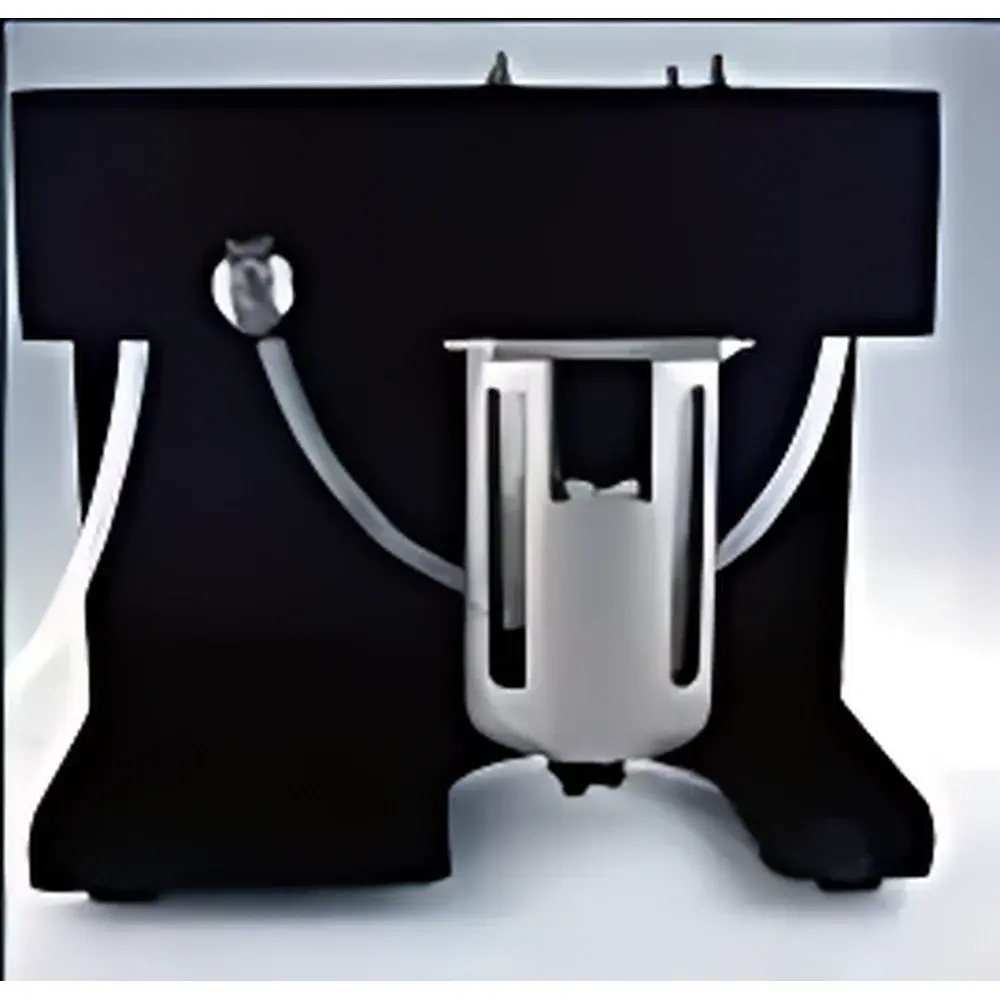
GBC Argon Humidifier for ICP Spectroscopy
| Brand | GBC |
|---|---|
| Origin | Australia |
| Model | Argon Humidifier |
| Application | In-line humidification of argon carrier gas for ICP-OES/ICP-MS sample introduction systems |
| Compliance | Designed for integration with ISO/IEC 17025-compliant analytical workflows |
| Regulatory Context | Supports GLP/GMP-aligned sample introduction stability in high-salinity matrix analysis |
Overview
The GBC Argon Humidifier is an engineered accessory designed specifically for inductively coupled plasma optical emission spectroscopy (ICP-OES) and mass spectrometry (ICP-MS) platforms. It functions by introducing a controlled, sub-saturation level of water vapor into the argon carrier gas stream upstream of the nebulizer. This humidification process mitigates salt deposition at critical orifice points—particularly within concentric glass or quartz nebulizers—by promoting transient solubilization and mechanical flushing of crystalline residues during aerosol generation. Unlike passive moisture traps or inline filters, the GBC unit operates on a continuous bubble-diffusion principle: dry argon is directed through a calibrated depth of deionized water, generating fine, consistent bubbles that maximize interfacial surface area and enable reproducible vapor-phase transfer. The resulting humidified gas maintains thermodynamic stability across standard laboratory temperature and pressure conditions, ensuring minimal impact on plasma ignition, torch alignment, or signal baseline drift.
Key Features
- Optimized bubble-column design with precision-machined gas dispersion frit for uniform humidification and minimal pressure drop (< 5 kPa at 0.8 L/min Ar flow)
- Chemically resistant borosilicate glass body and PTFE gas inlet/outlet fittings compatible with high-purity argon (99.999%) and trace-metal-free operation
- Integrated water-level indicator and overflow relief port to prevent backflow into gas supply lines
- Modular mounting interface enabling direct serial connection between argon regulator and standard concentric nebulizers (e.g., Meinhard®, SeaSpray®)
- No external power, pumps, or controllers required—fully passive, maintenance-free operation
- Validated performance with saline matrices up to 40 g/L total dissolved solids (TDS), including NaCl, CaCl₂, and seawater-mimetic solutions
Sample Compatibility & Compliance
The GBC Argon Humidifier is routinely deployed in laboratories analyzing environmental waters, geological digests, biological fluids, and industrial process streams where elevated chloride and sulfate concentrations challenge conventional pneumatic nebulization. It enables direct aspiration of samples containing ≤40% w/v salt without pre-dilution or offline desalting—reducing dilution errors, improving detection limits for trace elements (e.g., As, Cd, Pb, U), and extending nebulizer service life by >3× compared to dry-gas operation. The device supports compliance with ASTM D1976 (analysis of saline waters), ISO 17294-2 (ICP-MS water testing), and USP / elemental impurities protocols. Its passive architecture requires no electronic logging, but when integrated into validated ICP systems, it contributes to audit-ready documentation under FDA 21 CFR Part 11–aligned data integrity frameworks.
Software & Data Management
As a hardware-only auxiliary component, the GBC Argon Humidifier does not incorporate embedded firmware, communication interfaces, or software drivers. Its operational parameters are intrinsically defined by physical configuration (water temperature, argon flow rate, column height) and require no calibration or digital configuration. However, its use must be formally documented within instrument qualification records (IQ/OQ/PQ), method validation reports, and electronic lab notebooks (ELNs) to ensure traceability in regulated environments. When paired with ICP instruments supporting audit-trail functionality (e.g., Thermo iCAP RQ, Agilent 5110), humidifier deployment status should be noted in acquisition metadata to support root-cause analysis of signal instability or drift events.
Applications
- Routine analysis of seawater, brines, and hypersaline effluents without offline dilution
- Direct quantification of metals in concentrated acid digests from soil and sediment samples
- Stabilized nebulization of high-chloride biological matrices (e.g., serum, urine, tissue homogenates)
- Extended runtime for automated multi-element analyses requiring >8-hour unattended operation
- Reduction of routine nebulizer cleaning frequency in clinical and environmental testing labs operating under ISO/IEC 17025 accreditation
FAQ
Does the GBC Argon Humidifier require periodic water replacement?
Yes—deionized water should be refreshed daily in high-throughput labs or every 48 hours under moderate usage to prevent microbial growth and mineral accumulation.
Can it be used with nitrogen or mixed gases?
No—it is validated exclusively for argon; nitrogen exhibits different solubility and diffusion kinetics, leading to inconsistent humidification and potential plasma instability.
Is the unit compatible with ultrasonic nebulizers?
Not recommended—ultrasonic systems operate at fundamentally different aerosol generation mechanisms and do not benefit from carrier-gas humidification in the same manner as pneumatic nebulizers.
What is the maximum recommended argon flow rate?
0.6–0.9 L/min; exceeding 1.0 L/min reduces residence time and compromises humidification efficiency.
Does humidification affect plasma robustness metrics (e.g., Mg II/I ratio)?
When operated within specification, no statistically significant deviation in robustness indicators is observed versus dry-gas controls—verified via NIST SRM 3133a and multi-laboratory intercomparisons.
Related Products





