
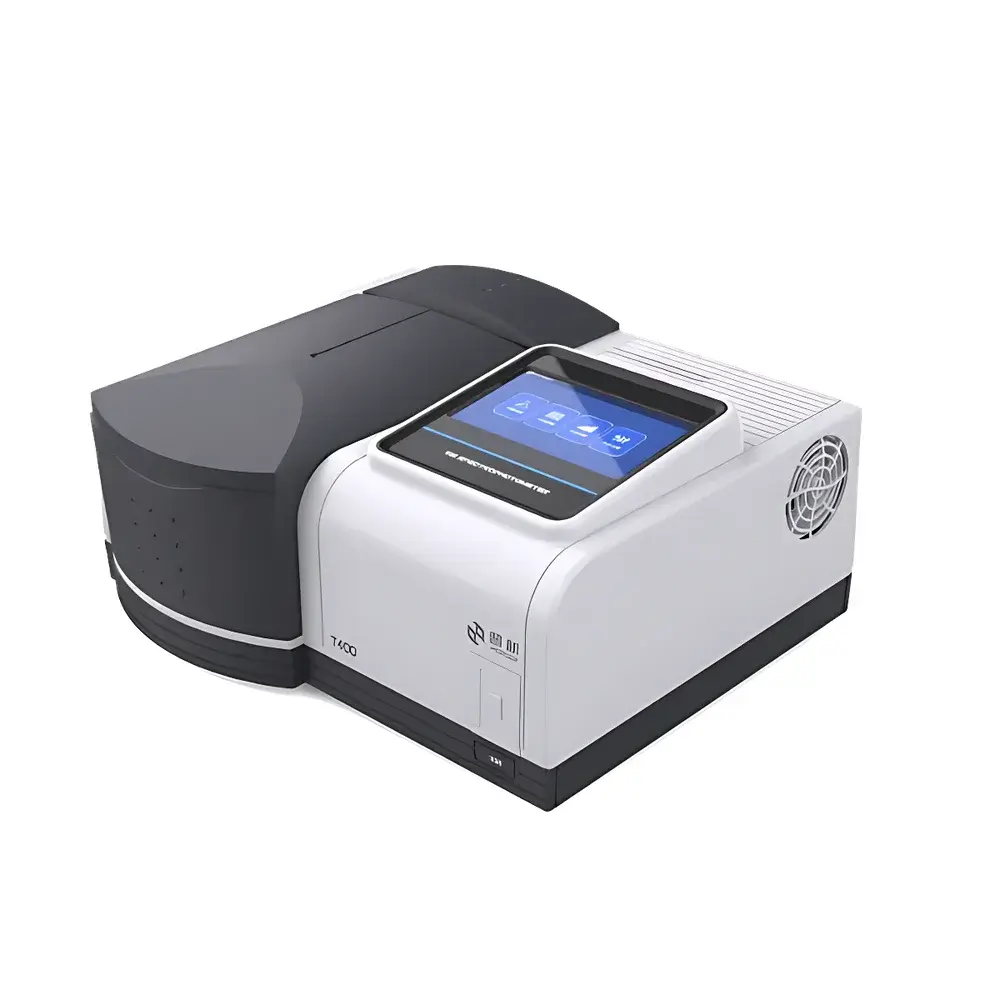
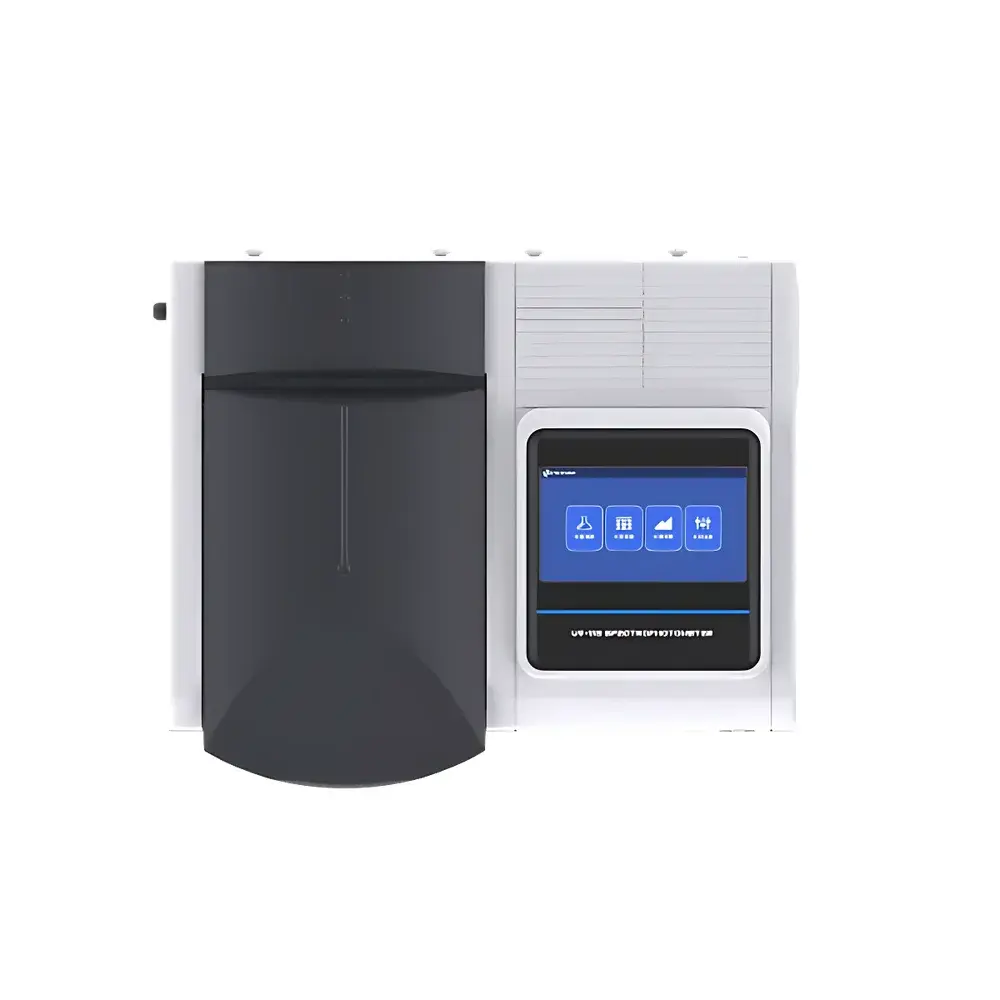
Persee T400/T500 Series Ultraviolet-Visible Spectrophotometer
| Brand | Persee |
|---|---|
| Origin | Beijing, China |
| Manufacturer Type | Direct Manufacturer |
| Product Origin | Domestic (China) |
| Model | T400 / T500 |
| Price Range | USD 1,400 – 4,200 |
| Optical Design | Single-Beam |
| Detector Type | Silicon Photocell |
| Wavelength Range | 325–1100 nm (T400) / 190–1100 nm (T500) |
| Wavelength Accuracy | ±0.2 nm (T400) / ±0.1 nm (T500) |
| Wavelength Repeatability | ≤0.4 nm (T400) / ≤0.2 nm (T500) |
| Spectral Bandwidth | 2 nm |
| Stray Light | ≤0.05%T at 360 nm (T400) / ≤0.05%T at 220 nm (T500) |
| Wavelength Scanning Speed | 2500 nm/min |
| Wavelength Setting Speed | 7000 nm/min |
| Dimensions (W×D×H) | 470 × 400 × 210 mm |
| Weight | 11 kg |
| Display | 7-inch Color Touchscreen |
| Data Export | USB Flash Drive Support |
| Sample Compartment | Open-Design with Integrated Cuvette Storage Rack |
| Software Interface | PC-Connectable Workstation with GLP Compliance Features |
| Firmware Upgradability | Over-the-Air (OTA) for Application Module Expansion (e.g., Protein Quantitation, Pesticide Residue Analysis, Water Quality Testing) |
Overview
The Persee T400/T500 Series Ultraviolet-Visible Spectrophotometer is a precision single-beam optical instrument engineered for routine quantitative and qualitative analysis across academic, industrial, and regulatory laboratory environments. Based on Beer–Lambert law-compliant absorbance measurement, it delivers high-fidelity spectral data in the ultraviolet (190 nm), visible (400–700 nm), and near-infrared (700–1100 nm) regions. The T500 variant extends low-end wavelength coverage to 190 nm—enabling detection of key chromophores such as nucleic acids, aromatic amino acids, and nitrate ions—while the T400 provides optimized performance for applications where deep-UV capability is not required. Its fixed 2 nm spectral bandwidth ensures sufficient resolution for most standard assays without compromising signal-to-noise ratio, and its silicon photocell detector offers stable, linear response across the full operational range. Designed for long-term metrological integrity, the system employs a direct-drive grating mechanism eliminating mechanical backlash and wear associated with traditional screw-driven monochromators.
Key Features
- Motor-driven grating monochromator with no lubrication or periodic alignment required—reducing scheduled maintenance to optical cleaning only.
- Hermetically sealed optical bench with SiO2-coated mirrors and lenses, minimizing degradation from ambient humidity, ozone, and volatile organic compounds.
- Corrosion-resistant chassis and internal components (including anodized aluminum housing and stainless-steel fasteners) ensure durability in teaching labs, field-deployed settings, and quality control facilities.
- 7-inch capacitive touchscreen interface with intuitive icon-based navigation, real-time spectrum preview, and on-device data annotation.
- Modular mechanical architecture: all major subassemblies—including light source housing, monochromator, sample compartment, and detector module—are independently removable using standardized fasteners.
- Dust-filtered air intake with washable electrostatic mesh prevents particulate ingress into the optical path and detector chamber.
- Integrated cuvette storage rack accommodates up to six standard 10-mm-pathlength quartz or glass cells, reducing handling errors during multi-sample workflows.
Sample Compatibility & Compliance
The open-access sample compartment supports standard 10 mm square cuvettes (quartz, glass, or plastic), as well as optional accessories including micro-volume adapters (down to 2 µL), fiber-optic probes, and temperature-controlled holders. The instrument complies with ISO 9001 manufacturing standards and meets core requirements of ISO/IEC 17025 for calibration traceability. While not certified for GMP production environments, its firmware includes audit-trail logging, user-level access control, and electronic signature support—features aligned with GLP documentation practices. Stray light performance (<0.05%T at critical wavelengths) satisfies ASTM E275 and ISO 6223 specifications for photometric accuracy validation. Wavelength accuracy and repeatability are verified per NIST-traceable procedures using holmium oxide and didymium filters.
Software & Data Management
The Persee UV-Vis workstation software (v3.2+) runs on Windows 10/11 and provides full instrument control, spectral acquisition, kinetic time-course analysis, multi-wavelength quantitation, and derivative spectroscopy. It supports CSV, TXT, and proprietary .SPC file export, and integrates seamlessly with LIMS via ODBC-compliant database connectors. All data files embed metadata including operator ID, timestamp, instrument serial number, lamp hours, and calibration history. Firmware updates are delivered via encrypted OTA packages, enabling post-purchase activation of application-specific modules—including protein A280/A260 ratio calculation, pesticide residue screening (based on EPA Method 505/525 derivatization protocols), and COD/BOD surrogate quantification for wastewater analysis. Optional printer drivers support direct output to ESC/POS-compatible thermal printers for lab notebook integration.
Applications
- Academic teaching laboratories: UV-Vis fundamentals, Beer’s law verification, kinetics experiments, and spectrophotometric titrations.
- Environmental testing: Nitrate/nitrite, phosphate, ammonia, and heavy metal (e.g., Cr(VI), Fe(II)) quantification in water per APHA Standard Methods.
- Pharmaceutical QC: Assay of active pharmaceutical ingredients (APIs), excipient purity checks, and dissolution profile monitoring.
- Food & agriculture: Chlorophyll, carotenoid, and anthocyanin content analysis; pesticide residue screening in fruit/vegetable extracts.
- Biotechnology: DNA/RNA concentration and purity assessment (A260/A280, A260/A230), Bradford/Lowry protein assays, and enzyme activity kinetics.
FAQ
Does the T400/T500 support dual-beam operation?
No. The T400/T500 series implements a robust single-beam architecture with real-time reference baseline correction enabled by stabilized deuterium/tungsten-halogen dual-lamp switching and automatic zeroing routines.
Can I use quartz cuvettes below 220 nm on the T400 model?
The T400 has a lower wavelength limit of 325 nm; it is not designed for deep-UV transmission measurements. For sub-220 nm work, the T500 model—with its extended 190 nm cutoff and fused silica optics—is required.
Is the instrument compliant with FDA 21 CFR Part 11?
While the hardware and firmware support essential elements (audit trails, role-based access, electronic signatures), full Part 11 compliance requires site-specific validation documentation and procedural controls—not inherent to the device itself.
What is the expected lamp lifetime under normal usage?
Deuterium lamp: ≥1,000 hours; Tungsten-halogen lamp: ≥2,000 hours. Automatic lamp selection and power management extend service intervals.
How often should the optical filters be cleaned or replaced?
The SiO2-coated optical surfaces require cleaning only when visible contamination is observed—typically every 6–12 months in controlled lab environments. No consumable filter replacements are specified in the maintenance schedule.
Related Products




