
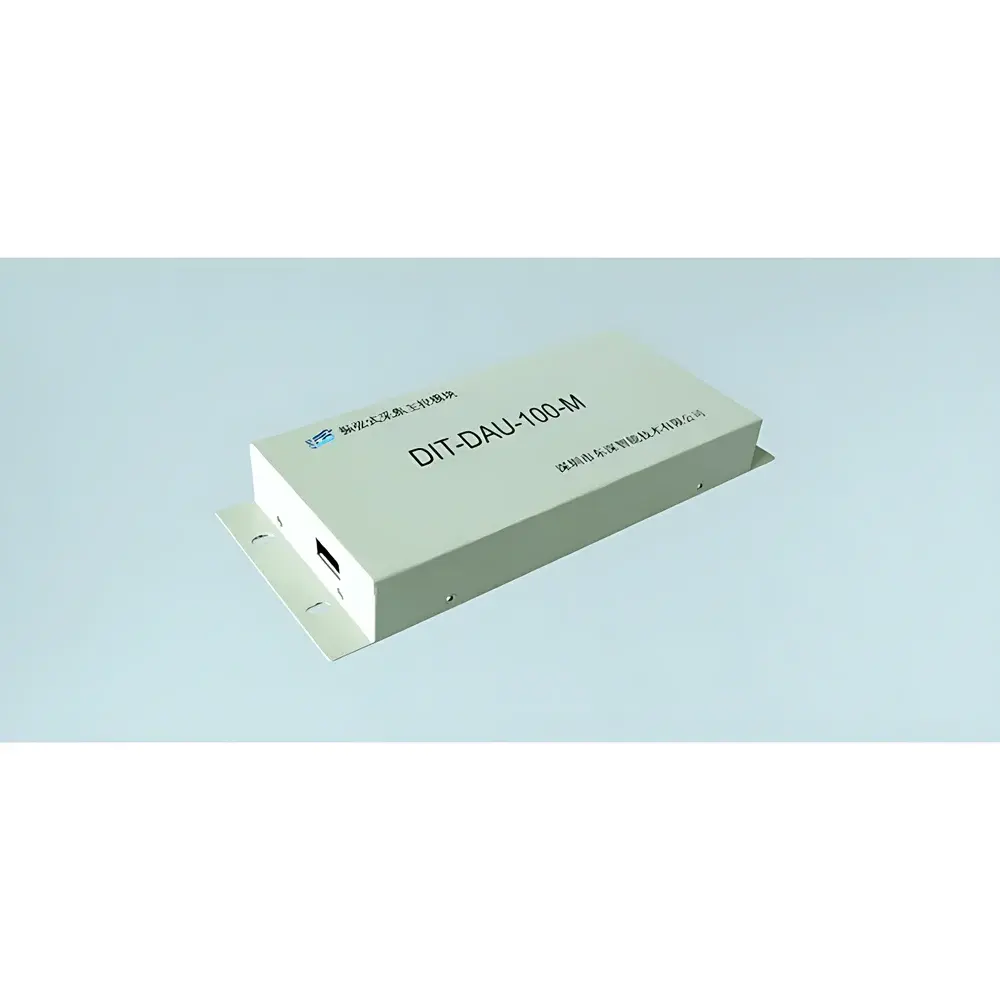
DSE DIT-DAU-100 Vibrating Wire Data Acquisition Unit
| Brand | DSE |
|---|---|
| Origin | Shenzhen, China |
| Manufacturer Type | Authorized Distributor |
| Country of Origin | China |
| Model | DIT-DAU-100 |
| Pricing | Upon Request |
Overview
The DSE DIT-DAU-100 Vibrating Wire Data Acquisition Unit is a rugged, field-deployable embedded measurement system engineered for long-term structural and geotechnical monitoring in demanding civil infrastructure environments. It operates on the fundamental principle of vibrating wire sensor interrogation—measuring the resonant frequency of tensioned steel wires embedded in transducers (e.g., piezometers, crackmeters, strain gauges, and load cells), where frequency shift correlates linearly with physical parameter change (e.g., pressure, strain, or displacement) per ASTM D4767 and ISO 18674-2 calibration conventions. Built around a high-efficiency 32-bit ARM Cortex-M microcontroller, the unit integrates precision excitation circuitry, low-noise signal conditioning, temperature-compensated frequency demodulation, non-volatile data storage, real-time clock (RTC), and multi-protocol communication interfaces—enabling autonomous, time-synchronized, and event-triggered acquisition without continuous host supervision.
Key Features
- Configurable channel count: 1-, 8-, 16-, or 32-channel variants supporting single-coil or dual-coil vibrating wire sensors
- High-resolution frequency measurement with ±0.02 Hz repeatability under thermal drift compensation (–20 °C to +70 °C operating range)
- Onboard 16 MB flash memory with power-fail-safe write protection—retains >5 years of 15-minute interval data at full channel capacity
- Multi-mode acquisition logic: scheduled巡测 (sequential channel scanning), selective point measurement, and programmable time-based polling (up to six daily fixed-time triggers or configurable time windows with user-defined intervals)
- Integrated temperature sensing (±0.5 °C accuracy) for simultaneous thermal compensation of sensor outputs
- Low-power design: typical 12 mA active current draw; sleep mode <30 µA—compatible with solar-battery hybrid power systems
- Ruggedized industrial enclosure (IP67-rated) with conformal coating, ESD-protected I/O, and reinforced terminal blocks for vibration-prone installations
Sample Compatibility & Compliance
The DIT-DAU-100 is validated for use with standard vibrating wire sensors compliant with ASTM D7263 (soil deformation), ASTM D4767 (consolidation testing), and IEC 61000-6-2/6-4 electromagnetic immunity standards. It supports common sensor configurations including single-wire (3-wire) and dual-wire (4-wire) topologies, accommodating nominal frequencies from 400 Hz to 5000 Hz. All firmware and data handling routines adhere to GLP-aligned traceability requirements: each stored record includes timestamp (UTC-synced via optional GPS/NTP), channel ID, raw frequency, compensated value, sensor serial identifier, and CRC-16 integrity checksum. The device meets CE marking requirements for EMC Directive 2014/30/EU and Low Voltage Directive 2014/35/EU.
Software & Data Management
Configuration, firmware updates, and data retrieval are performed via ASCII command protocol over RS-485 (Modbus RTU compatible), RS-232, or optional GPRS/LTE cellular interface. DSE provides the DAU Configuration Suite—a Windows-based utility enabling secure parameter setup (sampling schedules, thresholds, alarm logic), batch firmware deployment, and encrypted binary-to-CSV export with metadata tagging. Raw datasets include audit-trail logs for all configuration changes and manual interventions, satisfying basic FDA 21 CFR Part 11 documentation expectations for non-clinical infrastructure monitoring. Optional integration with SCADA platforms (e.g., Ignition, Wonderware) is supported through OPC UA or MQTT brokers with TLS 1.2 encryption.
Applications
The DIT-DAU-100 serves as a core node in distributed structural health monitoring (SHM) networks across hydraulic, transportation, and geotechnical domains. Typical deployments include: automated reservoir level and pore-water pressure tracking in earth-fill dam instrumentation; real-time convergence monitoring in tunnel boring machine (TBM) advance zones; long-term strain evolution analysis in post-tensioned bridge girders; lateral displacement profiling along highway cut slopes; and seismic response validation in instrumented retaining walls. Its modular architecture allows seamless integration into legacy telemetry infrastructures using SDI-12, Modbus, or custom radio mesh protocols—reducing total cost of ownership in remote, off-grid monitoring campaigns exceeding 10-year service life.
FAQ
What sensor types are natively supported?
The DIT-DAU-100 is optimized for standard vibrating wire sensors—including piezometers, crackmeters, strain gauges, anchor load cells, and tiltmeters—with factory-calibrated frequency-to-engineering-unit conversion tables.
Does the unit support remote firmware updates?
Yes—secure over-the-air (OTA) firmware upgrades are supported via RS-485 or cellular interface using signed binary packages and bootloader-level verification.
How is time synchronization maintained during extended power outages?
The integrated RTC retains time accuracy within ±2 minutes/month using a backup supercapacitor; optional GPS timing module enables sub-second UTC alignment.
Can data be transmitted directly to cloud platforms?
Yes—via optional LTE modem with configurable MQTT endpoints, supporting TLS-encrypted payloads to AWS IoT Core, Azure IoT Hub, or private time-series databases.
Is calibration traceability documented?
Each unit ships with a factory calibration certificate referencing NIST-traceable frequency standards; end-user recalibration procedures follow ISO/IEC 17025-compliant workflows outlined in the Technical Manual.







