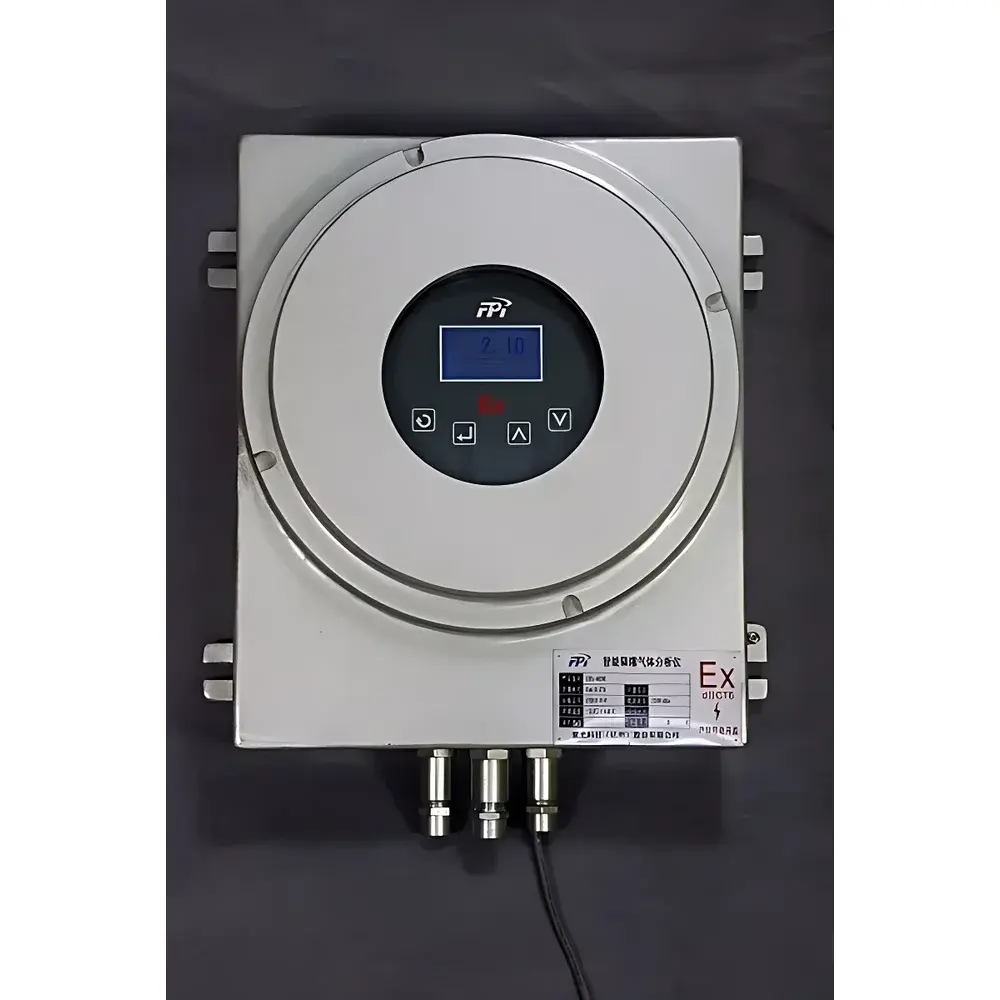
FPI IRA-4000 Explosion-Proof Infrared Gas Analyzer
| Brand | FPI |
|---|---|
| Origin | Zhejiang, China |
| Manufacturer Type | Original Equipment Manufacturer (OEM) |
| Country of Origin | China |
| Model | IRA-4000 |
| Pricing | Upon Request |
Overview
The FPI IRA-4000 Explosion-Proof Infrared Gas Analyzer is a certified intrinsically safe analytical instrument engineered for continuous, real-time quantification of multiple infrared-active gases in hazardous industrial environments. It operates on the principle of non-dispersive infrared (NDIR) absorption spectroscopy, where target gas molecules—such as CO, CO₂, CH₄, NH₃, hydrocarbons (HC), and SO₂—exhibit characteristic fundamental vibrational absorption bands in the mid-infrared region (typically 2–14 µm). The analyzer employs a highly stable, hermetically sealed optical path with a gold-plated or stainless-steel measurement cell, ensuring long-term resistance to corrosive process streams. Its core detection element is a micro-machined thin-film microphonic detector, which converts minute pressure fluctuations induced by modulated IR radiation into precise electrical signals. This architecture eliminates moving parts, enhances mechanical robustness, and delivers high selectivity via dual-chamber (reference/sample) differential detection—effectively minimizing spectral cross-interference and improving signal-to-noise ratio.
Key Features
- Explosion-proof certification compliant with GB 3836.1–2010 / GB 3836.2–2010 (equivalent to IEC 60079-0/IEC 60079-1) for use in Zone 1/Zone 2 hazardous areas.
- Thin-film microphonic detector with dual-compartment design for enhanced gas selectivity and reduced interferences from overlapping absorption spectra.
- Amplitude-modulated IR source with hermetically sealed housing, delivering exceptional thermal and spectral stability over extended operational cycles.
- Full-sealed optical bench resistant to ambient humidity, dust, and process condensates—no optical alignment required during field service.
- Dual-range automatic switching with full-scale digital linearization, supporting wide dynamic concentration ranges without manual range adjustment.
- Integrated O₂ measurement module (optional): electrochemical sensor with 0–25% vol range and 0.01% vol resolution, independently calibrated and temperature-compensated.
- Large backlit LCD display with full Chinese GUI, contextual operation prompts, and real-time diagnostics including lamp voltage, baseline reference voltage, and system health indicators.
Sample Compatibility & Compliance
The IRA-4000 is designed for direct in-situ or extractive sampling of hot, humid, or mildly corrosive industrial gas streams—including flue gas, syngas, biogas, refinery off-gas, and chemical reactor exhausts. Sample conditioning (e.g., particulate filtration, moisture removal) is recommended when inlet gas contains >0.1 mg/m³ suspended solids or >60% RH. The analyzer meets electromagnetic compatibility (EMC) requirements per GB/T 18268.1–2010 (IEC 61326-1) and environmental operating specifications: –20 °C to +50 °C ambient, 15–90% RH non-condensing. All firmware and calibration procedures support traceable documentation for GLP/GMP-aligned quality systems. While not pre-certified for FDA 21 CFR Part 11, its audit trail functionality—including timestamped calibration logs, alarm event records, and configuration change history—enables validation-ready deployment in regulated manufacturing settings.
Software & Data Management
The embedded microprocessor provides comprehensive local data handling capabilities. Built-in non-volatile memory supports time-stamped storage of up to 30 days of second-interval concentration readings (configurable sampling interval: 1–60 s). Historical data can be retrieved directly via the LCD interface or exported through the RS-232 serial port to external PCs or printers. Analog outputs (isolated 4–20 mA or 0–10 mA) are fully scalable per gas channel and include fault signaling (e.g., open-circuit, over-range). Alarm relays (two SPDT contacts) support programmable high/low setpoints across the entire measurement span, with configurable hysteresis and delay timers to suppress transient false triggers. Optional PC-based configuration software enables remote parameter setup, calibration verification, and trend visualization—compatible with standard Modbus RTU protocol for integration into DCS/SCADA platforms.
Applications
- Continuous emissions monitoring (CEMS) for combustion sources subject to national pollutant discharge standards (e.g., GB 13223, GB 16297).
- Process safety interlock systems in petrochemical, fertilizer, and synthetic ammonia plants requiring real-time CO, CH₄, or NH₃ detection.
- Biogas upgrading facilities monitoring CO₂ and CH₄ purity prior to grid injection or vehicle fuel compression.
- Flue gas desulfurization (FGD) scrubber exit streams for SO₂ compliance verification.
- Incineration and waste-to-energy plants tracking CO as a combustion efficiency indicator and regulatory compliance parameter.
- Hydrogen production units (e.g., steam methane reforming) where CH₄ slip and CO concentration impact catalyst protection strategies.
FAQ
What explosion-proof certifications does the IRA-4000 hold?
It complies with Chinese national standards GB 3836.1 and GB 3836.2 for flameproof enclosure “d” type equipment, rated for use in Class IIA/IIB T4 explosive atmospheres (Zone 1/2).
Can the instrument operate without external sample conditioning?
For optimal accuracy and longevity, it requires filtered, dried sample gas; unconditioned wet or particulate-laden streams may impair optical performance and detector lifetime.
Is factory calibration traceable to national standards?
Yes—each unit ships with a calibration certificate referencing certified gas standards traceable to NIM (National Institute of Metrology, China) or equivalent ISO/IEC 17025-accredited providers.
Does the optional O₂ module require separate maintenance?
The electrochemical O₂ sensor has a typical service life of 24 months; replacement and recalibration are performed independently of the IR optics and electronics.
How is zero/span calibration performed in the field?
Manual or automated calibration using certified zero air and span gases is supported via the front-panel menu; all calibration parameters and timestamps are logged internally.
Related Products