
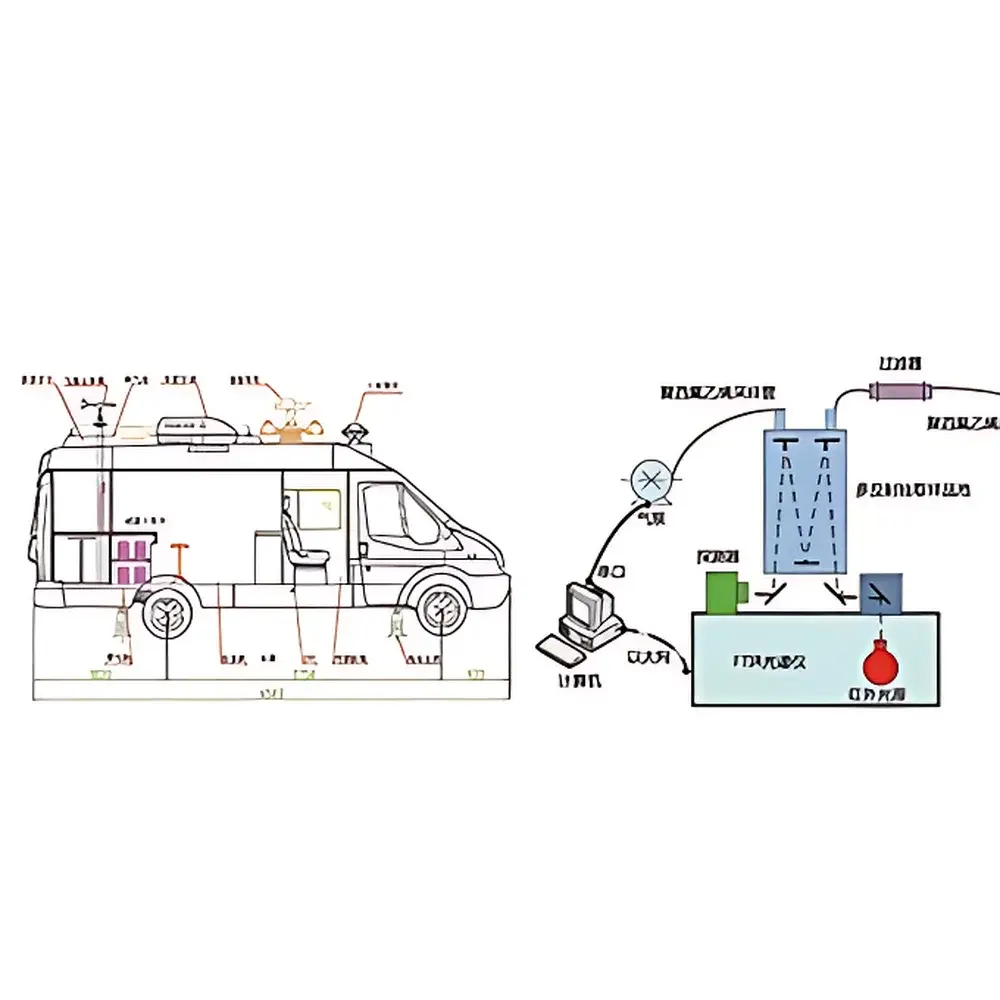
FPI Extractive Fourier Transform Infrared Multicomponent Gas Analyzer
| Brand | FPI |
|---|---|
| Origin | Zhejiang, China |
| Manufacturer Type | Original Equipment Manufacturer (OEM) |
| Product Category | Domestic |
| Model | Extractive FTIR |
| Configuration | Online Continuous Monitoring System |
| Optical Resolution | 1 cm⁻¹ |
| Effective Path Length | Adjustable from 10 m to 64 m |
| Detector Operating Temperature | −196 °C (Liquid Nitrogen Cooled MCT) |
| Detection Limit | Sub-ppb for Selected Analytes |
| Spectral Library | >300 Certified Reference Spectra (Developed with Anhui Institute of Optics and Fine Mechanics, CAS |
| Simultaneous Quantification | ≥20 Gaseous Species (e.g., VOCs, CO, CO₂, NH₃, SO₂, NO, HCl, HF, CH₄) |
| Interference Compensation | Multi-point Calibration + Multi-spectral Band Fitting Algorithm |
| Sample Handling | Direct Extractive Sampling — No Pre-concentration or Chemical Derivatization Required |
| Compliance Readiness | Designed for ASTM D6348, ISO 12039, EPA Method 320, and GLP/GMP-aligned Data Integrity Frameworks |
| Software Architecture | Supports 21 CFR Part 11 Audit Trail, Electronic Signatures, and Secure Data Export (CSV, XML, PDF) |
Overview
The FPI Extractive Fourier Transform Infrared Multicomponent Gas Analyzer is an online, real-time spectroscopic monitoring system engineered for continuous, unattended atmospheric emission surveillance. It operates on the fundamental principle of Fourier Transform Infrared (FTIR) absorption spectroscopy: gaseous molecules absorb infrared radiation at discrete wavenumbers corresponding to their vibrational–rotational energy transitions—creating unique spectral “fingerprints.” By extracting ambient or stack gas through a heated, inert sampling line into a thermostatically controlled, multi-pass absorption cell (path lengths configurable from 10 m to 64 m), the instrument captures high-fidelity interferograms across the mid-IR range (typically 600–4000 cm⁻¹). These interferograms are digitized, Fourier-transformed, and quantitatively deconvoluted using proprietary multivariate algorithms to resolve overlapping spectral features—enabling simultaneous identification and concentration determination of multiple analytes in complex matrices without chemical separation.
Key Features
- High-fidelity optical architecture featuring a liquid nitrogen-cooled mercury cadmium telluride (MCT) detector operating at −196 °C, minimizing thermal noise and extending detectable spectral range while enhancing signal-to-noise ratio (SNR) and long-term baseline stability.
- Adjustable multi-reflection White-type or Herriott-type gas cell with precise path length selection (10 m, 20 m, 32 m, or 64 m), optimized for sensitivity–response time trade-offs in industrial fence-line monitoring, emergency response, or source attribution applications.
- Comprehensive spectral reference library containing >300 experimentally validated IR absorption spectra—curated over 15 years by the Anhui Institute of Optics and Fine Mechanics, Chinese Academy of Sciences, and cross-verified against Bruker’s commercial spectral database used in regulatory laboratories across China.
- Proprietary quantitative engine integrating multi-point calibration routines and multi-spectral band fitting algorithms, specifically designed to mitigate inter-analyte spectral interference in mixtures containing VOCs, acidic gases (HCl, HF), nitrogen oxides (NO, NO₂), sulfur compounds (SO₂), ammonia (NH₃), and greenhouse gases (CO₂, CH₄).
- True extractive configuration with heated sample transport line (up to 180 °C), condensate management, and particle filtration—eliminating need for pre-concentration, derivatization, or catalytic conversion prior to analysis.
- Optical resolution fixed at 1 cm⁻¹ (unapodized), meeting minimum requirements for reliable qualitative peak assignment and quantitative linearity per ISO 12039 and ASTM D6348 for stack gas analysis.
Sample Compatibility & Compliance
The analyzer accommodates a broad spectrum of gaseous matrices including ambient air, flue gas (post-SCR/FGD), landfill/biogas streams, semiconductor process exhaust, and fugitive emissions from petrochemical facilities. It maintains measurement integrity across humidity ranges up to 95% RH (non-condensing) and particulate loadings ≤10 mg/m³ when equipped with standard inline filtration. The system architecture supports compliance with internationally recognized standards: data acquisition and processing modules are structured to align with EPA Method 320 for FTIR-based stack testing; spectral validation protocols conform to ISO 12039 Annex B; and operational documentation satisfies GLP audit requirements for environmental laboratories. Optional firmware modules provide 21 CFR Part 11–compliant electronic signatures, role-based access control, and immutable audit trails for regulated industrial QA/QC environments.
Software & Data Management
The embedded acquisition and analysis platform runs on a real-time Linux OS with deterministic I/O scheduling. Spectral acquisition, phase correction, apodization, zero-filling, and Fourier transformation occur onboard with latency <500 ms per scan. Quantitative results are generated via constrained non-linear least-squares fitting against reference spectra, with residual diagnostics and uncertainty estimation reported per analyte. Data export supports CSV (tabular time-series), XML (metadata-rich), and PDF (certified report) formats. Remote access is enabled via TLS-secured HTTPS interface; historical datasets are stored in encrypted SQLite databases with automatic daily backup to network-attached storage. All user actions—including method changes, calibration updates, and report generation—are logged with timestamp, operator ID, and hash-verified integrity metadata.
Applications
- Continuous emissions monitoring (CEMS) for industrial stacks subject to local environmental regulations (e.g., China’s GB 16297, GB 31570).
- Fence-line monitoring and odor source identification in chemical parks and pharmaceutical manufacturing zones.
- Emergency response deployment for rapid hazard assessment following chemical spills or process upsets.
- Scientific research on atmospheric chemistry, including VOC speciation, secondary organic aerosol (SOA) precursor tracking, and nitrogen/sulfur cycle dynamics.
- Validation and cross-calibration of portable PID/FID sensors and electrochemical gas detectors in field QA programs.
- Long-term trend analysis of urban background pollutants (e.g., formaldehyde, acetaldehyde, benzene) under national air quality observation networks.
FAQ
What gases can this analyzer quantify simultaneously?
It routinely quantifies ≥20 species—including CO, CO₂, CH₄, NH₃, NO, SO₂, HCl, HF, N₂O, H₂S, formaldehyde, benzene, toluene, and other C₂–C₁₀ VOCs—with additional analytes supported via custom spectral library expansion.
Is sample conditioning required before analysis?
No. The system uses direct extractive sampling with heated lines and particulate filtration; no scrubbing, drying, or pre-concentration is necessary for standard operation.
How is spectral interference between co-eluting gases resolved?
Through a dual-layer algorithm: first, multi-point calibration establishes instrument-specific response functions; second, multi-spectral band fitting constrains solutions within physically plausible absorbance boundaries across selected wavenumber windows, rejecting mathematically degenerate fits.
Can the system operate unattended for extended periods?
Yes. Designed for 7×24 autonomous operation, it includes automated self-diagnostic routines, scheduled background acquisition, and remote alarm notification via SNMP or email upon critical fault detection.
Does the analyzer meet international regulatory requirements for stack testing?
Its optical design, calibration traceability, and software architecture support alignment with ASTM D6348, ISO 12039, and EPA Method 320; final compliance validation requires site-specific performance qualification per local authority protocols.
Related Products







