
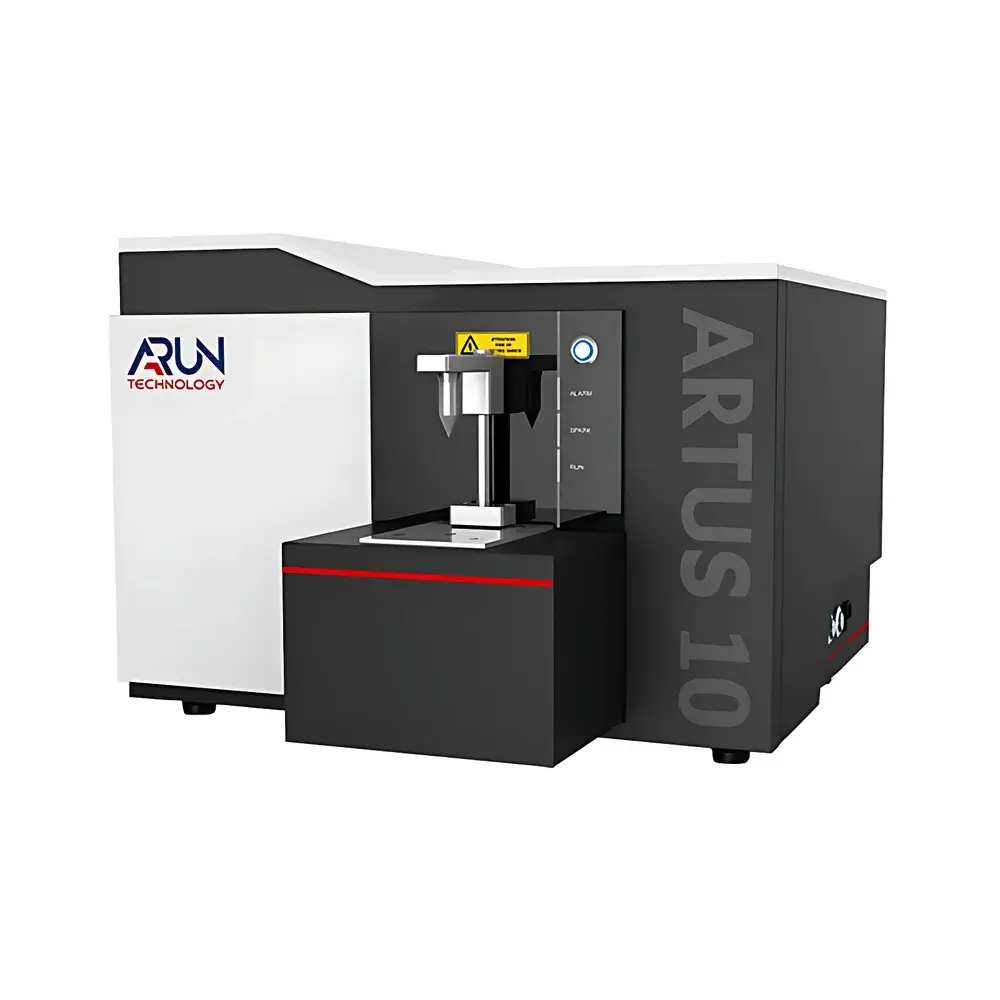
ARUN ARTUS 10 Full-Spectrum Direct-Reading Optical Emission Spectrometer
| Brand | ARUN TECHNOLOGY LTD. |
|---|---|
| Origin | United Kingdom |
| Instrument Type | Benchtop |
| Excitation Source | Spark Discharge |
| Detector | Cooled Scientific-Grade A-CMOS Array |
| Wavelength Range | 130–700 nm |
| Optical Configuration | Dual-Optical-Path System |
| Element Coverage | ≥40 elements across Fe, Al, Cu, Ni, Zn, Mg, Co, Ti, Sn, Pb matrices |
| Detection Limit | ≤1 ppm (C, P, S, N with cryogenic cooling) |
| Compliance | Designed for ISO/IEC 17025-compliant laboratories |
Overview
The ARUN ARTUS 10 is a benchtop full-spectrum direct-reading optical emission spectrometer (OES) engineered for high-precision elemental analysis of metallic alloys and ultra-pure metals. It operates on the principle of spark-induced plasma emission spectroscopy: a controlled high-voltage spark ablates a micro-volume of solid metal sample, generating excited atoms and ions whose characteristic atomic emission lines are dispersed by a diffraction grating and resolved across a broad spectral range (130–700 nm). Unlike traditional PMT-based or standard CCD spectrometers, the ARTUS 10 integrates a custom-designed, thermoelectrically cooled A-CMOS detector — an innovation developed over three decades of ARUN’s UK-based R&D in analytical spectroscopy. This detector architecture enables simultaneous acquisition of the entire spectrum with high quantum efficiency, low read noise, and intrinsic stability — eliminating mechanical scanning and enabling true multi-element quantification without sequential wavelength selection.
Key Features
- Cooled A-CMOS Detection Platform: Features an 8192-pixel scientific-grade A-CMOS sensor with active thermoelectric cooling (−10 °C), delivering enhanced signal-to-noise ratio and extended dynamic range — particularly critical for trace-level UV-emitting elements (C, P, S, N).
- Dual-Optical-Path Architecture: Separates UV (130–200 nm) and VIS-NIR (200–700 nm) spectral regions into dedicated optical channels. The UV path operates under argon-purged, non-vacuum conditions — removing reliance on vacuum pumps, oil contamination risks, and mechanical deformation from pressure differentials.
- OEO (Optimal Element-Oriented) Signal Processing: Enables pixel-level spectral extraction: each element’s analytical line is assigned to a specific, optimized subset of detector pixels, decoupling calibration parameters (integration time, background correction, gain) per element — maximizing accuracy and reproducibility.
- RTMC (Real-Time Multi-Channel Calibration) Technology: Dynamically adjusts spectral baseline, peak shape, and inter-element interference corrections during acquisition — compensating for matrix effects and spark variability without user intervention.
- ASR (Abnormal Spark Rejection) Algorithm: Identifies and excludes outlier sparks caused by surface oxides, inclusions, or microstructural heterogeneity — improving measurement robustness and reducing relative standard deviation (RSD) below 0.5% for major constituents.
- Monolithic Aluminum Alloy Optical Chamber: Precision-cast and subjected to four-stage stress-relief annealing, coupled with active thermal stabilization (±0.1 °C), ensures long-term wavelength registration stability — eliminating need for routine drift correction over multi-year operational cycles.
Sample Compatibility & Compliance
The ARTUS 10 supports standardized solid metal sampling per ASTM E415, ISO 11577, and GB/T 4336. It accommodates flat, cylindrical, and irregularly shaped samples (diameter ≥10 mm, thickness ≥5 mm) across ten primary metallic matrices: Fe, Al, Cu, Ni, Zn, Mg, Co, Ti, Sn, and Pb. Its dual-optical design ensures reliable quantification of light elements — including nitrogen (N), phosphorus (P), sulfur (S), and carbon (C) — at sub-ppm levels in high-purity copper, aluminum, titanium, and specialty steels. The system complies with analytical data integrity frameworks required in regulated environments: full electronic audit trail, user-access controls, instrument-event logging, and secure raw-data archiving — fully aligned with FDA 21 CFR Part 11, EU Annex 11, and ISO/IEC 17025 Clause 7.7.
Software & Data Management
Controlled via A-Care™ — ARUN’s cloud-integrated software platform — the ARTUS 10 delivers remote diagnostics, over-the-air firmware updates, and predictive maintenance alerts. All analytical workflows are implemented through a unified graphical interface: method creation, calibration management, sample registration, and report generation occur within a single screen. Calibration models are matrix-independent and stored as portable XML files; switching between control samples (e.g., from low-alloy steel to aluminum alloy) requires no model reloading or reinitialization. Raw spectral data (full 8192 × 1 array per spark) is preserved alongside processed results, supporting retrospective reprocessing, multivariate outlier detection, and laboratory information management system (LIMS) integration via ASTM WK53295-compliant API.
Applications
- Ultra-trace impurity profiling in high-purity metals (e.g., 6N Al, 5N Cu, aerospace-grade Ti alloys)
- Acid-soluble residue (ASR) and inclusion analysis in bearing steels and transformer core materials
- Process control in foundries, secondary smelters, and precision casting facilities
- Verification of specification compliance for ASTM, EN, JIS, and GB standards in incoming raw material inspection
- Research applications requiring high-resolution spectral deconvolution of overlapping emission lines (e.g., V 309.310 nm / Fe 309.321 nm)
FAQ
Does the ARTUS 10 require vacuum pumping for UV analysis?
No — the UV optical path uses continuous argon purging at controlled flow rate and pressure, eliminating vacuum pumps, associated maintenance, and risk of oil backstreaming.
Can the same calibration be used across different base metals?
Calibration models are matrix-specific by design; however, the A-Care software supports rapid model switching and cross-matrix interpolation using certified reference materials (CRMs) traceable to NIST or BAM.
Is raw spectral data export supported?
Yes — full-resolution intensity arrays (wavelength vs. intensity) are stored in HDF5 format and exportable for third-party chemometric analysis.
What is the recommended maintenance interval?
Optical chamber purge gas filters: every 6 months; spark stand electrodes: after 10,000–15,000 sparks; A-CMOS cooling system health check: annually — all tracked automatically via A-Care.
How is data integrity ensured during remote operation?
All remote sessions are encrypted (TLS 1.3), logged with timestamped operator ID, and subject to role-based access control — satisfying ALCOA+ principles (Attributable, Legible, Contemporaneous, Original, Accurate, Complete, Consistent, Enduring, Available) for GxP-regulated use.




