
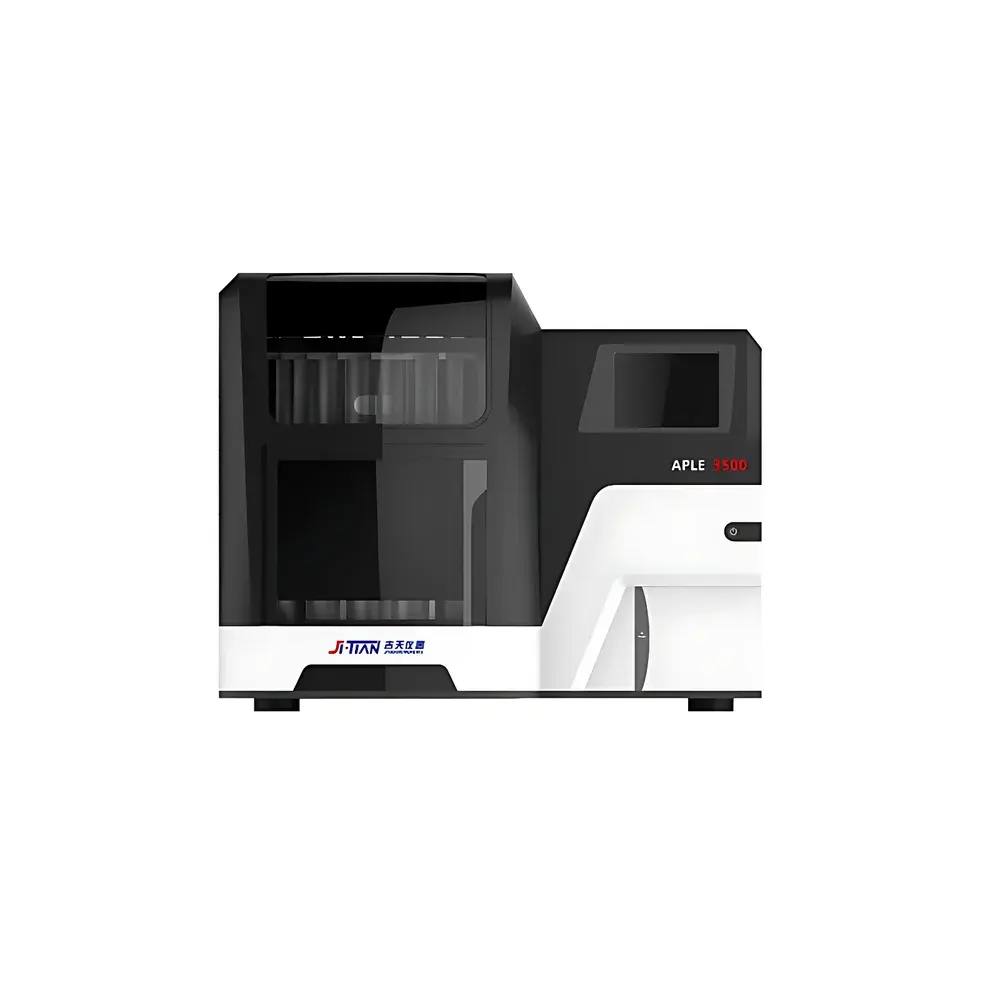
Titan Instruments APLE-3500 Automated Pressurized Liquid Extractor
| Brand | Titan Instruments |
|---|---|
| Origin | Beijing, China |
| Model | APLE-3500 |
| Extraction Pressure | Up to 20 MPa |
| Temperature Range | Ambient to 200 °C |
| Pump Flow Rate | 100 mL/min |
| Extraction Cell Volumes | 1, 5, 11, 22, 34, 66, and 100 mL |
| Cycle Time per Sample | <20 min |
| Solvent Consumption (typical) | ≥1.5 mL per 1 g sample |
| Compliance | EPA Method 3545, HJ 782–2016, HJ 783–2016 |
Overview
The Titan Instruments APLE-3500 Automated Pressurized Liquid Extractor is an engineered solution for high-efficiency, reproducible solid-phase sample extraction under elevated temperature and pressure conditions. Based on the principle of pressurized liquid extraction (PLE), the system accelerates mass transfer kinetics by simultaneously applying controlled heat (up to 200 °C) and pressure (up to 20 MPa), thereby enhancing solvent penetration into matrix pores and improving analyte desorption. Unlike conventional Soxhlet or ultrasonic extraction, PLE minimizes thermal degradation risk while achieving rapid, quantitative recovery of thermally labile and semi-volatile organic compounds. Designed for routine use in environmental, food safety, agricultural, and polymer testing laboratories, the APLE-3500 delivers robust performance aligned with internationally recognized regulatory frameworks—including U.S. EPA Method 3545 and Chinese environmental standards HJ 782–2016 and HJ 783–2016.
Key Features
- Modular extraction cell architecture offering seven standardized volumes (1, 5, 11, 22, 34, 66, and 100 mL) to accommodate diverse sample masses and matrix types—from trace soil extracts to bulk polymer additives.
- 360° circumferential heating furnace ensuring uniform thermal distribution across the entire extraction cell surface, critical for consistent extraction efficiency and inter-sample reproducibility.
- Integrated active cooling system enabling rapid thermal equilibration between sequential runs, reducing turnaround time without compromising method integrity.
- High-capacity dual-piston high-pressure pump delivering stable flow at up to 100 mL/min, maintaining precise pressure control throughout the extraction cycle.
- Single-needle collection design with precision vertical alignment to prevent cross-contamination, minimize solvent splashing, and extend septum life in autosampler vials.
- High-resolution capacitive touchscreen interface supporting real-time monitoring of temperature, pressure, elapsed time, and solvent delivery status—enabling immediate operator intervention if required.
- Configurable method editor supporting both sequential and batch-mode operation, with independent parameter assignment per extraction cell within a single run sequence.
Sample Compatibility & Compliance
The APLE-3500 accommodates heterogeneous solid and semi-solid matrices including soils, sediments, plant tissues (e.g., fruits, tea leaves), animal feed, food commodities, and synthetic polymers. Its compatibility with common organic solvents (e.g., acetone, dichloromethane, ethyl acetate, hexane, and methanol) supports broad-spectrum analyte recovery. The instrument’s operational parameters are validated against EPA Method 3545 for polycyclic aromatic hydrocarbons (PAHs), polychlorinated biphenyls (PCBs), and organochlorine pesticides in environmental solids. In China, it meets the technical requirements of HJ 782–2016 (determination of organophosphorus pesticides in soil and sediment) and HJ 783–2016 (determination of organochlorine pesticides and PCBs). While not certified for GLP or 21 CFR Part 11 out-of-the-box, its audit-ready data logging architecture supports integration into validated workflows requiring electronic record retention and user-access controls.
Software & Data Management
The embedded control software provides intuitive method development with granular control over extraction temperature ramping profiles, static/dynamic cycle timing, purge duration, and rinse volume. All method parameters—including operator ID, timestamp, cell ID, and final solvent volume—are automatically logged to internal memory and exportable via USB. Sequence files retain full metadata for traceability, facilitating compliance with ISO/IEC 17025 documentation requirements. Optional PC-based software enables remote monitoring, report generation (PDF/CSV), and integration with LIMS environments through standard TCP/IP protocols. Audit trails capture all parameter modifications, user logins, and system alerts—supporting laboratory quality assurance practices.
Applications
- Environmental analysis: Quantitative recovery of PAHs, PCBs, organochlorine pesticides, phthalates, and flame retardants from soil, sediment, and sludge samples.
- Food safety testing: Extraction of multi-residue pesticides from fruits, vegetables, grains, and tea; veterinary drug residues (e.g., sulfonamides, tetracyclines) from animal feed and muscle tissue.
- Polymer characterization: Isolation of plasticizers (e.g., DEHP), antioxidants (e.g., BHT), UV stabilizers, and flame retardants (e.g., TBBPA) from polyolefins, PVC, and engineering resins.
- Pharmaceutical excipient screening: Recovery of residual solvents and leachables from tablet coatings and packaging materials.
- Forensic and customs labs: Rapid preparation of seized material for subsequent GC-MS or LC-MS/MS analysis.
FAQ
What regulatory methods does the APLE-3500 support?
It is fully compatible with U.S. EPA Method 3545 and Chinese national standards HJ 782–2016 and HJ 783–2016.
Can the APLE-3500 perform online cleanup during extraction?
Yes—it supports inline solid-phase extraction (SPE) cartridge integration prior to collection, reducing co-extractives and minimizing post-extraction clean-up steps.
Is method validation data available for the APLE-3500?
Titan Instruments provides application notes and recovery studies for representative analytes; full validation packages may be developed in collaboration with end-user laboratories per ISO 17025 guidelines.
What maintenance is required for long-term reliability?
Routine checks include pump seal inspection, heater calibration verification annually, and periodic cleaning of solvent lines and needle ports—no proprietary tools are required.
Does the system support unattended overnight operation?
Yes—the APLE-3500 includes automatic shutdown, leak detection, and thermal overload protection, enabling secure unattended sequencing of up to 24 samples.



