
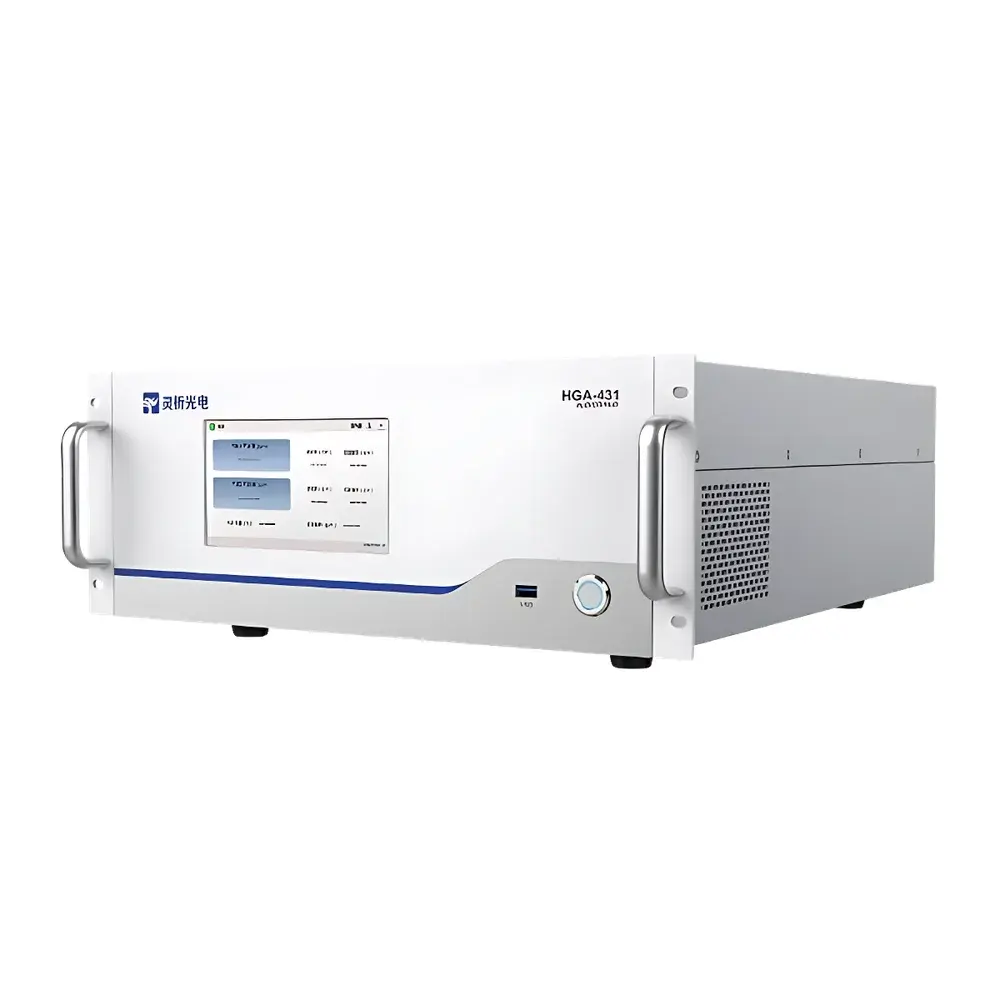
Lingxi Optoelectronics HGA-431 High-Precision Greenhouse Gas Analyzer
| Brand | Lingxi Optoelectronics |
|---|---|
| Origin | Zhejiang, China |
| Model | HGA-431 |
| Detection Gases | N₂O, CO, H₂O |
| Measurement Range | 1–1500 ppb |
| Sensitivity | Sub-ppt (≤0.1 ppt) |
| Compliance | WMO Compatibility for Atmospheric Monitoring Stations |
| Water Vapor Correction | Integrated proprietary algorithm for dilution correction and dry-mole-fraction output |
| Technology | Mid-Infrared Cavity Ring-Down Spectroscopy (Mid-IR CRDS) |
| Environmental Rating | Industrial-grade enclosure for continuous unattended operation |
Overview
The Lingxi Optoelectronics HGA-431 High-Precision Greenhouse Gas Analyzer is a compact, field-deployable trace gas measurement system engineered for continuous, real-time quantification of nitrous oxide (N₂O), carbon monoxide (CO), and water vapor (H₂O) in ambient air. It employs mid-infrared cavity ring-down spectroscopy (Mid-IR CRDS), a highly selective and sensitive absorption-based optical technique that achieves sub-part-per-trillion (sub-ppt) detection limits within the 1–1500 ppb dynamic range. The instrument operates on the physical principle of measuring the exponential decay time of laser light trapped within a high-finesse optical cavity—where trace gas concentration is directly proportional to the change in ring-down time induced by molecular absorption at specific mid-IR vibrational-rotational transitions. This architecture eliminates moving parts and optical misalignment risks, contributing to exceptional long-term stability. Designed to meet the stringent performance specifications outlined by the World Meteorological Organization (WMO) for global atmospheric monitoring stations—including baseline observatories and regional networks—the HGA-431 delivers metrologically traceable, interference-resistant measurements suitable for regulatory-grade environmental reporting and climate science applications.
Key Features
- Sub-ppt sensitivity and precision for N₂O and CO over 1–1500 ppb range, verified via independent calibration against NIST-traceable standards
- Integrated thermally stabilized optical cavity and pressure-regulated sample path, enabling <±0.5 ppb/month baseline drift under continuous operation
- Real-time, algorithm-driven water vapor correction: simultaneous H₂O measurement enables stoichiometric dilution compensation, yielding dry-mole-fraction outputs for N₂O and CO per WMO GAW guidelines
- Robust industrial enclosure rated IP54, with internal temperature and pressure control loops ensuring consistent spectral line shape and minimal thermal broadening
- Zero external consumables: no carrier gases, scrubbers, or reagents required; maintenance interval ≥12 months under typical field conditions
- Onboard diagnostics including cavity mirror reflectivity monitoring, laser wavelength lock verification, and signal-to-noise ratio trending
Sample Compatibility & Compliance
The HGA-431 accepts standard 1/4″ OD stainless steel or PFA sample lines with flow rates of 0.5–2.0 L/min. It is compatible with both ambient air sampling (via heated inlet lines to prevent condensation) and extracted stack or duct gas streams conditioned to <40 °C and <90% RH. All measurements adhere to ISO 14644-1 cleanroom air classification protocols for background contamination control during calibration. The analyzer satisfies key requirements of WMO Global Atmosphere Watch (GAW) Station Performance Specifications for N₂O and CO, including detection limit ≤0.05 ppt (1σ, 100 s averaging), accuracy ±0.1 ppb (relative to NOAA CMDL reference scale), and inter-laboratory comparability <0.3 ppb. While not certified for FDA 21 CFR Part 11 compliance out-of-the-box, its audit trail functionality supports GLP/GMP-aligned deployment when integrated with validated data acquisition systems.
Software & Data Management
The embedded Linux-based firmware provides a secure web interface (HTTPS/TLS 1.2) for remote configuration, real-time spectral visualization, and diagnostic logging. Raw ring-down decay curves, calibrated mole fractions, cavity pressure/temperature telemetry, and alarm status are streamed via Modbus TCP or MQTT to SCADA or cloud platforms (e.g., AWS IoT Core, Azure IoT Hub). Data export formats include CSV (time-stamped, UTC-synchronized) and NetCDF4 compliant with CF Metadata Conventions v1.8. Firmware updates are delivered via signed package files with SHA-256 verification. Audit logs record all user actions, parameter changes, and calibration events with immutable timestamps—enabling full traceability for ISO/IEC 17025-accredited laboratories.
Applications
- Urban and regional atmospheric monitoring networks requiring long-term trend analysis of N₂O and CO as proxies for combustion efficiency and agricultural emissions
- Industrial facility boundary monitoring for regulatory compliance with national GHG reporting frameworks (e.g., China’s MRV system, EU ETS Tier 3)
- Carbon flux studies using eddy covariance towers, where precise co-measurement of CO aids in partitioning fossil vs. biogenic sources
- Calibration transfer and intercomparison campaigns among GAW stations, leveraging its WMO-compliant stability and traceability
- Mobile platform integration (e.g., research aircraft, ground vehicles) due to its low power draw (<120 W) and shock/vibration tolerance (MIL-STD-810G)
FAQ
What calibration standards are required for routine operation?
The HGA-431 requires quarterly span calibration using two certified gas standards: one near the lower detection limit (e.g., 0.5 ppb N₂O in synthetic air) and one near mid-range (e.g., 500 ppb CO). Zero gas must be CO- and N₂O-free synthetic air with <10 ppt total hydrocarbon content.
Can the instrument operate unattended for extended periods?
Yes. With scheduled automated zero/span checks and environmental telemetry, the HGA-431 supports >6 months of continuous operation without manual intervention, provided inlet filtration and power stability meet IEC 61000-4-30 Class S requirements.
Is dry-mole-fraction output configurable for other gases?
No. Dry-mole-fraction correction is implemented only for N₂O and CO using the concurrently measured H₂O signal. Additional gas species would require hardware-level spectral reconfiguration and separate validation.
Does the analyzer meet EPA Method TO-15 or ISO 12039 requirements?
While not formally validated under those specific methods, its Mid-IR CRDS architecture inherently avoids chromatographic interferences and meets or exceeds their stated detection limits and precision criteria for N₂O and CO in ambient air matrices.
How is data integrity ensured during network outages?
Internal storage retains 30 days of second-by-second raw and processed data. Upon network recovery, buffered records are transmitted with sequence-numbered acknowledgments to prevent duplication or loss.
Related Products







