
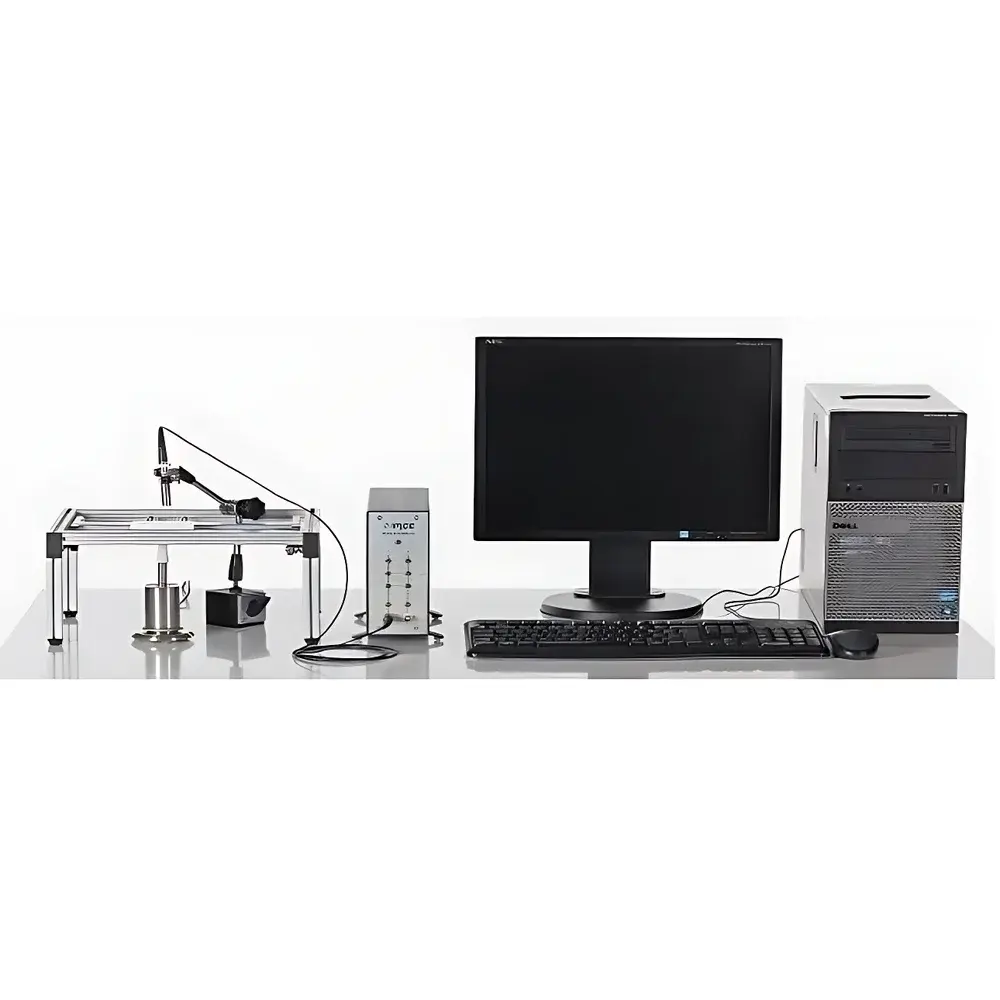
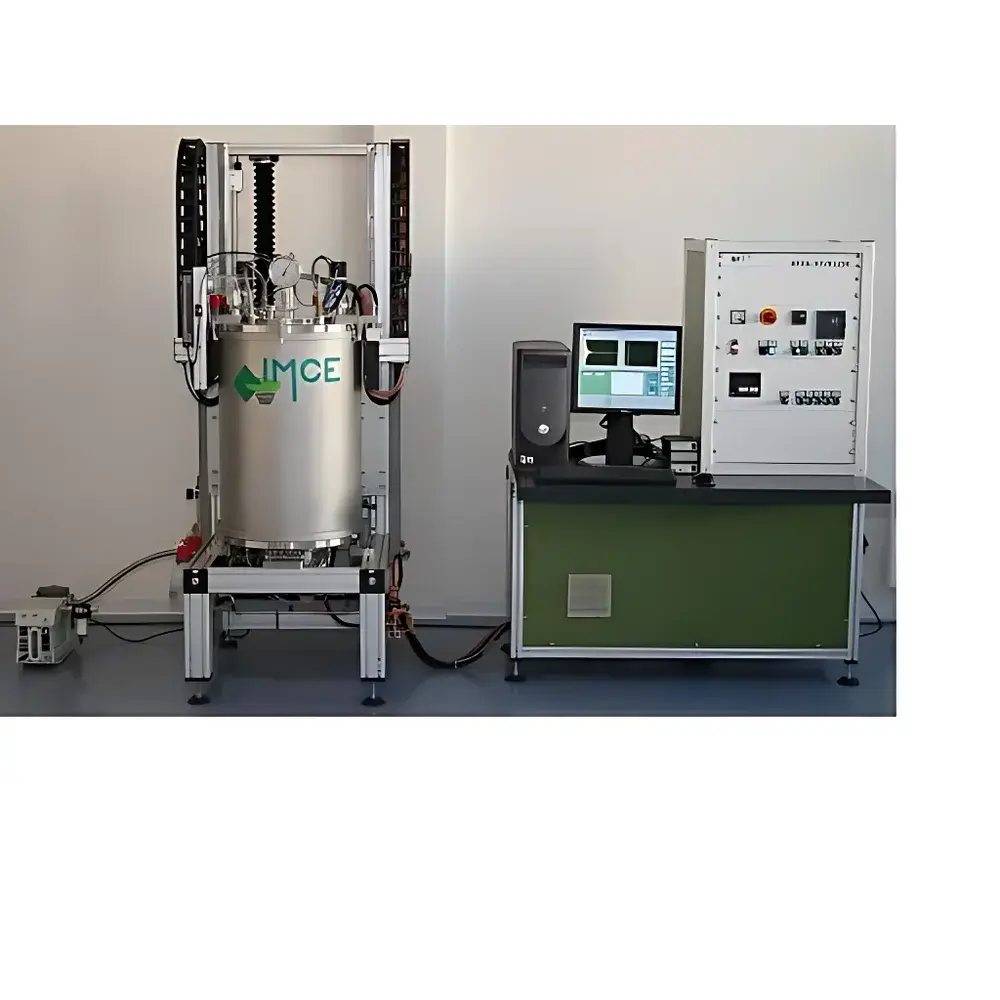
IMCE RFDA MF Professional Resonant Frequency, Elastic Modulus & Damping Analyzer
| Brand | IMCE |
|---|---|
| Model | RFDA MF Professional |
| Origin | Belgium |
| Application | Non-destructive dynamic mechanical characterization of ceramics, metals, and advanced materials |
| Temperature Range | Ambient to 1750 °C |
| Atmosphere Control | Yes |
| Damping Measurement Range | 1×10⁻⁵ to 0.1 (dimensionless) |
| Measured Parameters | Resonant frequency, elastic modulus (E), shear modulus (G), Poisson’s ratio (ν), internal damping (Q⁻¹ or tan δ) |
| Compliance | ASTM E1876, ISO 12680, DIN 51045-1, applicable to GLP/GMP environments with audit trail enabled in RFDA MF Software |
Overview
The IMCE RFDA MF Professional is a high-precision resonant frequency and dynamic mechanical analyzer engineered for non-destructive, contactless determination of fundamental elastic and viscoelastic properties of solid materials. It operates on the principle of free-free flexural and torsional resonance—exciting specimens acoustically or electromagnetically and analyzing the resulting natural vibration modes using high-sensitivity laser Doppler vibrometry or piezoelectric transduction. From these resonance spectra, the system calculates Young’s modulus (E), shear modulus (G), Poisson’s ratio (ν), and internal damping (tan δ or Q⁻¹) with traceable uncertainty derived from modal analysis and dimensional metrology. Unlike static or quasi-static testing methods, the RFDA MF Professional delivers intrinsic material behavior under dynamic loading conditions, making it indispensable for R&D laboratories and quality control departments evaluating structural ceramics, refractory metals, composites, and additively manufactured components where microstructural integrity must be preserved during evaluation.
Key Features
- True non-destructive operation: No sample machining, clamping, or applied stress beyond acoustic excitation—preserving microstructure and surface integrity.
- Simultaneous multi-parameter extraction: Single measurement yields resonant frequencies (flexural, torsional, longitudinal), elastic modulus, shear modulus, Poisson’s ratio, and damping loss factor.
- Dynamic method flexibility: Supports both linear viscoelastic regime analysis and controlled non-linear excitation for amplitude-dependent property mapping.
- Modular high-temperature integration: Compatible with IMCE’s RFDA-HTVP series furnaces (up to 1750 °C) featuring precise atmosphere control (inert, reducing, oxidizing, vacuum).
- Robust mechanical architecture: Vibration-isolated optical bench, temperature-stabilized signal conditioning, and electromagnetic shielding for high signal-to-noise ratio in industrial lab environments.
Sample Compatibility & Compliance
The RFDA MF Professional accommodates standard bar, rod, disc, and ring geometries (typical dimensions: 1–10 mm thickness, 10–100 mm length/diameter), including as-sintered or as-cast specimens without surface finishing. It is validated for use with oxide and non-oxide ceramics (Al₂O₃, SiC, ZrO₂), superalloys (Inconel, Hastelloy), titanium alloys, and CMCs. System compliance aligns with ASTM E1876 (“Standard Test Method for Dynamic Young’s Modulus, Shear Modulus, and Poisson’s Ratio by Sonic Resonance”), ISO 12680-1 (“Fine ceramics — Determination of elastic modulus — Resonance method”), and DIN 51045-1. When configured with RFDA MF Software v5.2+ and timestamped audit trails, the platform meets data integrity requirements for GLP and GMP-regulated environments per FDA 21 CFR Part 11 guidelines.
Software & Data Management
The RFDA MF Software provides full instrument control, real-time spectral acquisition, automated mode identification, and ISO-compliant reporting. It includes built-in curve-fitting algorithms based on Euler–Bernoulli and Timoshenko beam theory, with correction factors for finite aspect ratio and boundary condition deviations. Raw FFT spectra, modal shape visualization, temperature-dependent property plots, and statistical batch analysis are exportable in CSV, HDF5, and PDF formats. Version-controlled software updates, user role management (admin/operator/auditor), and electronic signature support ensure regulatory readiness. Data backups are encrypted and time-stamped, with optional integration into LIMS via RESTful API.
Applications
- Quality assurance of sintered ceramic components in aerospace and biomedical manufacturing.
- High-temperature modulus tracking during thermal cycling of turbine blade coatings.
- Correlation of damping behavior with microcrack density in nuclear-grade graphite.
- Validation of additive manufacturing process parameters via in-situ post-build elastic property mapping.
- Fundamental research on anelastic relaxation mechanisms in shape-memory alloys and ferroelectrics.
FAQ
What sample preparation is required?
Minimal preparation: Samples must be geometrically regular and free of surface cracks or large voids. No polishing, coating, or mounting is necessary—only dimensional measurement (caliper/micrometer) prior to placement on soft support points.
Can the system operate under reactive atmospheres?
Yes—when coupled with RFDA-HTVP high-temperature modules, it supports N₂, Ar, H₂/N₂ mixtures, CO/CO₂, air, and vacuum down to 10⁻³ mbar, with programmable gas flow and pressure regulation.
Is calibration traceable to national standards?
Yes—frequency calibration uses NIST-traceable reference oscillators; dimensional calibration employs certified gauge blocks; temperature calibration follows ITS-90 via dual-point thermocouple verification.
How is damping quantified, and what is its physical significance?
Damping is calculated as tan δ = 1/Q, derived from the half-power bandwidth of resonance peaks. It reflects energy dissipation mechanisms—including dislocation motion, grain boundary sliding, and phase transformation hysteresis—critical for predicting fatigue life and thermo-mechanical stability.
Does the system support custom test protocols?
Yes—users can define multi-step temperature ramps, dwell sequences, and excitation amplitude sweeps via scripting interface, with full parameter logging and inter-step correlation analysis.



