
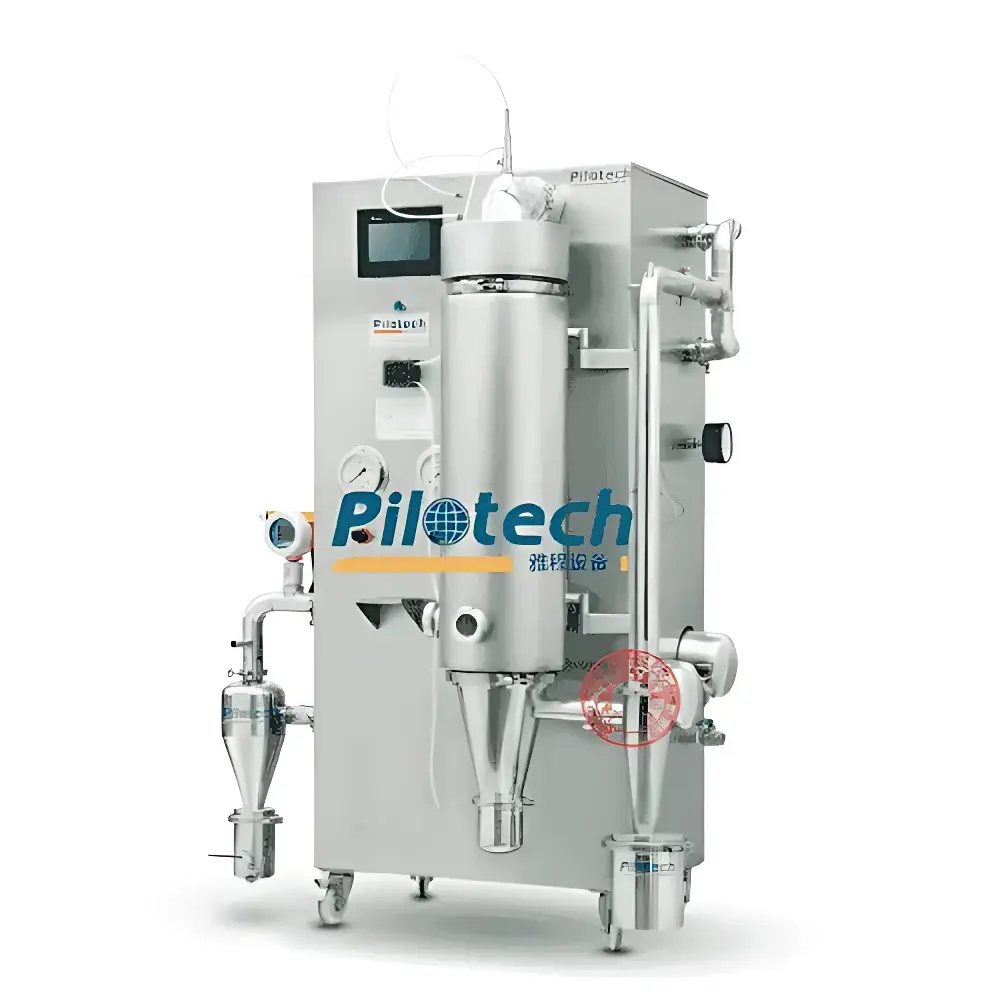
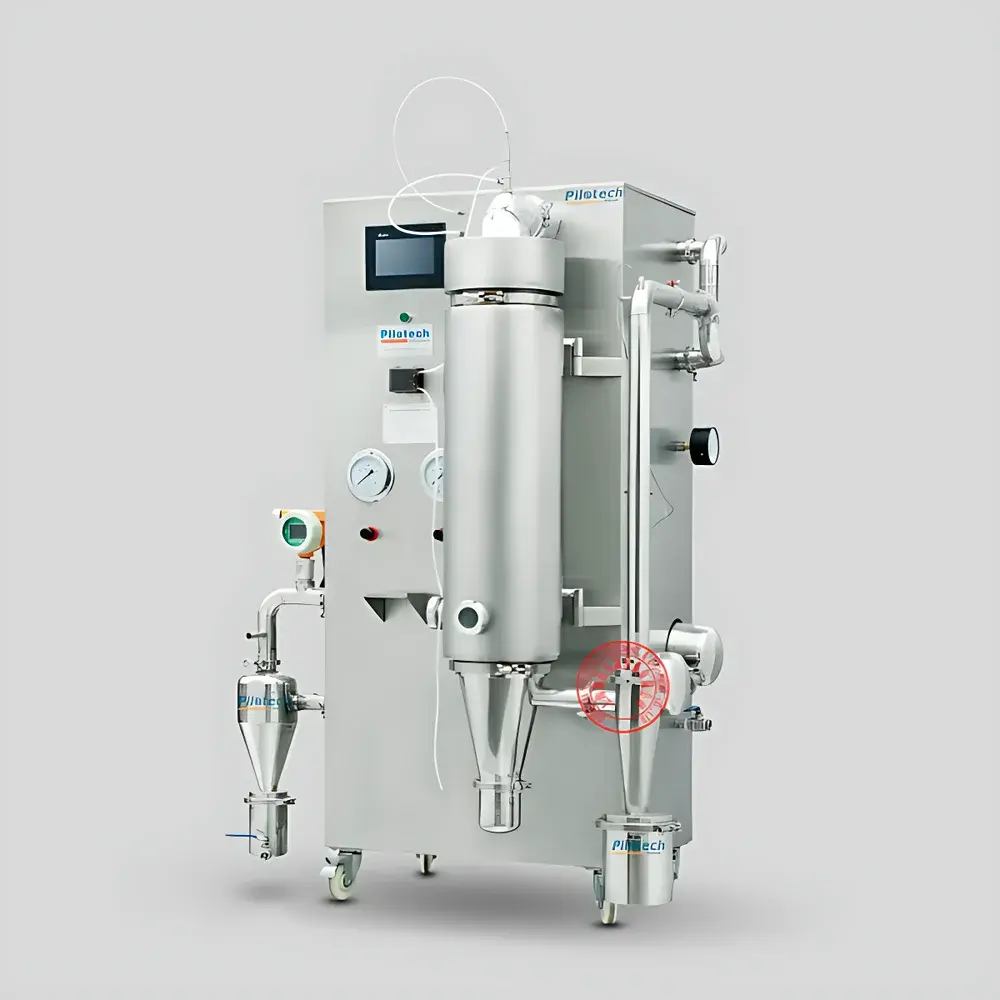
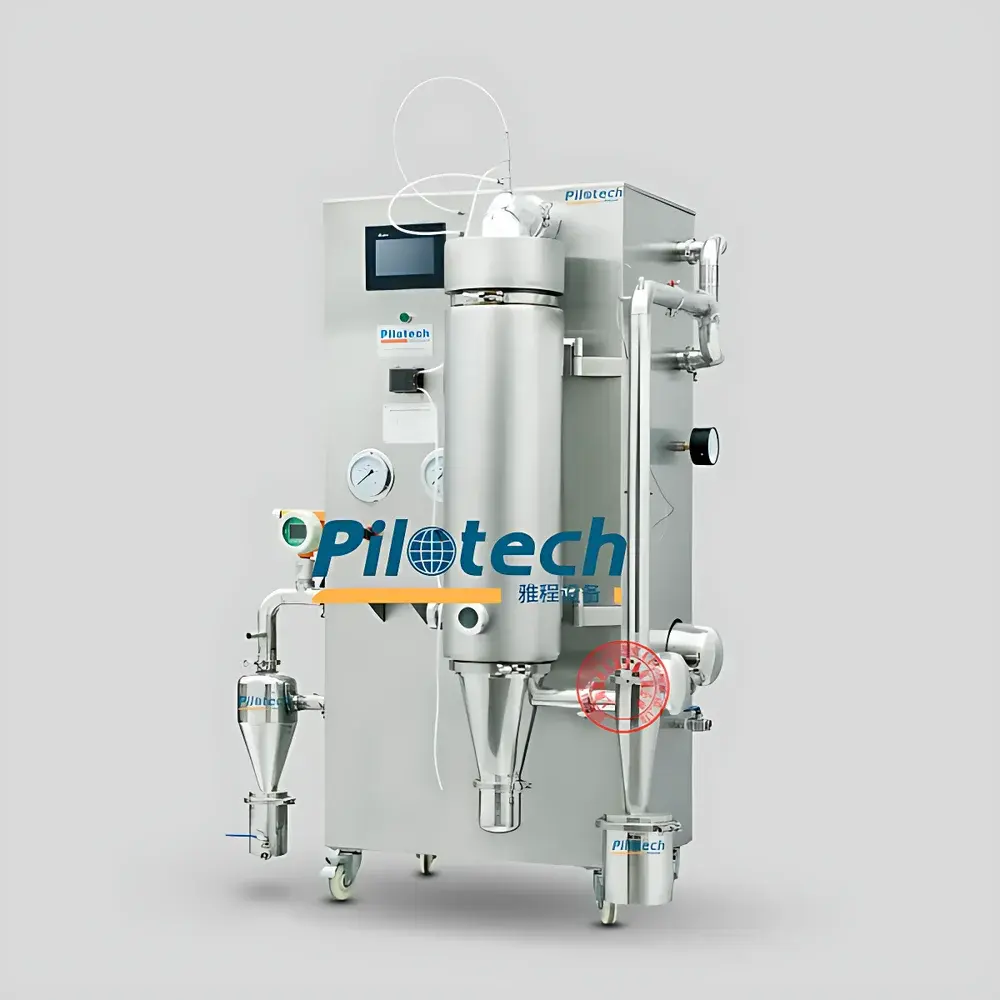
雅程 YC-019A Closed-Loop Organic Solvent Spray Dryer (5 L/h Capacity)
| Brand | YaCheng / PILOTECH |
|---|---|
| Origin | Shanghai, China |
| Manufacturer Type | Direct Manufacturer |
| Product Origin | Domestic (China) |
| Model | YC-019A |
| Sample Compatibility | Aqueous, Organic, and Mixed Solvent Systems |
| Maximum Feed Rate | 5000 mL/h |
| Inlet Air Temperature Range | Up to 280 °C |
| Particle Size Output | 3–100 µm |
| Oxygen Monitoring Threshold | Auto-Shutdown at ≥2.5% O₂ |
| Nozzle Orifice | Standard 2.0 mm (Optional: 0.5 / 0.8 / 1.0 / 1.5 mm) |
| Temperature Control Accuracy | ±2 °C (PID-regulated) |
| Integrated Solvent Recovery | Yes (via Condenser + Heat Exchanger) |
| Optional | Low-Temperature Chiller Integration for Volatile Solvents |
Overview
The YaCheng YC-019A Closed-Loop Organic Solvent Spray Dryer is an engineered laboratory-scale drying system designed for the safe, reproducible, and scalable conversion of heat-sensitive liquid feeds—including aqueous, organic, and mixed-phase solutions—into free-flowing microparticulate powders. Unlike conventional open-loop spray dryers, the YC-019A operates on a fully sealed nitrogen-based recirculation principle grounded in inert gas thermofluid dynamics. Liquid feed is atomized via a concentric nozzle under controlled nitrogen sheath flow, then rapidly dried by heated nitrogen (up to 280 °C inlet temperature) in a negative-pressure drying chamber. Evaporated solvent vapors are continuously cooled through an integrated heat exchanger and condensed in a cryogenic or ambient condenser unit, enabling >95% solvent recovery efficiency. The residual nitrogen stream—stripped of vapor and oxygen—is filtered, reheated, and reintroduced into the cycle. This closed architecture eliminates exposure to ambient oxygen, mitigating fire/explosion hazards associated with flammable solvents (e.g., acetone, ethanol, THF, dichloromethane), while simultaneously preventing oxidative degradation of labile compounds such as peptides, enzymes, liposomes, and active pharmaceutical ingredients (APIs).
Key Features
- Inert Gas Safety Architecture: Real-time oxygen concentration monitoring (0–25% range) with automatic emergency shutdown if O₂ exceeds 2.5%—compliant with IEC 60079-0 explosion protection guidelines for laboratory equipment handling Class I flammable vapors.
- Concentric Dual-Flow Nozzle: Precision-machined 2.0 mm standard orifice (optional sizes: 0.5/0.8/1.0/1.5 mm) ensures symmetrical atomization without wall impingement, maximizing powder yield and minimizing residue buildup in the drying chamber.
- Modular Solvent Recovery System: Integrated air-cooled or chiller-coupled condensation unit enables efficient capture and reuse of low-boiling-point solvents; optional low-temperature cooling pump support extends operational range to solvents with boiling points below 40 °C (e.g., diethyl ether, pentane).
- PLC-Controlled Touch Interface: 7-inch color touchscreen with intuitive Chinese/English bilingual UI displays and logs critical process parameters: inlet temperature, peristaltic pump speed (0.1–99.9 rpm), needle cleaning frequency, and real-time O₂ concentration.
- Thermal Safety Protocol: Post-run cooldown sequence maintains fan operation until chamber temperature falls below 60 °C—preventing thermal shock, residual solvent ignition risk, and operator error-induced premature shutdown.
- Corrosion-Resistant Fluid Path: All wetted components—including fan housing, ductwork, and cyclone separator—are constructed from electropolished stainless steel (SS316L) or PTFE-lined materials, ensuring long-term compatibility with aggressive organic media.
Sample Compatibility & Compliance
The YC-019A accommodates diverse feedstock chemistries, including water-based emulsions, ethanol/water mixtures, chlorinated hydrocarbon solutions, and polar aprotic systems (e.g., DMF, DMSO). Its low minimum feed volume (100 mL) supports early-stage formulation screening, while its 5 L/h throughput enables pilot-scale batch production suitable for GLP-compliant preclinical studies. The system meets essential requirements for ISO 9001-certified manufacturing environments and aligns with core elements of FDA 21 CFR Part 11 for electronic record integrity—particularly when paired with optional audit-trail-enabled data logging software. Oxygen-controlled operation satisfies ASTM E2018-22 standards for inert-atmosphere processing of oxidation-prone biologics and nanocarriers.
Software & Data Management
Embedded firmware supports time-stamped parameter logging at user-defined intervals (1–60 sec), exporting CSV-formatted datasets compatible with MATLAB, JMP, and Python-based statistical process control (SPC) workflows. Optional Ethernet/Wi-Fi connectivity enables remote monitoring and integration into centralized laboratory information management systems (LIMS). All temperature and flow setpoints are PID-regulated with ±2 °C stability, and historical run files include metadata tags for sample ID, operator name, and environmental conditions—facilitating traceability during regulatory audits under GMP Annex 11 or ICH Q5C stability protocols.
Applications
- Encapsulation of proteins, vaccines, and mRNA-LNPs into inhalable or injectable dry powders
- Rapid prototyping of solvent-based nanoparticle suspensions (e.g., PLGA, chitosan, lipid nanoparticles)
- Drying of thermolabile natural extracts (curcumin, resveratrol, anthocyanins) without degradation
- Production of catalyst precursors and metal-organic framework (MOF) powders from alcoholic sol-gels
- Recovery and reconstitution of high-value fine chemicals after extraction or synthesis steps
FAQ
Can the YC-019A handle chloroform or carbon tetrachloride?
Yes—provided the optional low-temperature condenser (-20 °C) is installed and nitrogen purity is maintained above 99.995%. Chlorinated solvent vapors require enhanced corrosion-resistant seals and post-condensation activated carbon filtration, available as a custom configuration.
Is validation documentation (IQ/OQ/PQ) available?
Factory-issued IQ/OQ protocols are supplied with each unit; PQ templates and third-party calibration services (traceable to NIST standards) can be arranged upon request.
What maintenance intervals are recommended?
Nozzle inspection every 200 operating hours; O₂ sensor recalibration every 6 months; condenser coil cleaning after every 50 runs involving high-residue feeds (e.g., polysaccharide solutions).
Does the system comply with ATEX directives?
While not ATEX-certified as a complete unit, the YC-019A’s intrinsic safety design—including explosion-proof motor housings, static-dissipative tubing, and O₂ interlock—meets the functional safety criteria outlined in EN 60079-11 for Zone 2 environments when operated within specified solvent vapor limits.
Can particle morphology be tuned via process parameters?
Yes—feed concentration, inlet temperature, atomization pressure, and drying residence time collectively influence surface roughness, density, and crystallinity. Empirical DOE studies using Design-Expert® software are routinely conducted to map these relationships for specific formulations.
Related Products



