
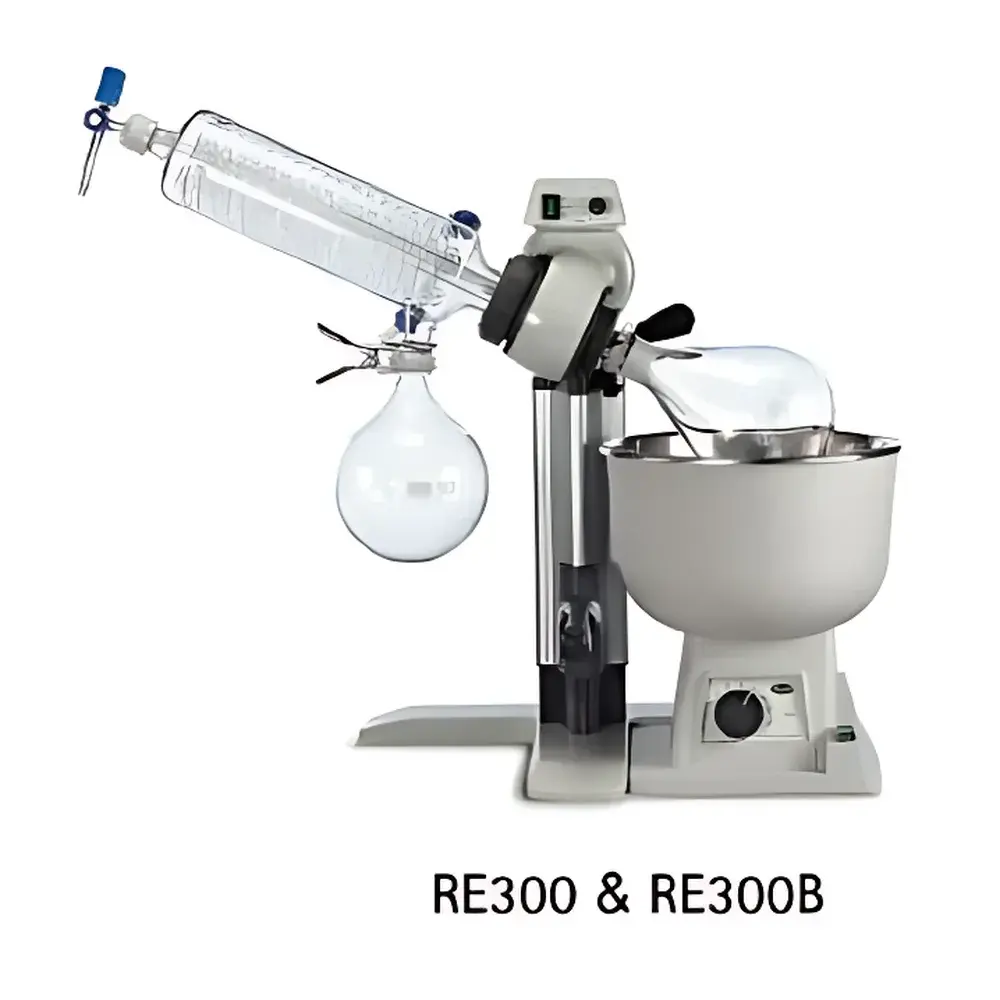
RE-300 Inclined-Coil Condenser
| Origin | Germany |
|---|---|
| Manufacturer Type | Authorized Distributor |
| Origin Category | Imported |
| Pricing | Upon Request |
Overview
The RE-300 Inclined-Coil Condenser is a precision-engineered laboratory condensation module designed for integration into standard distillation and rotary evaporation systems. Unlike vertical or straight-tube condensers, the RE-300 employs a deliberately inclined helical coil geometry—optimized to maximize vapor residence time, enhance thermal contact area, and promote laminar film flow of condensed liquid along the inner wall. This configuration leverages gravity-assisted drainage while minimizing back-pressure and flooding risk during high-boiling-point solvent recovery or heat-sensitive sample concentration. The unit operates on the principle of forced-convection cooling (with circulating coolant) combined with passive surface condensation, delivering consistent thermal transfer performance across a broad range of solvents—from low-boiling diethyl ether (bp 34.6 °C) to high-boiling ethylene glycol (bp 197 °C). It is not a standalone instrument but a modular component engineered for compatibility with ISO-standard ground-glass joints (e.g., ISO 29/32, 24/29), enabling seamless integration into GLP-compliant distillation setups.
Key Features
- Inclined helical coil design ensures extended vapor path length and uniform coolant distribution across the entire condensing surface
- High-purity borosilicate glass 3.3 construction (DIN ISO 3585), resistant to thermal shock (ΔT ≤ 120 K) and compatible with common organic and aqueous solvents
- Optimized inclination angle (15°–20° from horizontal) balances condensate runoff velocity and film thickness for reproducible heat transfer coefficients
- Double-jacketed outer shell accommodates standard coolant circulation (e.g., tap water, chiller units at 5–15 °C)
- Ground-glass joints conforming to ISO 29/32 and ISO 24/29 specifications ensure leak-tight, rotationally stable mounting on distillation heads or rotary evaporator adapters
- No internal moving parts or electronic components—designed for long-term reliability, minimal maintenance, and compatibility with Class A fume hood environments
Sample Compatibility & Compliance
The RE-300 supports condensation of volatile and semi-volatile analytes in compliance with established laboratory practices for solvent recovery and sample enrichment. Its inert glass surface prevents catalytic degradation or adsorption of sensitive compounds—including acids (e.g., acetic, formic), bases (e.g., triethylamine), and polar organics (e.g., DMSO, DMF). While the condenser itself does not perform analytical measurement, its geometric and material specifications align with ASTM E260 and ISO 6425 requirements for distillation apparatus integrity. When integrated into validated evaporation workflows, it contributes to adherence with USP dissolution apparatus qualification and FDA 21 CFR Part 11 data traceability frameworks—provided upstream instrumentation (e.g., temperature controllers, vacuum regulators) maintains audit-ready calibration records.
Software & Data Management
As a passive, non-instrumented component, the RE-300 does not incorporate embedded firmware, sensors, or digital interfaces. Its operational parameters are governed entirely by external system controls—such as chiller temperature setpoints, vacuum pressure regulation, and heating bath ramp profiles. Laboratory information management systems (LIMS) or electronic lab notebooks (ELN) may document its use via configurable metadata fields (e.g., “Condenser Model”, “Coolant Inlet Temp”, “Joint Size”). For GxP-regulated environments, users are advised to include the RE-300 in equipment qualification protocols (IQ/OQ/PQ) as part of the overall distillation train, verifying joint sealing integrity, thermal gradient stability, and absence of glass defects per ASTM C148–22 visual inspection criteria.
Applications
- Solvent removal in natural product isolation (e.g., terpene enrichment from essential oil extracts)
- Concentration of HPLC fractions under reduced pressure without thermal decomposition
- Recovery and reuse of high-purity solvents (e.g., chloroform, hexane, acetone) in QC laboratories performing residual solvent testing per ICH Q3C guidelines
- Distillative purification of reaction mixtures prior to NMR or MS analysis
- Scale-down modeling of industrial wiped-film evaporation processes in process chemistry development
- Teaching laboratories demonstrating fundamental principles of vapor–liquid equilibrium and heat transfer in chemical engineering curricula
FAQ
Is the RE-300 suitable for vacuum distillation at pressures below 10 mbar?
Yes—the inclined-coil geometry reduces vapor velocity and mitigates bumping or entrainment under deep vacuum; however, optimal performance requires coolant temperatures ≤10 °C and controlled feed rate modulation.
Can it be used with aggressive solvents such as concentrated nitric acid or bromine?
No—borosilicate glass 3.3 is incompatible with hot, concentrated oxidizers; consult Corning PYREX® Chemical Resistance Guide before deployment.
Does the RE-300 require periodic recalibration?
No—it is a static glass component; however, visual inspection for star cracks, etching, or joint wear should be included in routine equipment maintenance logs.
What joint sizes are available besides ISO 29/32?
Custom configurations with ISO 24/29, ISO 19/22, and ANSI 24/40 joints are available upon request through authorized distributors.
Is CE marking applicable to this device?
As a non-electrical, non-pressurized glass component, the RE-300 falls outside the scope of CE directives; however, it complies with DIN EN 13823 for laboratory glassware safety classification.



