
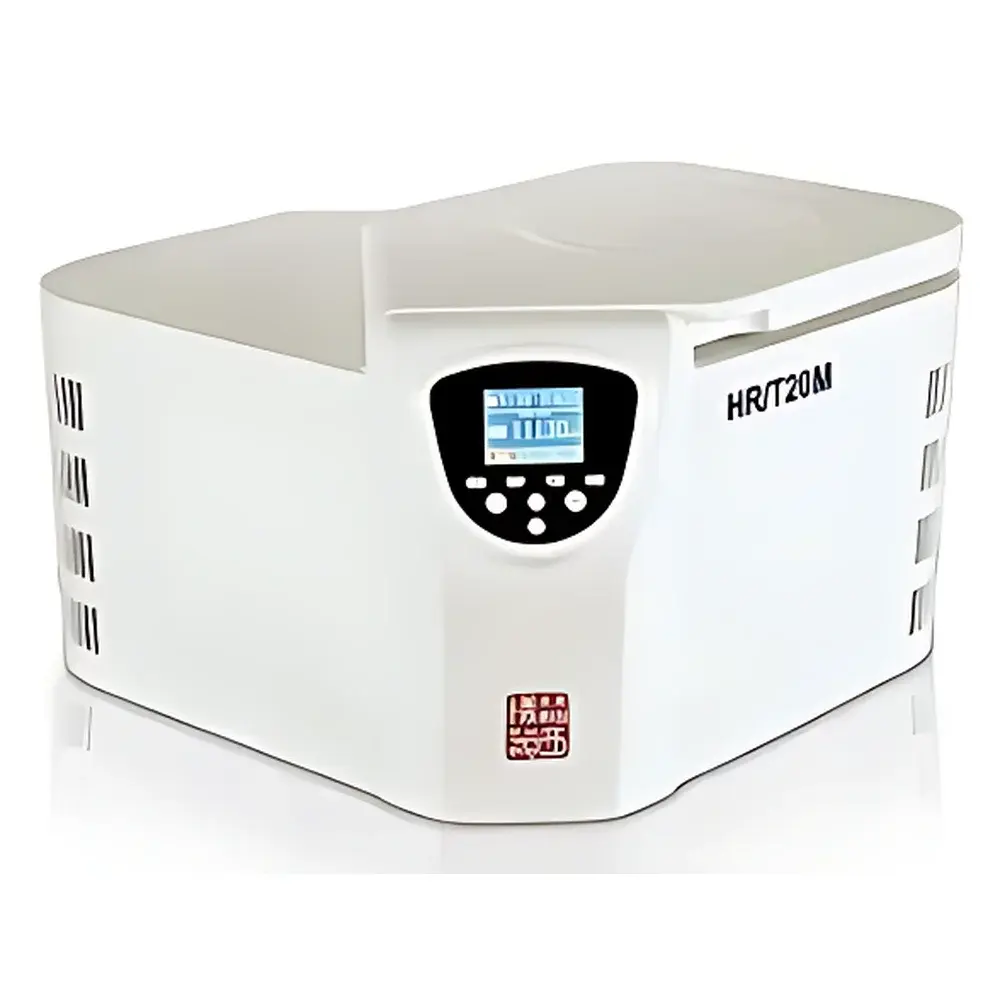
3H 3H24RI Intelligent High-Speed Refrigerated Centrifuge
| Origin | Hunan, China |
|---|---|
| Manufacturer Type | Authorized Distributor |
| Origin Category | Domestic (China) |
| Model | 3H24RI |
| Max Speed | 24,000 rpm |
| Max RCF | 39,900 × g |
| Max Capacity | 4 × 100 mL |
| Dimensions (L×W×H) | 710 × 630 × 350 mm |
| Temperature Range | −20 °C to +40 °C |
| Temp Control Accuracy | ±1 °C |
| Acceleration/Deceleration | 10 selectable rates |
| Noise Level | ≤65 dB(A) |
| Power Supply | 220 V AC, 50 Hz |
| Total Power | 1.5 kW |
| Weight | 75 kg |
| Refrigerant | R404a (non-CFC) |
| Display | TFT true-color touch LCD |
| Programmable Protocols | >100 user-defined methods |
| Safety Certifications | CE-compliant design per IEC 61010-2-020, ISO 13485-aligned manufacturing processes |
Overview
The 3H 3H24RI Intelligent High-Speed Refrigerated Centrifuge is an engineered platform for high-resolution separation of biological macromolecules—including proteins, nucleic acids, organelles, and subcellular particles—under precisely controlled thermal conditions. Based on the principle of sedimentation velocity centrifugation, it applies radial acceleration to heterogeneous suspensions, enabling differential pelleting and density-gradient fractionation with reproducible rotor dynamics and thermally stable operation. Designed for routine and method-critical workflows in regulated environments, the system integrates a brushless frequency-controlled motor, microprocessor-based motion control (dsPIC30F architecture), and a dedicated intelligent drive module (FSBB30CH) to ensure long-term torque stability and minimal speed drift. Its refrigerated architecture employs a sealed, non-CFC R404a compression cycle with active condensate management and real-time evaporator temperature feedback—critical for preserving labile analytes during extended runs (up to 99 h 59 min). The instrument complies with core mechanical safety requirements defined in IEC 61010-2-020 for centrifugal equipment and supports GLP/GMP-aligned operational traceability through programmable protocols and parameter logging.
Key Features
- Brushless high-torque motor with closed-loop speed regulation, delivering ±50 rpm speed accuracy across full operational range (0–24,000 rpm)
- TFT true-color capacitive touch display with dual-parameter real-time visualization: set values vs. actuals (speed, RCF, time, temperature, acceleration/deceleration stage)
- Three-layer steel rotor chamber enclosure with stainless-steel interior, certified for containment integrity under maximum load and failure-mode testing
- Active imbalance detection with automatic deceleration and audible/visual alarm; electronic overspeed and overtemperature cut-off circuits
- Standby cooling function: maintains preset temperature during rotor idle state without initiating rotation
- Electromechanical door lock with position-sensing interlock—prevents lid opening during operation or until rotor fully stops and chamber temperature stabilizes
- 10-step programmable acceleration and deceleration profiles to minimize sample shear and pellet resuspension
- Point-centrifugation mode for rapid spin-down prior to full protocol execution
- Acoustic damping architecture achieving ≤65 dB(A) at 1 m distance—optimized for shared laboratory spaces
Sample Compatibility & Compliance
The 3H24RI accommodates a broad spectrum of primary and secondary containers via interchangeable rotors, including titanium-angle rotors (12 × 1.5/2.0 mL, 24 × 1.5/2.0 mL), fixed-angle configurations for 5–100 mL tubes, and horizontal carriers supporting 4 × 100 mL bottles or microplate formats (2 × 96-well). All rotors are dynamically balanced per ISO 1940-1 G2.5 grade and validated for use within specified RCF envelopes. The system meets CE marking requirements under Directive 2014/30/EU (EMC) and 2014/35/EU (LVD), with structural compliance verified against EN 61010-1 and EN 61010-2-020. While not FDA 510(k)-cleared as a medical device, its construction, material traceability (304 stainless steel chamber), and documentation support validation in ISO 13485-certified biomanufacturing facilities and CLIA-registered clinical labs performing preparative centrifugation.
Software & Data Management
Operation is managed entirely through embedded firmware with no external PC dependency. Over 100 preconfigured or user-programmable protocols can be stored, recalled, and modified onsite. Each run logs timestamped metadata—including start/stop times, final rotor temperature, average RCF, total runtime, and error flags—to internal non-volatile memory. Export functionality supports USB flash drive retrieval of CSV-formatted session logs for audit trail reconstruction. Although the system does not implement FDA 21 CFR Part 11 electronic signature controls natively, its deterministic state machine architecture, immutable parameter history, and hardware-enforced access restrictions (no remote network interface) enable integration into validated IT infrastructures when deployed behind institutional firewall policies and procedural SOPs.
Applications
This centrifuge serves as a core preparatory tool in academic, pharmaceutical, and diagnostic settings where thermal integrity and rotational fidelity are non-negotiable. Typical applications include: isolation of mitochondria and lysosomes from tissue homogenates; purification of plasmid DNA and viral vectors using iodixanol or sucrose gradients; concentration of extracellular vesicles from cell culture supernatants; preparation of platelet-poor plasma (PPP) and buffy coat fractions in transfusion medicine; stabilization of enzyme complexes prior to kinetic assay; and batch processing of monoclonal antibody harvests in upstream bioprocessing. Its −20 °C to +40 °C thermal range supports both cryopreservation-compatible pelleting and ambient-temperature density separations—making it suitable for multi-step workflows spanning cold-chain-sensitive and room-temperature-stable protocols.
FAQ
What is the maximum relative centrifugal force (RCF) achievable with the standard 4 × 100 mL horizontal rotor?
At 11,000 rpm, the 4 × 100 mL rotor generates 11,720 × g—optimized for gentle pelleting of whole blood components or large-volume cell harvests.
Does the system support rotor calibration verification according to ISO/IEC 17025 requirements?
Yes—rotor identification tags, serial-number-traceable calibration certificates, and speed/temperature cross-validation reports are supplied with each unit and available upon request for accredited lab audits.
Can the centrifuge operate continuously for >24 hours?
Yes—the timer supports up to 99 h 59 min, and thermal management subsystems are rated for uninterrupted operation under nominal load at −10 °C setpoint.
Is the refrigeration system compatible with laboratory HVAC exhaust protocols?
The R404a charge is fully sealed; no venting or external condenser ducting is required. Ambient heat dissipation occurs passively through rear-mounted finned heat exchangers.
Are rotor lifetime and fatigue data provided per ASTM F2119 guidelines?
Rotor service life is defined by cumulative operational hours and documented RCF exposure history. Full fatigue test reports per ASTM F2119 are available under NDA for qualified industrial users.



