
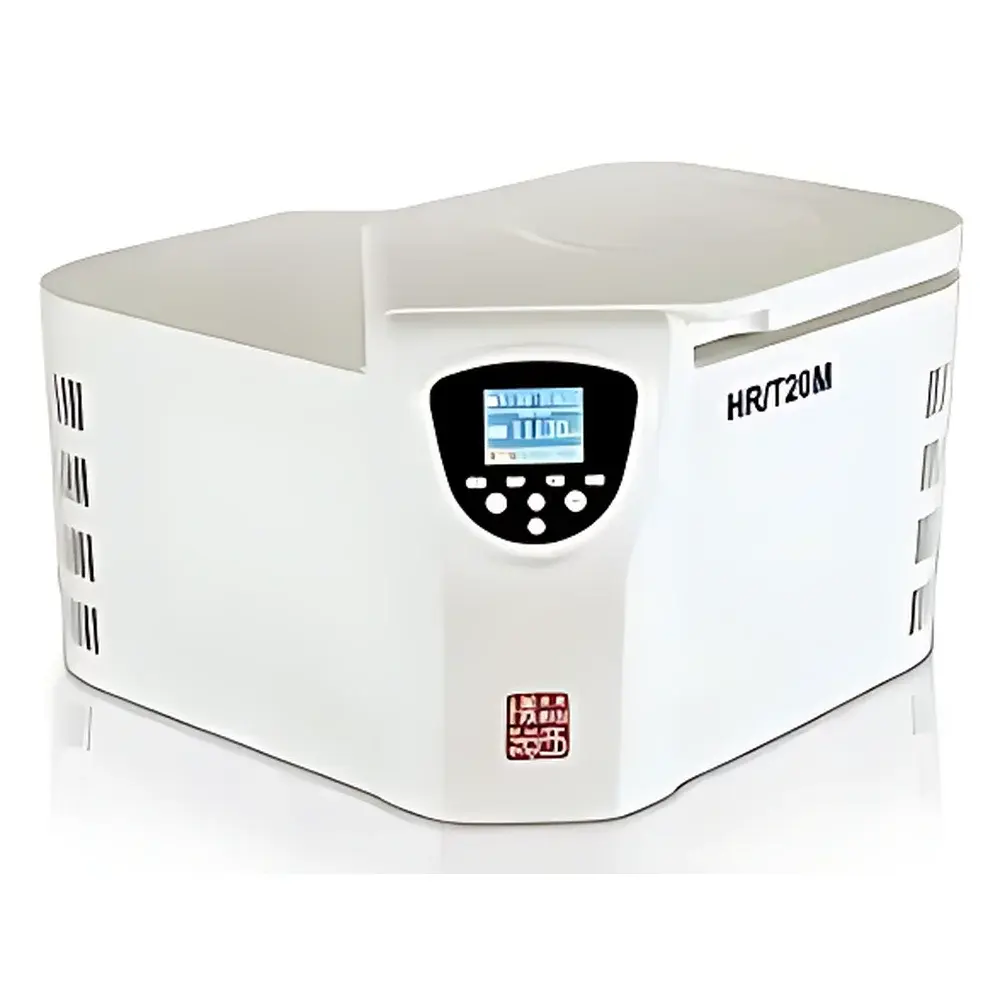
3H16RI High-Speed Refrigerated Centrifuge
| Origin | Hunan, China |
|---|---|
| Manufacturer Type | Authorized Distributor |
| Model | 3H16RI |
| Max. Speed | 16,800 rpm |
| Max. RCF | 19,600 × g |
| Max. Capacity | 4 × 100 mL |
| Dimensions (L×W×H) | 710 × 630 × 350 mm |
| Temperature Range | −20 °C to +40 °C |
| Temp. Accuracy | ±1 °C |
| Acceleration/Deceleration | 10 selectable rates |
| Noise Level | ≤65 dB(A) |
| Power Supply | 220 V, 50 Hz |
| Total Power | 1.5 kW |
| Weight | 75 kg |
| Refrigerant | R404a (non-CFC) |
| Control System | dsPIC30F microcontroller-based |
| Drive | FAIRCHILD FSBB30CH intelligent motor driver |
| Safety Features | Overspeed, overtemperature, imbalance, rotor recognition, automatic door lock, triple-layer steel rotor chamber, standby cooling |
Overview
The 3H16RI High-Speed Refrigerated Centrifuge is an engineered solution for high-throughput, temperature-sensitive separation of biological macromolecules—including proteins, nucleic acids, organelles, and subcellular particles—in research and quality control laboratories. Operating on the principle of sedimentation under controlled centrifugal force, it delivers precise, reproducible separations at rotational speeds up to 16,800 rpm and relative centrifugal forces (RCF) up to 19,600 × g. Its integrated refrigeration system maintains sample integrity during extended runs by stabilizing the rotor chamber between −20 °C and +40 °C with ±1 °C accuracy—critical for preserving enzyme activity, preventing thermal denaturation, and ensuring compliance with cold-chain protocols in biopharmaceutical development and clinical diagnostics.
Key Features
- High-torque brushless frequency-controlled motor with FAIRCHILD FSBB30CH intelligent drive module for stable torque delivery and low mechanical drift across speed ranges.
- Microchip dsPIC30F-series embedded controller enabling real-time monitoring of speed, temperature, time, RCF, and rotor status with adaptive fault response.
- TFT true-color capacitive touch screen interface supporting bilingual (English/Chinese) operation, intuitive parameter entry, and simultaneous display of setpoints and live operational data.
- Triple-layer reinforced steel rotor chamber with stainless-steel interior cavity, certified for containment under ISO 13485-aligned safety validation protocols.
- Active standby cooling: pre-chills the chamber while idle to minimize thermal lag upon run initiation—essential for heat-labile samples such as plasma-derived exosomes or ribonucleoprotein complexes.
- Mechanical and electronic safety interlocks including automatic rotor recognition, imbalance detection (<±2 g mass differential), overspeed cutoff, and fail-safe door locking compliant with IEC 61010-2-020.
- Programmable operation with 100 user-defined protocols, 10-step acceleration/deceleration profiles, and point-to-run (“pulse”) mode for transient pelleting or washing steps.
Sample Compatibility & Compliance
The 3H16RI accommodates a broad range of sample formats via interchangeable rotors—including fixed-angle, horizontal, and microplate carriers—supporting volumes from 0.5 mL tubes to 100 mL bottles. Standard configurations include titanium alloy 4 × 100 mL swing-bucket rotors and 12 × 1.5/2.0 mL angle rotors, all validated for maximum load balance and fatigue resistance per ASTM F2119-22. The unit meets electromagnetic compatibility (EMC) requirements per EN 61326-1 and electrical safety standards per EN 61010-1. Its refrigeration architecture uses R404a refrigerant, fully compliant with current EU F-Gas Regulation (EU No 517/2014) phase-down schedules. For regulated environments, audit trails, user access levels, and electronic signature support can be enabled via optional firmware upgrades aligned with FDA 21 CFR Part 11 and EU Annex 11 expectations.
Software & Data Management
While the 3H16RI operates autonomously via its onboard controller, optional USB export enables raw run logs (timestamp, speed, temperature, duration, rotor ID, error codes) in CSV format for traceability and LIMS integration. All parameter changes are timestamped and logged internally with persistent memory retention (>10,000 event records). Firmware updates are performed via secure USB key with cryptographic signature verification. The system supports GLP/GMP-aligned documentation practices: each run generates a unique identifier; users must authenticate before editing protocols or clearing logs; and calibration certificates for speed and temperature sensors are issued with NIST-traceable references.
Applications
This centrifuge serves core workflows across multiple regulated and academic domains: isolation of extracellular vesicles from cell culture supernatants (ISO 20363:2022); purification of plasmid DNA and viral vectors under cGMP conditions; fractionation of mitochondrial and lysosomal fractions in neurodegenerative disease models; preparation of platelet-poor plasma for coagulation assays (CLSI H21-A5); concentration of foodborne pathogen pellets prior to PCR amplification (ISO 16140-2); and routine QC of monoclonal antibody formulations where aggregation state must be preserved post-centrifugation. Its capacity and thermal stability make it suitable for batch processing in biomanufacturing support labs and central core facilities.
FAQ
What is the maximum RCF achievable with the standard 4 × 100 mL swing-bucket rotor?
At 11,000 rpm, the 4 × 100 mL rotor delivers 11,720 × g—optimized for gentle pelleting of whole cells or large particulates without shear-induced lysis.
Does the unit support rotor auto-identification?
Yes—each certified rotor contains an RFID tag read at lid closure, automatically loading compatible speed/temperature limits and safety thresholds.
Can the centrifuge maintain −20 °C during a 99-hour continuous run?
Under ambient conditions ≤25 °C and with adequate ventilation, the compressor sustains −20 °C setpoint with <±0.8 °C deviation over 48 h; extended runs require periodic thermal recalibration per maintenance schedule.
Is the touch interface programmable in English only?
The default UI language is English; Chinese localization is factory-configurable but not field-upgradable without service technician access.
What documentation is provided for regulatory submissions?
Factory-issued IQ/OQ documentation, temperature mapping reports (per ISO 14644-3), and speed calibration certificates with uncertainty budgets are available upon request.



