
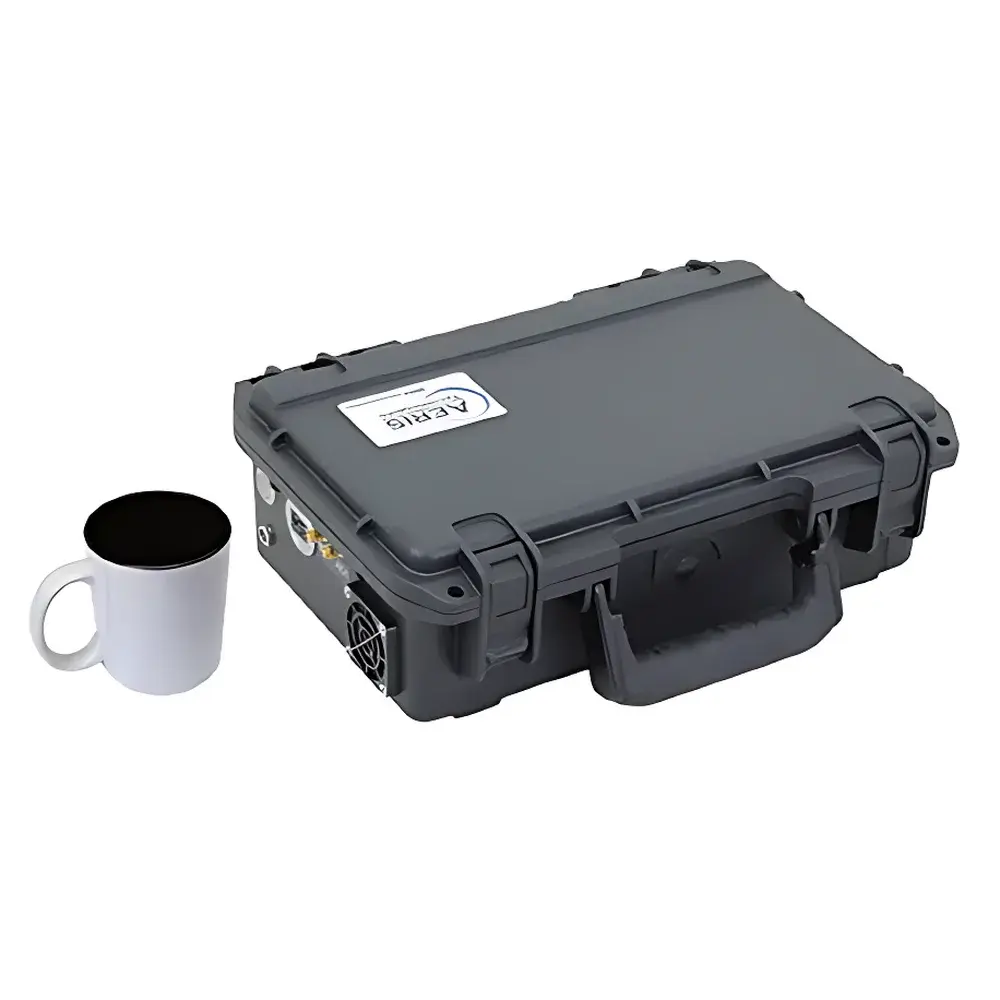
Aeris MIRA PICO N2O CO Portable Dual-Gas Analyzer
| Origin | USA |
|---|---|
| Manufacturer Type | Authorized Distributor |
| Origin Category | Imported |
| Model | MIRA PICO N2O CO |
| Pricing | Upon Request |
Overview
The Aeris MIRA PICO N2O CO Portable Dual-Gas Analyzer is an ultra-sensitive, field-deployable instrument engineered for real-time, simultaneous quantification of nitrous oxide (N₂O) and carbon monoxide (CO) in ambient air and emission sources. It employs mid-infrared (MIR) tunable diode laser absorption spectroscopy (TDLAS) — a physics-based, absolute measurement technique — to deliver sub-part-per-trillion (ppt) sensitivity and high spectral selectivity. Unlike electrochemical or metal-oxide semiconductor sensors, the MIRA PICO relies on fundamental molecular absorption cross-sections in the 4.5–4.7 µm spectral region, where both N₂O and CO exhibit strong, non-overlapping rovibrational transitions. This enables direct, interference-free detection without chemical conversion or catalytic scrubbing. The analyzer integrates Aeris’ proprietary “folded-path” multi-pass optical cell (60 mL volume, >13 m effective path length) with a hermetically sealed, alignment-free optical bench — eliminating sensitivity degradation from vibration, thermal drift, or mirror contamination. Designed for unattended operation across mobile platforms (ground vehicles, UAVs, backpacks), it meets the stringent demands of atmospheric science, eddy covariance flux studies, urban pollution mapping, and industrial leak detection.
Key Features
- Real-time dual-species measurement at 1 or 2 Hz data acquisition rate
- 500 ppt/s noise-equivalent detection limit (NEDL) for both N₂O and CO; signal averaging enables sub-ppt precision
- Integrated catalytic zero-air generator for CO — enabling automatic, drift-compensated zeroing without external gas cylinders
- Dual programmable sample inlets supporting differential measurement mode (e.g., inlet/outlet of soil chamber or stack duct)
- Ultra-low power consumption: 15 W typical; internal rechargeable Li-ion battery supports ≥6 hours of continuous operation
- Compact form factor: 11.5″ W × 8″ D × 3.75″ H; total mass 2.75 kg including battery and integrated sampling pump
- Onboard Wi-Fi, RS-232, USB, and optional analog output (0–5 V or 4–20 mA) for seamless integration into telemetry and SCADA systems
- 32 GB internal flash memory (expandable via microSD) with timestamped, metadata-rich binary logging
Sample Compatibility & Compliance
The MIRA PICO operates within an environmental envelope of 10–40 °C and 10–95% RH (non-condensing), making it suitable for deployment in diverse climatic zones without active humidity control. Its optical design inherently rejects water vapor interference through spectral line selection and embedded H₂O co-measurement (used for dry-mole-fraction correction). The analyzer complies with ASTM D6348–21 (standard test method for determination of gaseous compounds by TDLAS) and supports GLP/GMP-aligned data integrity via audit-trail-enabled firmware. While not certified under EPA PS-11 or EN 15267, its performance characteristics align with U.S. EPA’s recommended specifications for ambient CO monitoring (40 CFR Part 53) and N₂O flux validation per IPCC Tier 2 methodology. All firmware and calibration routines are traceable to NIST-traceable reference standards.
Software & Data Management
The MIRA PICO ships with Aeris’ proprietary AcquireLink™ software suite, providing full remote configuration, real-time spectral visualization, and automated calibration workflow management. Data files conform to netCDF-4 format with CF-1.8 metadata conventions — ensuring compatibility with Python (xarray, netCDF4), MATLAB, and R-based atmospheric analysis pipelines. Differential measurement sequences (e.g., alternating between ambient and chamber air) are scriptable via onboard scheduler, with zero/calibration events logged with full provenance. Firmware supports FIPS 140-2–compliant encrypted communication over Wi-Fi and TLS-secured cloud upload. Audit logs record all parameter changes, zero events, and firmware updates — satisfying FDA 21 CFR Part 11 requirements for electronic records and signatures when deployed in regulated environmental monitoring programs.
Applications
- Soil N₂O flux quantification using static/dynamic chambers or gradient methods
- Urban and regional CO monitoring for air quality compliance and source apportionment
- Mobile mapping of fugitive emissions (landfills, wastewater treatment plants, natural gas infrastructure)
- Drone-based vertical profiling of boundary layer greenhouse gas gradients
- Calibration transfer and validation of low-cost sensor networks
- In situ verification of satellite-derived XCO and XN₂O products (e.g., OCO-2, TROPOMI)
- Process monitoring in combustion facilities, biogas upgrading, and fertilizer production
FAQ
Does the MIRA PICO require external zero or span gases for routine operation?
No — the integrated catalytic CO zero-air generator enables autonomous zeroing. For N₂O, users may choose zero gas, calibration gas, or differential measurement to maintain <1 ppb accuracy without consumables.
How is water vapor interference corrected?
H₂O is co-measured at high spectral resolution; dry-mole-fraction concentrations are calculated in real time using measured temperature, pressure, and H₂O partial pressure.
Can the instrument operate unattended for extended periods?
Yes — with external DC power (12–15 V) and optional solar charging, field deployments exceeding 30 days have been validated in Arctic and tropical environments.
Is the optical path susceptible to particulate fouling?
The folded-path cell uses no high-reflectivity mirrors; its monolithic, fused-silica construction resists scattering and condensation, requiring no routine optical maintenance.
What is the minimum detectable concentration for N₂O in a 1-second average?
500 ppt (1σ, 1 s), improving to ~150 ppt with 10-second signal averaging — sufficient to resolve background atmospheric N₂O (~330 ppb) with <0.05% relative uncertainty.







