
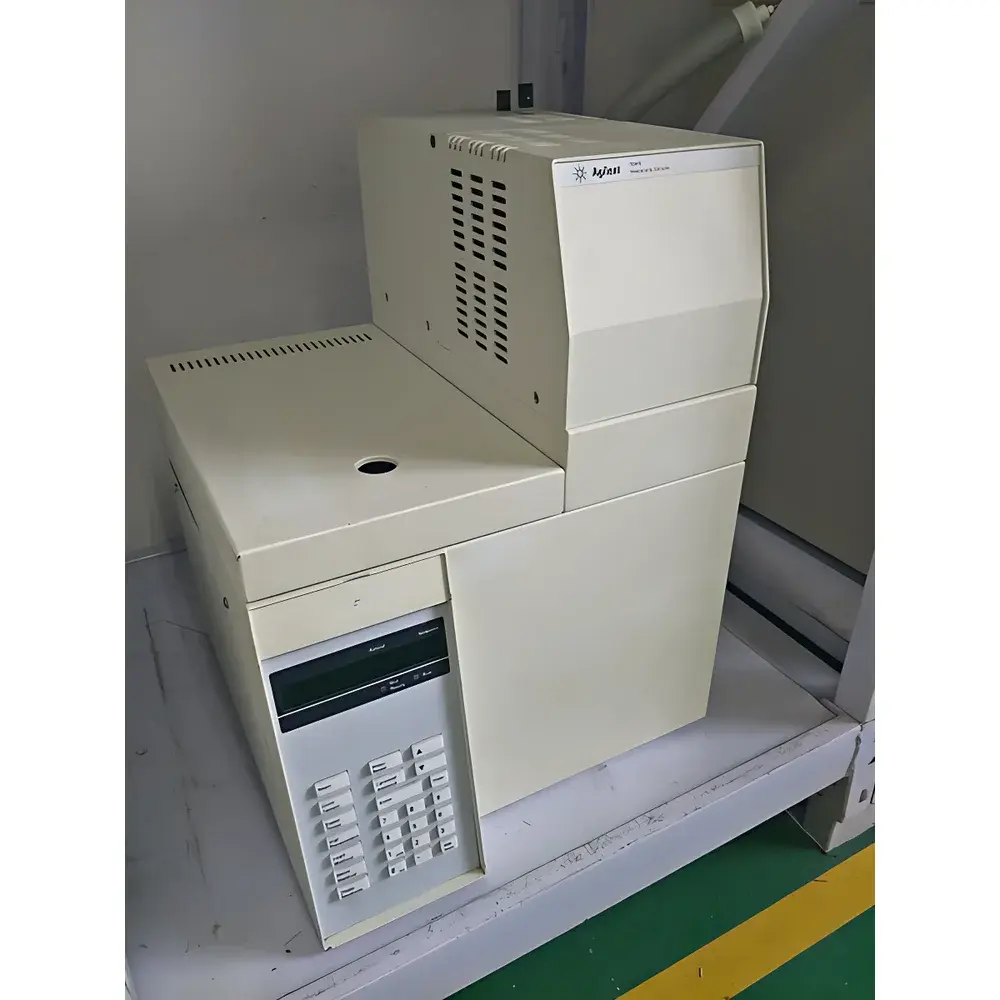
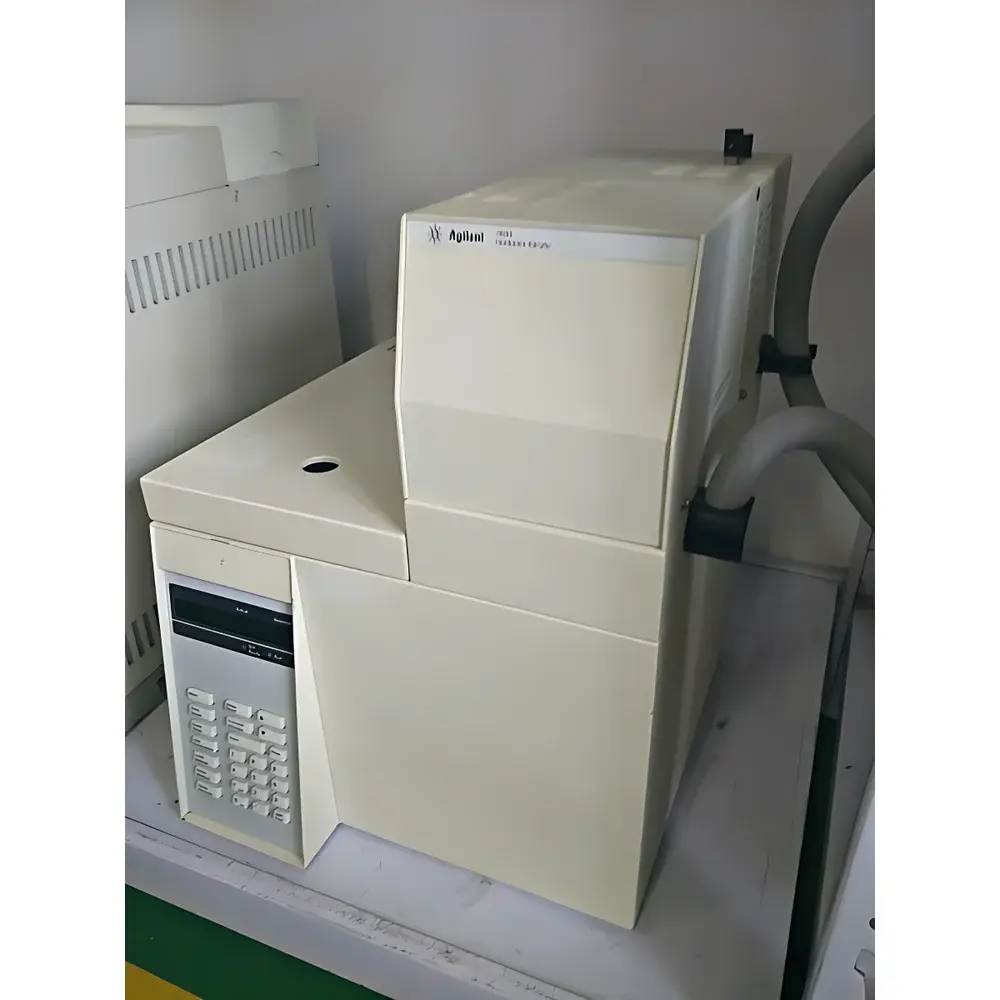
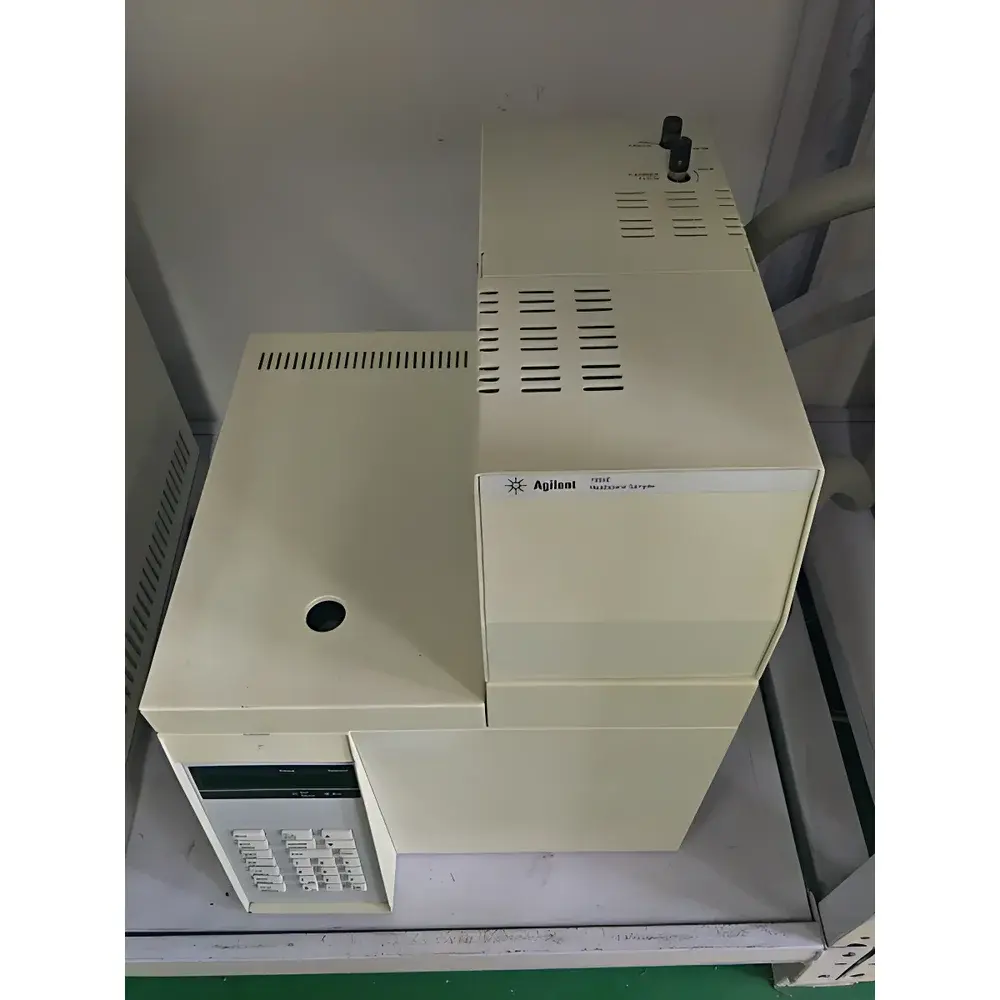
Agilent 7694E Used Automated Static Headspace Sampler
| Brand | Agilent Technologies |
|---|---|
| Origin | USA |
| Model | 7694E |
| Instrument Type | Static Headspace Sampler |
| Automation Level | Fully Automatic |
| Vial Heating Range | 15 °C above ambient to 200 °C (±1 °C) |
| Valve Heating Range | 15 °C above ambient to 200 °C (±1 °C) |
| Sample Loop Volume | 1 mL |
| Vial Capacity | 44 positions |
| Compatible Vial Sizes | 10 mL and 20 mL |
Overview
The Agilent 7694E Used Automated Static Headspace Sampler is a robust, field-proven interface designed for quantitative analysis of volatile and semi-volatile organic compounds (VOCs and SVOCs) in complex solid, liquid, or viscous matrices. Operating on the principle of static headspace equilibrium—where analytes partition between the sample phase and the vapor phase above it—the 7694E enables reproducible, solvent-free introduction of gaseous analytes into gas chromatography (GC) systems. Its design adheres to fundamental thermodynamic principles governing Henry’s law and phase distribution coefficients, ensuring method transferability across laboratories and compliance with standard analytical workflows in environmental, pharmaceutical, forensic, and food safety testing. As a legacy Agilent platform, the 7694E maintains full mechanical and electrical compatibility with all Agilent GC systems (e.g., 6890N, 7890A/B) and select third-party GC instruments via standardized pneumatic and electronic interfaces (e.g., TTL trigger, 24 V DC control signals).
Key Features
- Fully automated operation with unattended batch processing of up to 44 vials—supporting high-throughput screening without manual intervention.
- Dual-zone independent temperature control: separate, precision-regulated heating for the vial oven (15–200 °C, ±1 °C) and the transfer manifold/valve zone (15–200 °C, ±1 °C), minimizing thermal gradient-induced carryover or condensation artifacts.
- Inert nickel-coated sample pathway—including valve body, loop, and transfer lines—to prevent adsorption, catalytic degradation, or reactive loss of polar or labile analytes (e.g., aldehydes, organic acids, sulfur compounds).
- Programmable vial agitation: orbital shaking during equilibration enhances mass transfer kinetics and ensures representative headspace composition—critical for heterogeneous or high-viscosity samples (e.g., soil slurries, polymer extracts, biological tissues).
- Modular method storage: supports up to four user-defined methods with independent parameters (equilibration time, temperature, pressurization pressure, loop fill/purge cycles), facilitating rapid method optimization and routine switching.
- Robust mechanical architecture with minimal moving parts and industrial-grade solenoid valves—engineered for >10,000 cycle durability under continuous laboratory operation.
Sample Compatibility & Compliance
The 7694E accommodates standard crimp-top or screw-cap 10 mL and 20 mL headspace vials with PTFE/butyl or PTFE/silicone septa, conforming to ASTM D6866, EPA Method 502.2, USP , and ISO 11843-2 requirements for residual solvent analysis. Its inert flow path and thermal stability support validated applications in GMP environments when integrated with 21 CFR Part 11–compliant data systems (e.g., OpenLab CDS). While the unit itself does not embed audit trail functionality, its analog/digital I/O architecture allows seamless synchronization with chromatography data systems that enforce electronic record integrity, method version control, and operator authentication.
Software & Data Management
The 7694E operates via front-panel keypad and LCD interface—requiring no dedicated PC or proprietary software for basic operation. All method parameters (vial position sequence, equilibration time, oven/manifold setpoints, loop injection timing) are stored in non-volatile memory. For integration into regulated environments, the sampler synchronizes with Agilent OpenLab CDS or third-party GC control software using industry-standard RS-232 or contact-closure triggers. Raw acquisition metadata—including vial ID, timestamp, temperature logs, and valve actuation events—is captured by the host CDS, enabling full traceability per GLP/GMP documentation standards. Optional firmware upgrades (where available) may extend compatibility with newer Agilent GC firmware versions.
Applications
- Residual solvent quantification in pharmaceutical active ingredients and excipients (USP , ICH Q3C).
- VOC profiling in drinking water, wastewater, and soil extracts (EPA Methods 502.2, 624, 8260).
- Flavor and fragrance compound analysis in beverages, dairy products, and packaged foods.
- Forensic toxicology screening for ethanol, acetone, and volatile metabolites in blood or urine.
- Quality control of polymer monomers, adhesives, and coatings for off-gassing compliance (e.g., automotive interior VOC testing).
FAQ
Is the Agilent 7694E compatible with non-Agilent gas chromatographs?
Yes—provided the GC accepts TTL-level start triggers and offers configurable inlet pressure/flow control; many Shimadzu, Thermo Fisher, and PerkinElmer GC models integrate successfully via custom cable kits.
What maintenance is required for long-term reliability?
Routine replacement of septa and O-rings every 200–500 injections, annual calibration verification of oven and valve temperature sensors, and periodic cleaning of the nickel transfer line with methanol/chloroform are recommended.
Can the 7694E perform dynamic headspace or purge-and-trap sampling?
No—it is strictly a static headspace system; dynamic extraction requires dedicated purge-and-trap instrumentation (e.g., Agilent 7667A or Tekmar Atomx).
Does the unit support internal standard addition via syringe or spiking loop?
No—internal standard must be added manually to the vial prior to capping; the 7694E does not feature automated liquid spiking capability.
What is the typical equilibration time range supported?
Programmable from 0.1 to 99.9 minutes, with temperature-controlled incubation ensuring kinetic reproducibility across batches.
Related Products






