
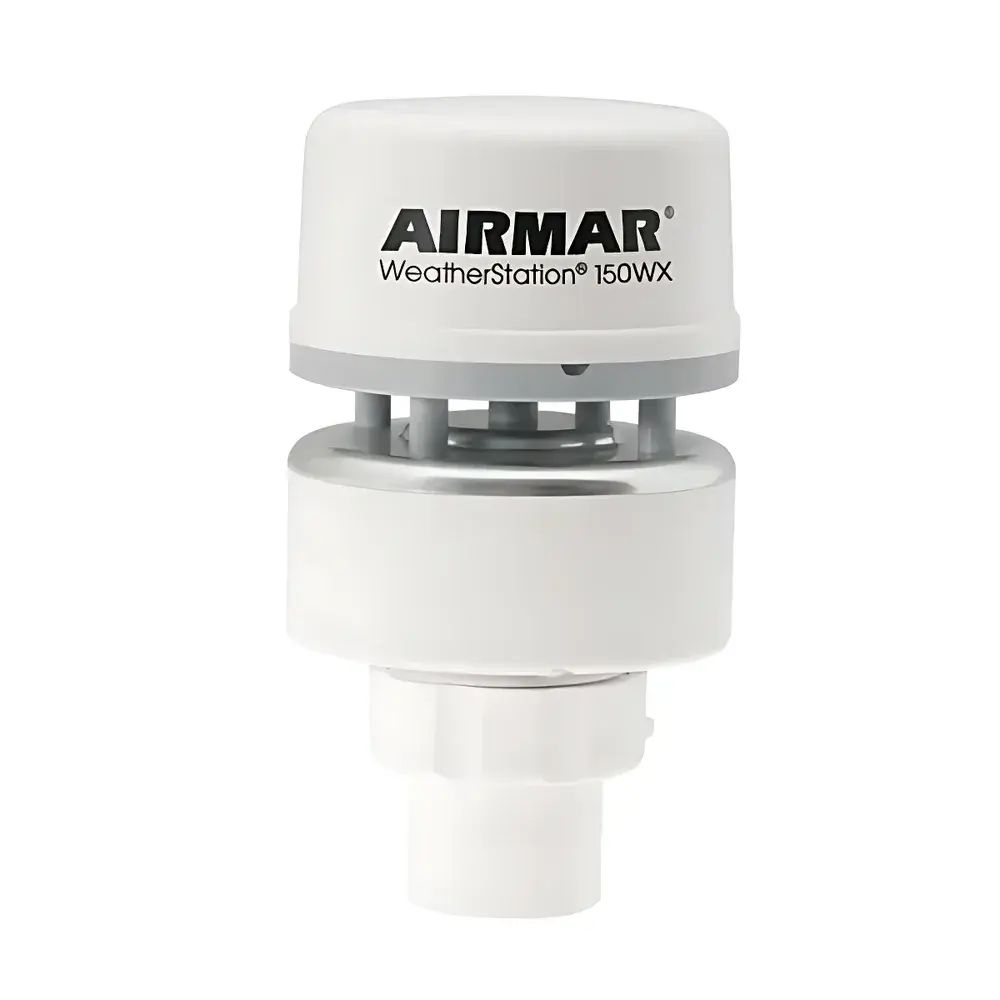
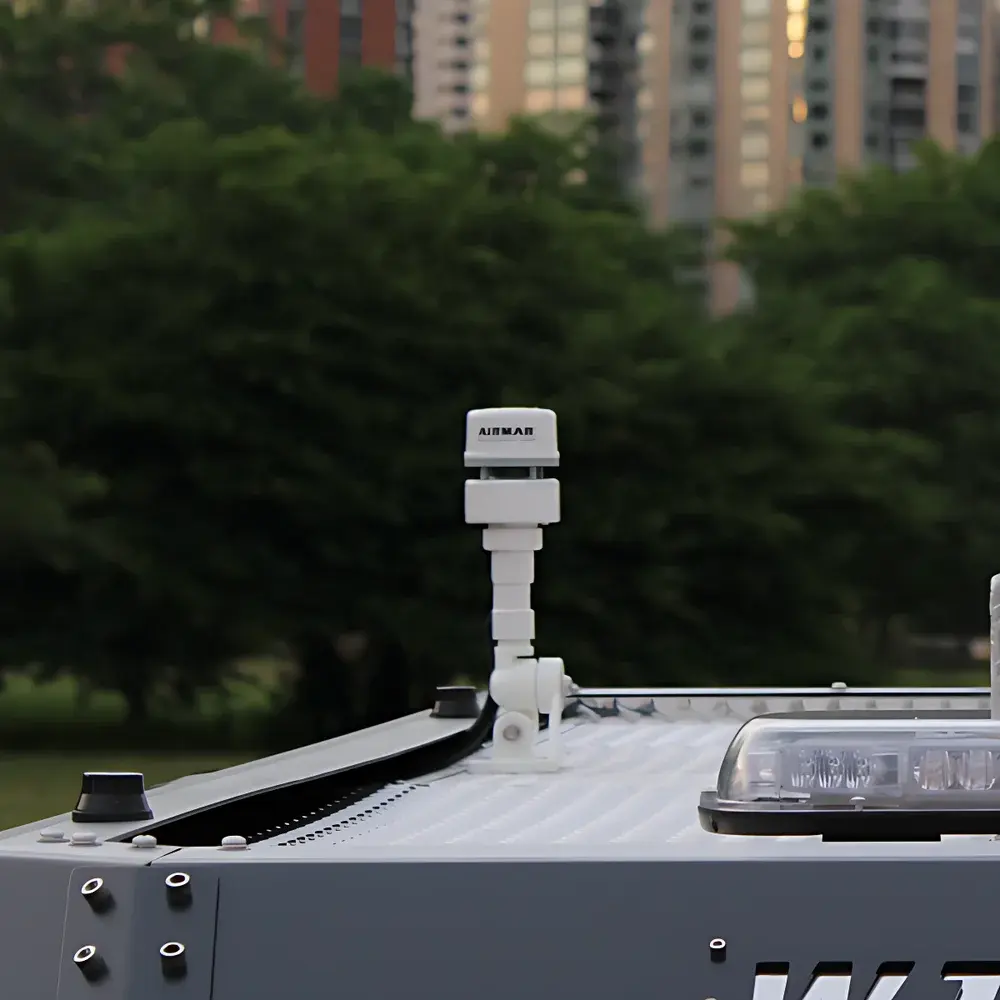

AirMar 150WX Ultrasonic Weather Station
| Brand | Airmar |
|---|---|
| Origin | USA |
| Model | 150WX |
| Instrument Type | Portable Weather Station |
| Output Interfaces | RS232, RS422 (NMEA 0183), CAN Bus (NMEA 2000) |
| Environmental Rating | IPX6 (IPX4 with humidity sensor installed) |
| Power Supply | 9–40 VDC |
| Integrated Sensors | Ultrasonic wind (speed/direction), 10 Hz GPS, solid-state compass, 3-axis accelerometer, barometric pressure, air temperature, optional replaceable relative humidity sensor |
| Wind Data Output | True wind, apparent wind, gust statistics (raw 10 Hz wind samples) |
| Mounting | 1"-14 UNS or ½" NPT thread |
Overview
The AirMar 150WX Ultrasonic Weather Station is a compact, marine-grade environmental sensing platform engineered for real-time meteorological data acquisition on mobile platforms—including vessels, autonomous surface vehicles (ASVs), buoys, and land-based mobile assets. Unlike traditional cup-and-vane anemometers, the 150WX employs ultrasonic time-of-flight measurement to determine horizontal wind speed and direction with no moving parts—ensuring long-term reliability, minimal maintenance, and immunity to mechanical wear or icing. Its integrated 10 Hz GPS receiver and solid-state 3-axis compass enable precise motion compensation, allowing simultaneous calculation and output of both apparent (relative) wind and true wind vectors—a critical requirement for navigation, weather routing, and oceanographic research. The device also delivers calibrated measurements of barometric pressure, ambient air temperature, and (with optional module) relative humidity, all synchronized to GPS time stamps for traceable temporal alignment.
Key Features
- Ultrasonic wind measurement (0–60 m/s range, ±2° directional accuracy) with raw 10 Hz sample output for high-frequency gust analysis
- Integrated 10 Hz GPS engine providing position, velocity over ground (SOG), course over ground (COG), and precise timing synchronization
- Solid-state electronic compass and 3-axis accelerometer enabling dynamic tilt compensation and heading stabilization
- Field-replaceable humidity sensor module (optional), designed for quick in-situ maintenance without instrument disassembly
- IPX6-rated enclosure (IPX4 when humidity sensor is installed), certified for continuous outdoor and marine deployment including buoy-mounted configurations
- Wide-input DC power architecture (9–40 VDC) compatible with marine battery systems and solar-charged auxiliary power supplies
- Triple-output interface support: RS232 (NMEA 0183), RS422 (NMEA 0183 differential), and CAN Bus (NMEA 2000)—enabling seamless integration into existing vessel networks or data acquisition systems
- Low-power design consuming <50% of legacy ultrasonic weather sensors—optimized for extended battery or energy-harvesting operation
- Standard 1″-14 UNS or ½” NPT threaded base for rigid mounting on masts, poles, or custom brackets
Sample Compatibility & Compliance
The 150WX is designed for unattended, long-duration operation in harsh coastal and offshore environments. Its sensor suite complies with fundamental performance expectations outlined in IEC 61000-6-2 (EMC immunity) and IEC 61000-6-4 (EMC emissions). While not certified to full IEC 60945 (marine navigation equipment standard) as a standalone unit, its electrical interfaces and mechanical construction align with common marine installation practices per ISO 8846 (ignition protection) and ABYC E-11 (boat electrical systems). Data outputs conform to NMEA 0183 v4.10 and NMEA 2000 v2.000 message structures, ensuring interoperability with chartplotters, VMS (Vessel Monitoring Systems), and scientific data loggers. For regulatory applications requiring audit trails or data integrity assurance, the device supports deterministic timestamping via GPS PPS (pulse-per-second) signal, facilitating GLP-aligned field deployments where metadata provenance is essential.
Software & Data Management
Configuration, calibration verification, and real-time telemetry monitoring are supported through AirMar’s Windows-based WeatherCaster software. This application provides live parameter visualization (including vector wind plots, GPS track overlays, and pressure trend graphs), firmware update capability, and customizable NMEA sentence selection. All configuration parameters—including sensor offsets, NMEA talker IDs, baud rates, and output sentence frequency—are stored non-volatilely in the instrument’s internal EEPROM. Raw serial/CAN data streams are ASCII- or binary-encoded per NMEA standards and can be ingested directly by third-party platforms such as LabVIEW, MATLAB, Python-based logging frameworks (e.g., PySerial + Pandas), or cloud telemetry services (e.g., AWS IoT Core, Azure IoT Hub) using standard protocol parsers. No proprietary drivers or cloud dependencies are required for basic data acquisition.
Applications
- Autonomous maritime platforms requiring wind-relative navigation inputs and real-time atmospheric correction
- Offshore buoy networks supporting NOAA, IOOS, and regional hydrographic offices in operational meteorology and climate monitoring
- Research vessels conducting air–sea interaction studies, including CO₂ flux estimation and boundary layer turbulence characterization
- Coastal emergency response units needing rapid-deploy environmental situational awareness during storm events
- Renewable energy site assessments—particularly floating wind farm feasibility studies requiring spatially distributed, motion-compensated wind profiles
- Educational marine science programs integrating field instrumentation with GIS and time-series analysis curricula
FAQ
Is the 150WX still in production?
No—the AirMar 150WX has been officially discontinued and superseded by the 200WX series. Units currently available are limited to remaining distributor inventory or refurbished OEM stock.
Can the 150WX output both apparent and true wind simultaneously?
Yes—true wind vector computation requires synchronized inputs from ultrasonic wind, GPS-derived SOG/COG, and compass heading; all are processed onboard and output as separate NMEA sentences (MWV and MWD).
What is the operational temperature range?
The specified operating range is –25 °C to +70 °C, validated under IEC 60068-2-1 (cold) and IEC 60068-2-2 (dry heat) test conditions.
Does it support NMEA 2000 plug-and-play installation?
Yes—when configured for CAN Bus output, the 150WX complies with NMEA 2000 physical layer specifications and uses standardized PGNs (e.g., 130306 for environmental parameters, 129026 for GNSS position).
How is humidity sensor replacement performed?
The RH module is accessed via a sealed service port on the instrument’s underside; replacement requires only a Torx T10 driver and takes less than 90 seconds—no recalibration is needed post-installation.
Related Products







