
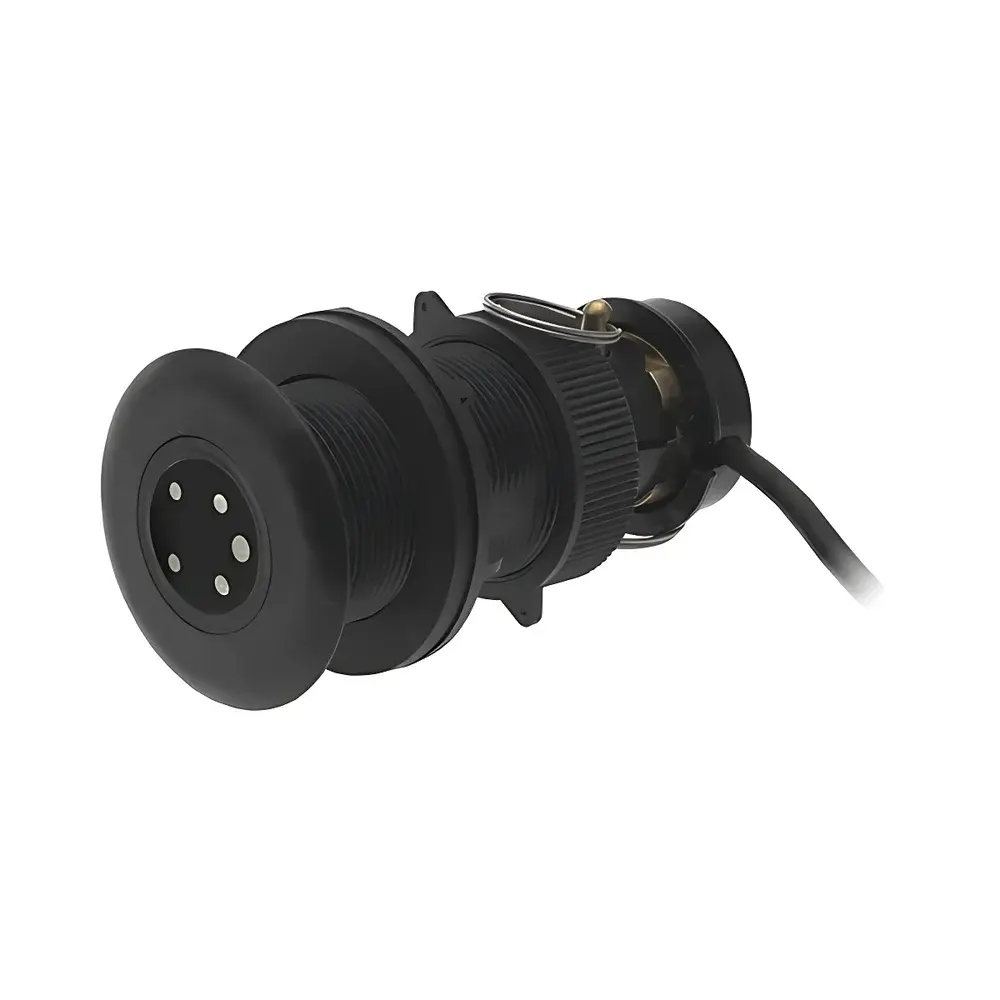
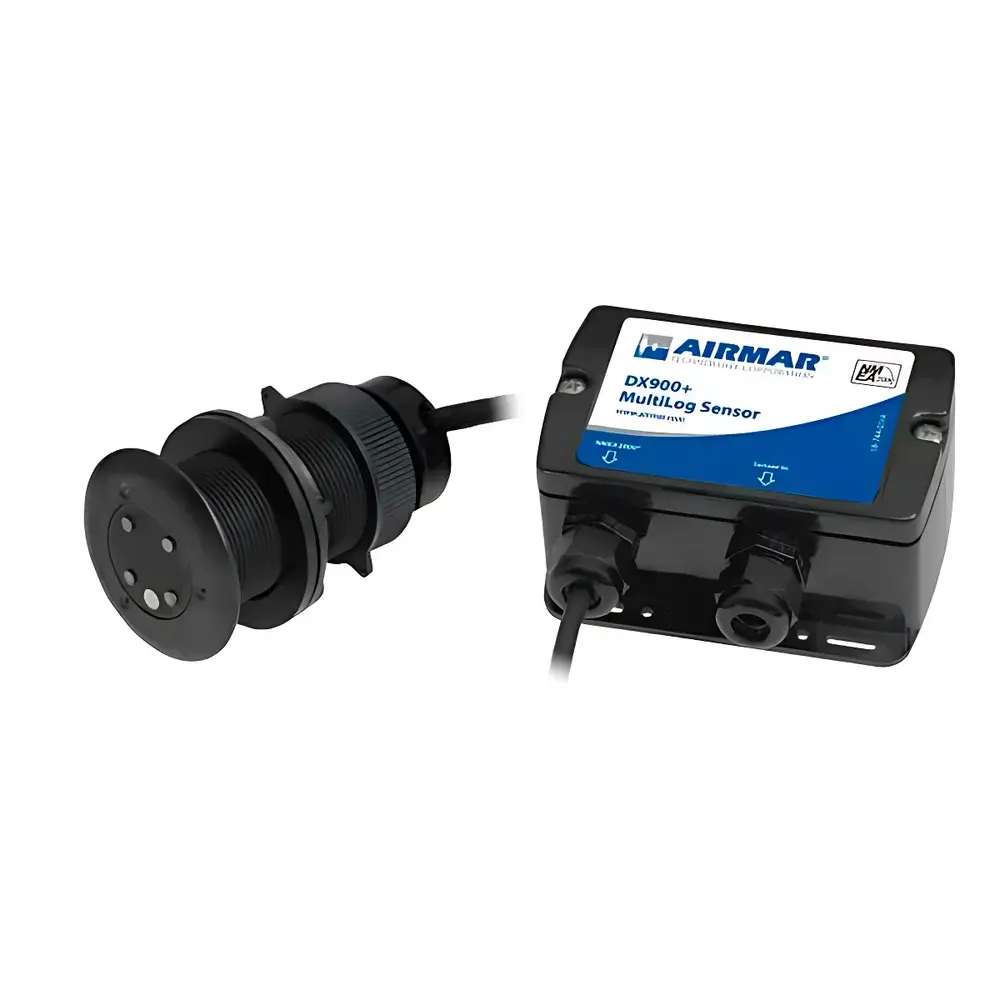
AIRMAR DX900+ Smart Dual-Axis Doppler Speed & Depth Sensor
| Brand | AIRMAR |
|---|---|
| Origin | USA |
| Model | DX900+ |
| Operating Frequency | 360 kHz |
| Depth Range | 60 m |
| Longitudinal Speed Range | ±60 knots |
| Transverse Speed Range | ±6 knots |
| Speed Accuracy | ±0.1 knots (≤10 kn), ±1% (>10 kn) |
| Speed Resolution | 0.01 knots |
| Temperature Accuracy | ±0.5 °C |
| Data Update Rate | up to 10 Hz |
| Operating Temperature | −15 °C to +55 °C |
| Power Supply | 9–16 VDC |
| Power Consumption | 5.0 W (DST variant), 2.5 W (ST variant) |
| Cable Length | 3 m (DST), 6 m (ST) |
| NMEA 2000® Load Equivalent Number (LEN) | 10 |
| Weight | 1 kg |
| Housing Material | Marine-grade corrosion-resistant alloy |
| Output Protocols | NMEA 0183 (ST), NMEA 2000® (DST) |
| Wireless Interface | Bluetooth 5.0 for AIRMAR CAST™ app |
Overview
The AIRMAR DX900+ is a high-precision, dual-axis electromagnetic Doppler speed and depth sensor engineered for performance-critical marine navigation environments. Unlike traditional paddlewheel or impeller-based speed sensors, the DX900+ employs solid-state electromagnetic velocity measurement—detecting induced voltage in seawater as it flows across a precisely oriented magnetic field—to deliver true water-referenced longitudinal (bow-to-stern) and transverse (port-to-starboard) velocity components without mechanical wear or calibration drift. Integrated with a 360 kHz broadband echosounder, it simultaneously provides high-resolution depth and water temperature measurements. Critically, the device computes Leeway (lateral drift angle relative to heading) and SOG (Speed Over Ground) in real time by fusing Doppler-derived water-referenced velocity with vessel attitude (heel and pitch) and external heading input—enabling dynamic course optimization for racing yachts, offshore cruisers, and high-maneuverability power vessels. Its physics-based measurement architecture eliminates reliance on GPS-derived SOG under low-signal conditions and avoids latency inherent in inertial or GNSS-only solutions.
Key Features
- Solid-state dual-axis Doppler velocity sensing: no moving parts, zero maintenance, immune to fouling or mechanical degradation
- Real-time Leeway calculation derived from vector subtraction of water-referenced velocity and heading data—no manual input or post-processing required
- Integrated 360 kHz echosounder optimized for minimal cross-talk with adjacent sonar, AIS, or radar systems
- Low-drag, low-profile transducer housing compatible with standard 51 mm (2″) P617V through-hull mounts—retrofit installation requires no hull modification
- On-device storage of calibration coefficients and configuration profiles; seamless propagation to NMEA 2000® networks via LEN-compliant interface
- Bluetooth 5.0 wireless connectivity to the AIRMAR CAST™ mobile application (iOS/Android) for intuitive speed calibration, firmware updates, and diagnostic logging
- Simultaneous output of heel, pitch, water temperature, depth, longitudinal speed, transverse speed, SOG, and Leeway—all synchronized at up to 10 Hz
Sample Compatibility & Compliance
The DX900+ is designed for deployment in saltwater, brackish, and freshwater environments. Its transducer face is fabricated from proprietary marine-grade nickel-aluminum-bronze alloy, certified to ASTM B148-18 for corrosion resistance in continuous immersion service. The sensor meets IEC 60945 maritime equipment standards for environmental robustness (including vibration, shock, and thermal cycling per IEC 60068-2 series). Electrical interfaces comply with NMEA 0183 v4.10 and NMEA 2000® v2.000 specifications—including full PGN support for proprietary velocity vectors (PGN 130577), attitude (PGN 127257), and depth/temperature (PGN 128267). It is suitable for GLP-aligned operational logging when integrated with NMEA 2000®-compatible chartplotters supporting audit-trail metadata (e.g., Raymarine Axiom+, Furuno TZtouch3).
Software & Data Management
The AIRMAR CAST™ application serves as both commissioning and diagnostics platform—providing guided speed calibration workflows that account for hull geometry, shaft alignment, and flow distortion. All calibration parameters (including transverse offset compensation and temperature-dependent conductivity correction) are stored in non-volatile memory onboard the DX900+. Configuration changes propagate automatically to connected NMEA 2000® devices, ensuring consistency across multi-brand instrument networks. Raw sensor data streams (including timestamped velocity vectors and echo envelope traces) can be exported in CSV format for third-party hydrodynamic analysis or race performance modeling. Firmware updates are delivered over-the-air via Bluetooth, with version rollback capability and SHA-256 signature verification.
Applications
- Racing sailboats requiring real-time Leeway feedback to optimize tacking angles and VMG (Velocity Made Good) in varying wind gradients
- Offshore motor yachts performing precision docking maneuvers in confined harbors where transverse speed awareness prevents contact with pilings or adjacent vessels
- Scientific research vessels conducting underway CTD profiling where concurrent depth, temperature, and water-relative motion data support ADCP synchronization
- Commercial ferries operating in tidal estuaries where accurate SOG/Leeway differentiation improves ETA reliability and fuel efficiency modeling
- Naval training platforms validating inertial navigation system (INS) drift using independent water-referenced ground truth
FAQ
Does the DX900+ require external heading input to compute Leeway?
Yes—Leeway calculation depends on fusion of Doppler-derived water velocity vectors with true heading from a compatible NMEA 2000® compass or AHRS. The sensor itself does not contain a magnetometer.
Can the DX900+ replace both a traditional speed log and depth sounder?
Yes—it consolidates functions previously requiring separate through-hull transducers, reducing hull penetrations and drag while maintaining ISO 10816-3 vibration tolerance for high-speed planing hulls.
Is the 360 kHz echosounder suitable for shallow-water operation?
Yes—the narrow beamwidth (12° vertical × 24° horizontal) and high pulse repetition frequency enable reliable depth resolution down to 0.3 m in clear water, with automatic gain control adapting to sediment-laden conditions.
What NMEA 2000® PGNs does the DX900+ transmit?
Primary PGNs include 127257 (Attitude), 128267 (Depth, Temperature), 130577 (Dual-Axis Speed), 128259 (Water Temperature), and 128275 (Environmental Parameters). Proprietary PGNs for Leeway and SOG are embedded within PGN 130577.
How is long-term calibration stability ensured?
The electromagnetic measurement principle exhibits negligible zero-point drift over time; factory calibration is traceable to NIST-certified flow calibration rigs, with annual verification recommended only after 5,000 hours of cumulative operation or major hull modifications.







