
Alumina Nanoporous Membrane AO-K
| Origin | USA |
|---|---|
| Manufacturer Type | Distributor |
| Origin Category | Imported |
| Model | AO-K |
| Price | Upon Request |
Overview
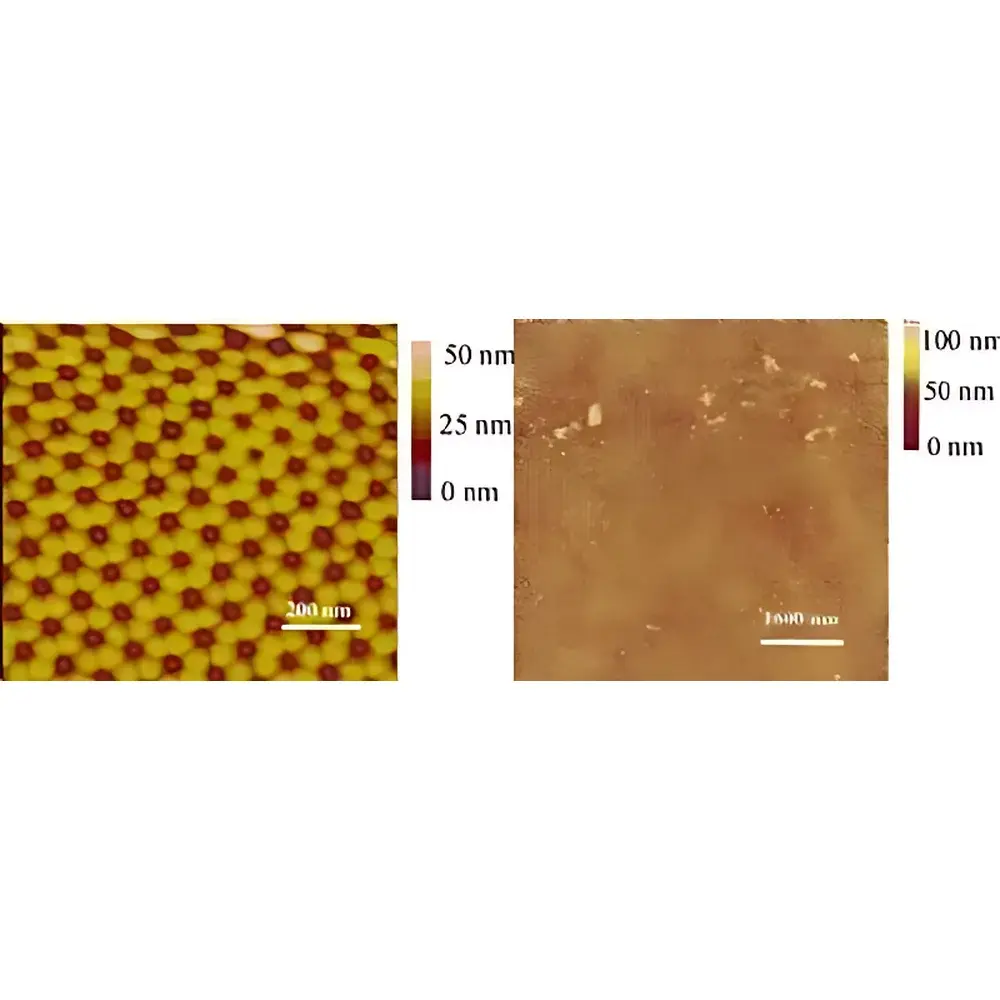
The Alumina Nanoporous Membrane AO-K is a high-precision inorganic filtration and substrate platform engineered for demanding life science and nanotechnology applications. Fabricated via controlled anodization of high-purity aluminum, this membrane consists of a highly ordered, amorphous aluminum oxide (Al2O3) matrix featuring vertically aligned, monodisperse cylindrical nanopores. Its operation relies on size-exclusion sieving at the nanoscale, where analyte retention occurs exclusively at the membrane surface—eliminating depth filtration artifacts and ensuring deterministic particle localization. Unlike polymeric membranes, AO-K exhibits intrinsic thermal stability up to 1000 °C, radiation resistance, and negligible extractables—making it suitable for ultra-clean workflows, high-temperature sterilization, and vacuum-compatible electron microscopy sample preparation.
Key Features
- Monodisperse nanopore architecture with tunable pore diameters from 10 nm to 200 nm (standard range: 30–70 nm), engineered for precise molecular cutoff control.
- High porosity (>50%) and uniform pore density (>1010 pores/cm2), enabling exceptional volumetric flux without sacrificing selectivity—critical for rapid buffer exchange, HPLC mobile phase degassing, and liposome extrusion.
- Optical transparency in hydrated state (refractive index: 1.60 ± 0.01), permitting real-time, label-free optical microscopy observation of adherent cells, bacteria, or retained particles directly on the membrane surface—without transfer-induced loss or distortion.
- Chemically inert across broad pH (1–14) and solvent compatibility (including acetone, ethanol, chloroform, and strong acids/bases), supporting harsh cleaning protocols and integration into organic synthesis or electrochemical cell assemblies.
- Structural rigidity and dimensional stability under thermal cycling and electron/ion beam exposure—validated for use as a robust support in SEM, TEM, and focused ion beam (FIB) analysis, as well as a high-fidelity stencil mask in nanolithography (e.g., RIE, EBL, IBE).
- Ultra-low background interference: non-fluorescent, non-autofluorescent, and free of leachable organics—enabling high signal-to-noise immunofluorescence, confocal imaging, and single-molecule detection assays.
Sample Compatibility & Compliance
The AO-K membrane is compatible with biological macromolecules (proteins, nucleic acids, exosomes), colloidal nanoparticles, bacteria (e.g., E. coli, B. subtilis), and synthetic vesicles. It meets material requirements for GLP-compliant filtration workflows and is routinely employed in USP particulate matter testing preparations. While not certified to ISO 9001 or ASTM F838 by default, its fabrication traceability, lot-specific pore size validation reports, and documented extractables profiles support regulatory submissions under FDA 21 CFR Part 11 when integrated into validated analytical methods.
Software & Data Management
As a passive, non-electronic consumable, the AO-K membrane does not incorporate embedded sensors or firmware. However, it is fully interoperable with standard laboratory data management systems through digital lot documentation—including calibrated pore size histograms (SEM/TEM-verified), thickness metrology (profilometry/XRR), and refractive index certificates. Customers receive PDF-based Certificate of Analysis (CoA) with each shipment, including batch number, anodization parameters, and QC imaging metadata—structured for ingestion into LIMS or ELN platforms compliant with ALCOA+ principles.
Applications
- HPLC & UHPLC sample preparation: Mobile phase filtration and degassing at ≤0.1 µm equivalent retention; eliminates column fouling while preserving solvent integrity.
- Single-cell and microbial analysis: Direct bacterial capture and on-membrane growth monitoring via phase-contrast or fluorescence microscopy—enabling colony enumeration, biofilm formation studies, and antibiotic susceptibility screening.
- Liposome and extracellular vesicle processing: Size-homogenization of lipid bilayers with minimal shear stress and no polymer contamination.
- Nanofabrication: As a self-assembled, high-aspect-ratio hard mask for pattern transfer in semiconductor R&D, plasmonic nanostructure templating, and quantum dot array synthesis.
- Advanced optical substrates: Exploitation of its periodic pore lattice as a 2D photonic crystal for wavelength-selective transmission, surface-enhanced Raman scattering (SERS) enhancement, and guided-mode resonance filtering.
FAQ
Can AO-K membranes be autoclaved?
Yes—membranes retain structural integrity and pore geometry after repeated autoclaving (121 °C, 20 min, saturated steam). No shrinkage, cracking, or pore collapse is observed.
Is pore size guaranteed per lot?
Each AO-K lot undergoes SEM cross-sectional imaging and statistical pore diameter analysis (n ≥ 500 pores); CoA reports mean pore diameter ± standard deviation and CV < 5%.
How should AO-K be mounted for optical microscopy?
Use standard glass slides with immersion oil or aqueous mounting media; the membrane’s transparency and flatness eliminate focus drift and spherical aberration.
Are custom thicknesses or pore sizes available?
Yes—custom configurations (2–200 µm thickness; 10–200 nm pore diameter; up to 5 cm2 area) are manufactured to specification; lead time varies from 4–12 weeks depending on process complexity.
Does AO-K exhibit any autofluorescence under UV or blue excitation?
No measurable autofluorescence is detected across 250–700 nm excitation wavelengths—confirmed by spectrophotometric emission scans and comparative imaging against commercial polymer membranes.




