
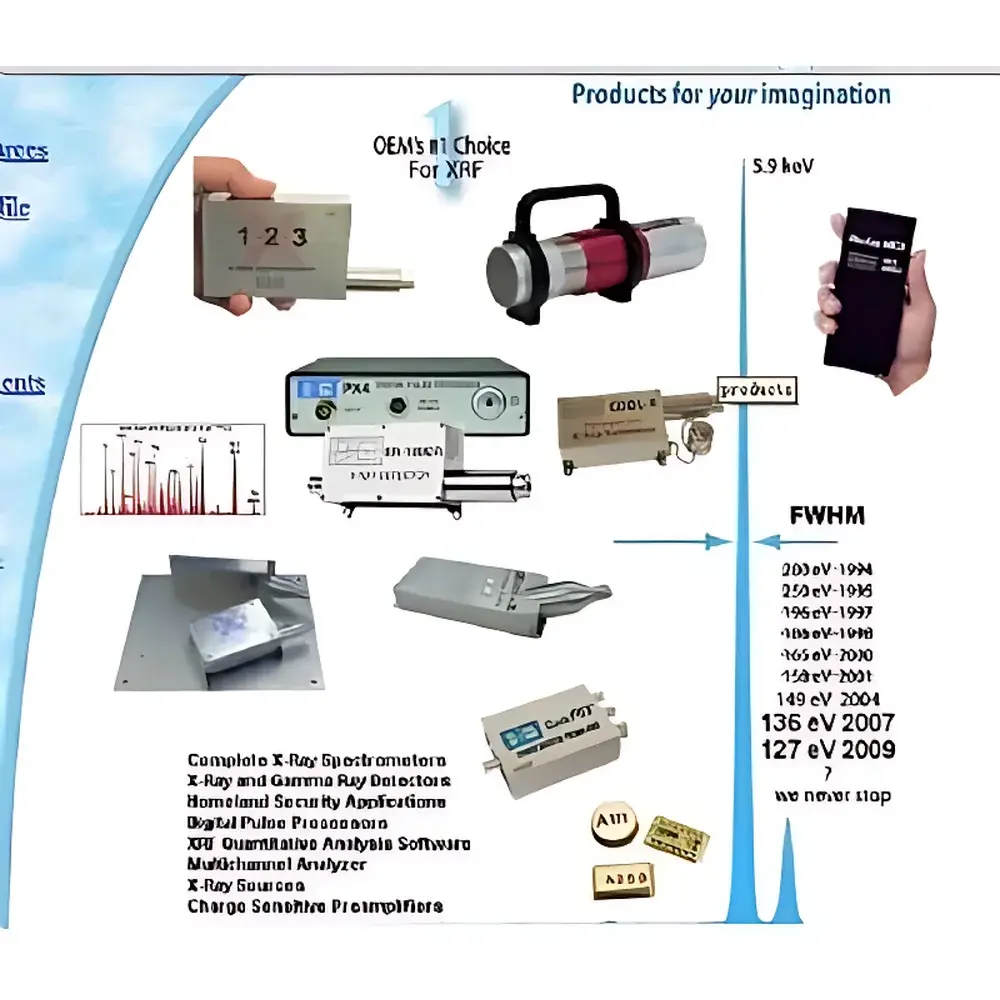
Amptek XR-100CR / XR-100SDD / XR-100T-CdTe / X-123 / X-123SDD / X-123CdTe / MCA8000A / Gamma-Rad5 X-ray and Gamma-ray Detection Systems
| Origin | USA |
|---|---|
| Manufacturer Type | Authorized Distributor |
| Import Status | Imported |
| Models | XR-100CR / XR-100SDD / XR-100T-CdTe / X-123 / X-123SDD / X-123CdTe / MCA8000A / Gamma-Rad5 |
| Pricing | Available upon Request |
Overview
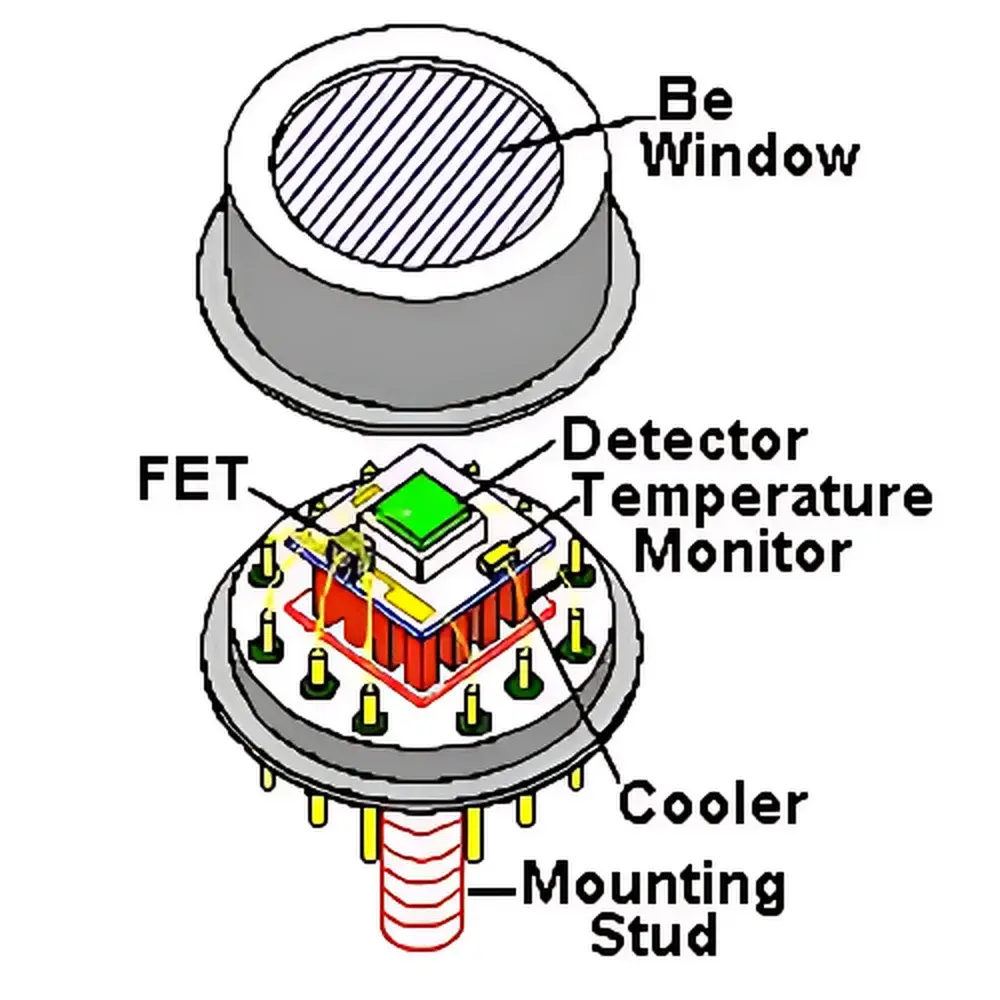
The Amptek XR-100 series, X-123 family, MCA8000A, and Gamma-Rad5 constitute a comprehensive portfolio of high-performance, compact X-ray and gamma-ray detection systems engineered for precision spectroscopy in laboratory, industrial, and field-deployable applications. These devices operate on the fundamental principle of energy-dispersive X-ray spectroscopy (EDS) or gamma-ray spectroscopy (GRS), where incident photons generate charge carriers in semiconductor detector materials—silicon PIN (Si-PIN), silicon drift detectors (SDD), cadmium telluride (CdTe), or scintillation-based sensors—whose collected charge is proportional to photon energy. Signal processing is performed by integrated low-noise preamplifiers, shaping amplifiers, and multichannel analyzers (MCAs), enabling high-fidelity spectral acquisition across defined energy ranges. Designed for compatibility with vacuum, helium-purged, or ambient-air measurement environments, these systems serve as core components in XRF analyzers, handheld spectrometers, nuclear safeguards instrumentation, environmental radiation monitoring, and academic research setups requiring trace elemental analysis or radionuclide identification.
Key Features
- Modular detector architecture supporting Si-PIN (XR-100CR), SDD (XR-100SDD, X-123SDD), CdTe (XR-100T-CdTe, X-123CdTe), and scintillator-based (Gamma-Rad5) configurations for optimal performance across soft X-ray, hard X-ray, and gamma-ray domains
- Energy resolution of ≤145–230 eV FWHM at 5.9 keV (Mn-Kα) for Si-based detectors; ≤7% at 662 keV (¹³⁷Cs) for Gamma-Rad5, meeting ASTM E1452 and IEC 62327 requirements for portable radiation detectors
- Active area options up to 25 mm² (standard Si detectors); CdTe variants optimized for higher-Z photon detection with reduced cooling demands
- Integrated digital pulse processing with real-time dead-time correction, pile-up rejection, and baseline restoration algorithms
- Maximum input count rate ≥200,000 counts per second (cps) with <0.1% nonlinearity across full dynamic range
- Temperature-stabilized gain control (<100 ppm/°C) ensuring long-term spectral stability without recalibration during routine operation
- USB 2.0 and RS-232 serial interfaces compliant with USB CDC class standards; driver support for Windows, Linux, and macOS
Sample Compatibility & Compliance
These detection systems accommodate diverse sample geometries—including solids, powders, thin films, liquids, and air filters—when integrated into custom or OEM analytical platforms. Detector window materials (e.g., beryllium, polymer, or ultra-thin Si₃N₄) are selected based on low-energy cutoff requirements (down to 1 keV for XR-100CR/X-123). Gamma-Rad5 meets ANSI N42.34 and IEC 62327-1:2017 for radiation portal monitor (RPM) and personal radiation detection (PRD) applications. All units comply with FCC Part 15 Class B and CE EMC Directive 2014/30/EU. Firmware and software architectures support audit trails, user access levels, and data integrity controls aligned with GLP and ISO/IEC 17025 laboratory accreditation frameworks. Optional firmware validation packages available for regulated environments requiring FDA 21 CFR Part 11 compliance.
Software & Data Management
Each system ships with Amptek’s PC-based Digital Pulse Processor (DPP) software suite, providing a complete graphical interface for spectral acquisition, visualization, calibration, and quantitative analysis. Core capabilities include real-time count rate display, cumulative statistics logging, automatic peak search and deconvolution (using Gaussian + tail modeling), ROI definition and integration, energy calibration via multi-point linear/quadratic fitting, and nuclide library management (including IAEA NuDat 3.0-compatible formats). The SDK includes C/C++, Python, and LabVIEW APIs with full register-level documentation, enabling seamless integration into custom DAQ systems, PLC-controlled analyzers, or automated QA/QC workflows. Raw spectrum files (.mca, .chn) adhere to IEEE 1451.4 metadata standards; export options include CSV, ASCII, and HDF5 for third-party analysis (e.g., PyMCA, AXIL, Genie 2000).
Applications
- Energy-dispersive X-ray fluorescence (EDXRF) for alloy verification, RoHS/WEEE screening, mining geochemistry, and cultural heritage artifact analysis
- Portable and benchtop XRF spectrometers used in scrap metal sorting, soil contamination assessment, and battery cathode material characterization
- Nuclear forensics and safeguards—identification and quantification of uranium/plutonium isotopes, fission products, and activation nuclides
- Environmental radiation monitoring—airborne particulate sampling, waterborne radionuclide detection, and decommissioning survey instrumentation
- Physics education and research—Compton scattering experiments, X-ray absorption edge studies, and detector response function modeling
- OEM integration into medical physics QA tools, synchrotron beamline diagnostics, and space-based particle detectors
FAQ
What is the minimum detectable energy for the XR-100CR detector?
The XR-100CR achieves effective detection down to ~1 keV in vacuum or He-purged environments, limited primarily by Be window transmission and electronic noise floor.
Can the Gamma-Rad5 be used for dose rate estimation?
Yes—when calibrated with traceable ¹³⁷Cs and ⁶⁰Co sources, Gamma-Rad5 supports dose rate calculation per IEC 60846-1 using stored fluence-to-dose conversion coefficients.
Is remote operation supported over Ethernet or Wi-Fi?
Native Ethernet is not built-in; however, USB-to-Ethernet converters with CDC-compliant drivers enable networked operation in controlled lab networks.
Do these systems require liquid nitrogen cooling?
No—all models feature Peltier thermoelectric cooling; SDDs operate at –20°C to –30°C, CdTe at –15°C, and Si-PIN at –10°C, eliminating cryogen dependency.
Are firmware updates provided free of charge?
Yes—Amptek offers lifetime firmware updates at no cost via registered user portal, including security patches and performance enhancements.






