
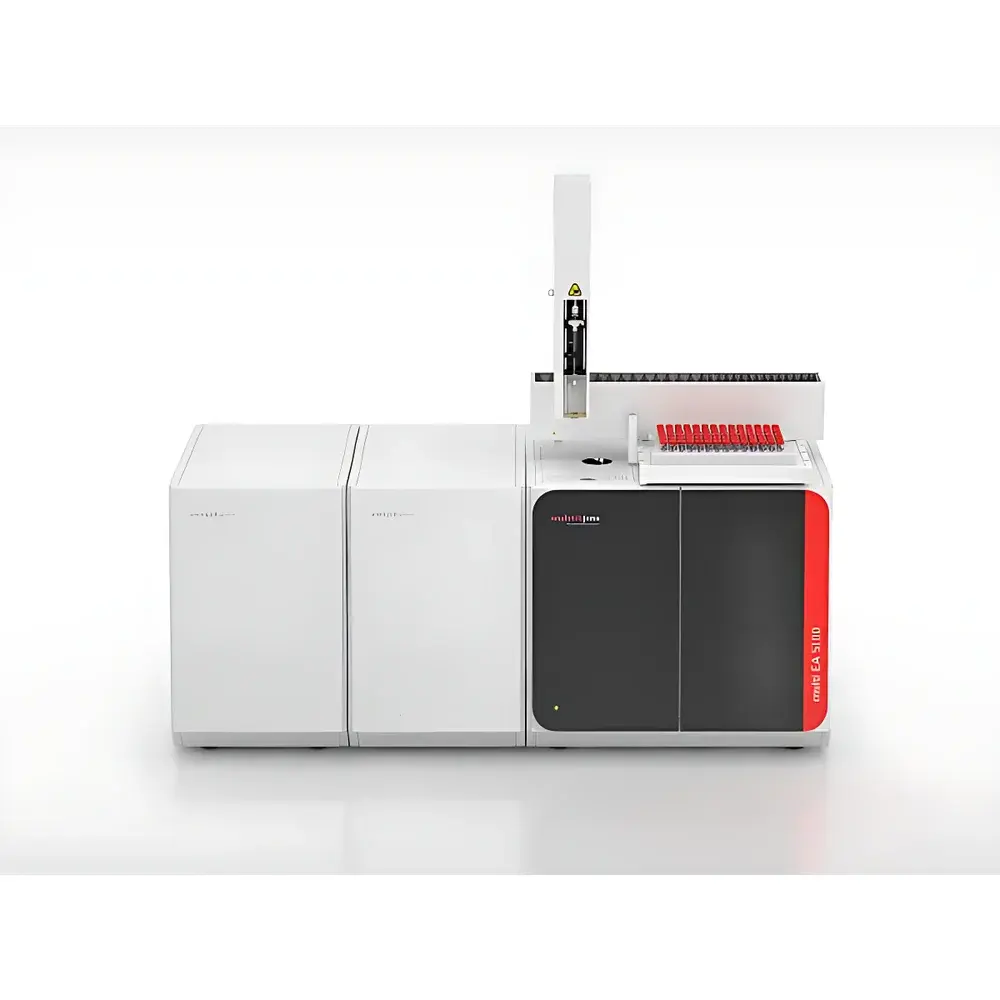
Analytik Jena multi EA 5100 Carbon, Sulfur, Nitrogen and Chlorine Elemental Analyzer
| Brand | Analytik Jena |
|---|---|
| Origin | Germany |
| Model | multi EA 5100 |
| Application Scope | Solid, Liquid and Gas Samples |
| Combustion Technology | Dual-Mode High-Temperature Catalytic Combustion (950–1150 °C) |
| Detection Principle | UV-Fluorescence (S), Chemiluminescence (N), Microcoulometric Titration (Cl), IR Absorption (C) |
| Sample Throughput | Up to 120 samples/day (with auto-sampler) |
| Compliance | ASTM D5291, D3120, D4294, D5762, ISO 20846, ISO 14596, UOP 390, IP 287, EN ISO 14596 |
| Safety Features | Integrated self-diagnostic system, real-time parameter monitoring, carbon deposit prevention via FIRE sensor technology |
| Automation | Optional high-capacity autosampler (up to 120 positions), gas sampling module (for LPG, natural gas, refinery streams) |
Overview
The Analytik Jena multi EA 5100 is a high-performance, modular elemental analyzer engineered for the simultaneous or independent quantification of carbon (C), sulfur (S), nitrogen (N), and chlorine (Cl) in solid, liquid, and gaseous matrices. It operates on a robust high-temperature catalytic combustion platform—capable of sustained operation between 950 °C and 1150 °C—followed by selective, trace-level detection using orthogonal analytical principles: ultraviolet fluorescence (S), chemiluminescence (N), microcoulometric titration (Cl), and non-dispersive infrared (NDIR) absorption (C). This multi-detection architecture ensures matrix-independent accuracy across diverse sample types—from crude oil and lubricants to polymers, coal, catalysts, and process gases—without requiring method reconfiguration or hardware swaps. Designed for continuous operation in regulated environments, the system integrates thermal stability control, active gas flow regulation, and real-time combustion efficiency feedback to maintain measurement integrity over extended duty cycles.
Key Features
- Dual-mode combustion furnace with adaptive temperature zoning: enables optimized oxidation for refractory solids (e.g., rubber, asphalt) and volatile liquids (e.g., gasoline, jet fuel) within a single platform
- FIRE (Fast Ignition & Residue Elimination) sensor technology: continuously monitors combustion chamber soot deposition and triggers automatic cleaning cycles, preventing carbon buildup and sustaining baseline stability over >10,000 analyses
- Modular expansion architecture: supports field-upgradable configurations—including liquid autosampler (120-position), gas sampling interface (pressure-regulated, with integrated cryo-trap and dilution), and halogen-specific reaction tube kits
- Self-diagnostic operating system: performs automated calibration verification, carrier gas purity checks, detector signal drift assessment, and combustion gas stoichiometry validation prior to each sequence
- Robust mechanical design: all critical components—including quartz combustion tubes, ceramic thermocouples, and IR cell optics—are rated for >50,000 thermal cycles and compatible with aggressive halogen-rich matrices
Sample Compatibility & Compliance
The multi EA 5100 accommodates heterogeneous sample forms without derivatization: powders (≤500 mg), viscous liquids (up to 100 µL direct injection), and pressurized gases (0.1–10 bar, via standardized DIN 32736 interface). Its validated performance meets or exceeds requirements of ASTM D5291 (C/H/N in petroleum products), ASTM D3120 (trace sulfur in distillates), ASTM D4294 (S in oils by XRF correlation), ASTM D5762 (N in refinery streams), ISO 20846 (S in automotive fuels), ISO 14596 (total halogens in waste oils), UOP 390 (N in hydrocarbons), and IP 287 (Cl in crude oil). The system supports full GLP/GMP compliance through audit-trail-enabled software, electronic signature capability, and 21 CFR Part 11–ready data handling protocols.
Software & Data Management
Control and evaluation are managed via the EA ControlSuite v4.x platform—a Windows-based application supporting method templates, sequence scheduling, real-time chromatogram overlay, and automated report generation per ISO/IEC 17025 requirements. All raw detector signals, calibration curves, maintenance logs, and user actions are time-stamped and cryptographically hashed. Data export complies with ASTM E1382 (analytical data interchange) and supports LIMS integration via OPC UA and ASTM WK57342-compliant XML schema. Software updates follow IEC 62443-3-3 cybersecurity guidelines, with firmware signing and secure boot enforced at hardware level.
Applications
The multi EA 5100 serves as a primary analytical workhorse in petroleum refining QA/QC labs (monitoring sulfur speciation in ultra-low-sulfur diesel), petrochemical R&D (tracking nitrogen poisoning in hydrotreating catalysts), polymer manufacturing (verifying chlorine content in PVC stabilizers), environmental testing (halogen screening in WEEE-compliant electronics), and regulatory compliance labs (EN 14049-compliant biofuel certification). Its ability to quantify total oxidizable halogens (TOX) in wastewater sludge—per EPA Method 9056A—further extends utility into municipal and industrial effluent monitoring.
FAQ
What sample types require pre-treatment before analysis on the multi EA 5100?
Solid samples with high inorganic salt content (e.g., seawater-impacted sediments) should undergo acid-wash pretreatment to avoid chloride interference; no pretreatment is required for hydrocarbons, plastics, or purified gases.
Can the system be validated for ISO/IEC 17025 accreditation?
Yes—the instrument includes built-in validation tools (linearity verification, recovery spikes, repeatability assessment), and documentation packages align with ILAC-G8:2022 requirements for elemental analyzers.
Is remote diagnostics supported?
Yes—via optional Secure Remote Access Module (SRAM), enabling encrypted technician access for firmware updates, error log review, and parameter optimization under ITAR-compliant network policies.
How often does the combustion tube require replacement?
Under typical refinery lab usage (8 h/day, 200 samples/week), quartz combustion tubes demonstrate ≥18 months service life; lifetime is extended by FIRE sensor–driven optimization of oxygen flow and temperature ramp profiles.
Does the system support unattended overnight operation?
Yes—fully automated sequences, including auto-calibration, blank correction, and post-run purge cycles, are scheduled and monitored via EA ControlSuite’s job queue manager with SMS/email alert escalation.





