
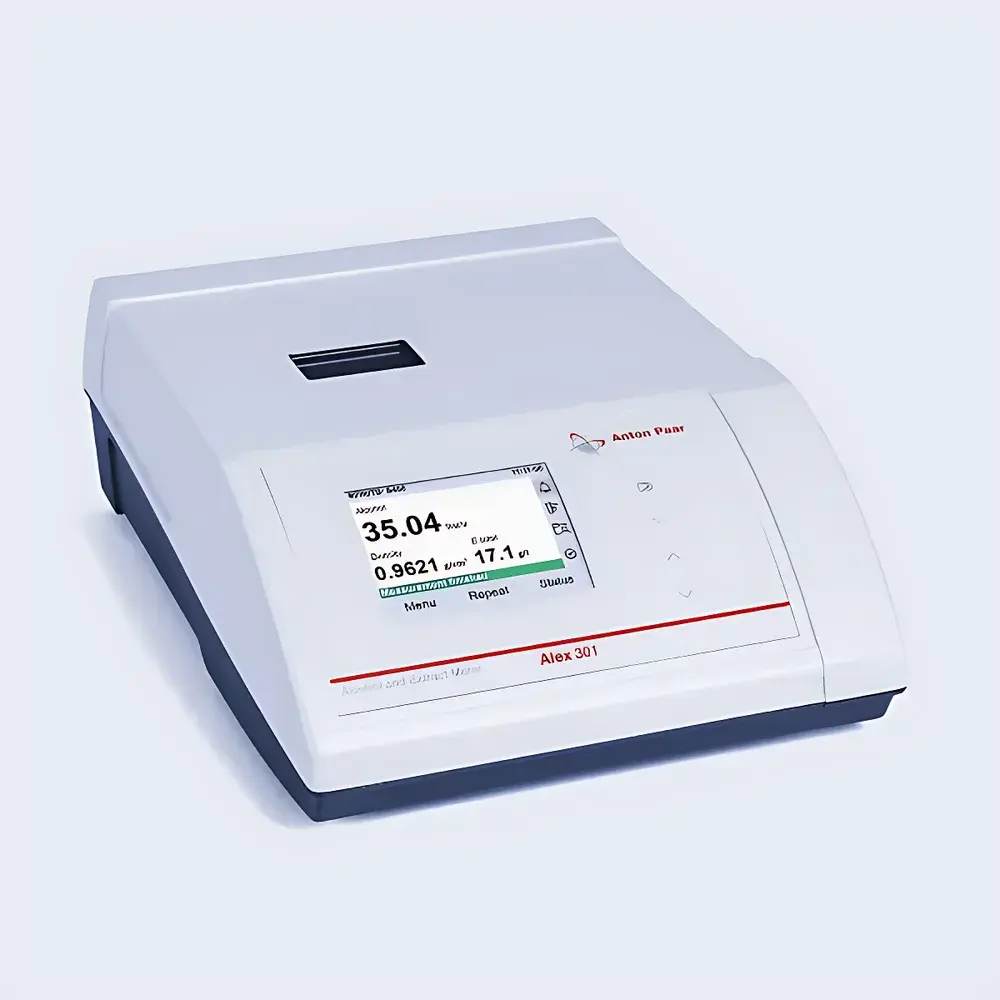
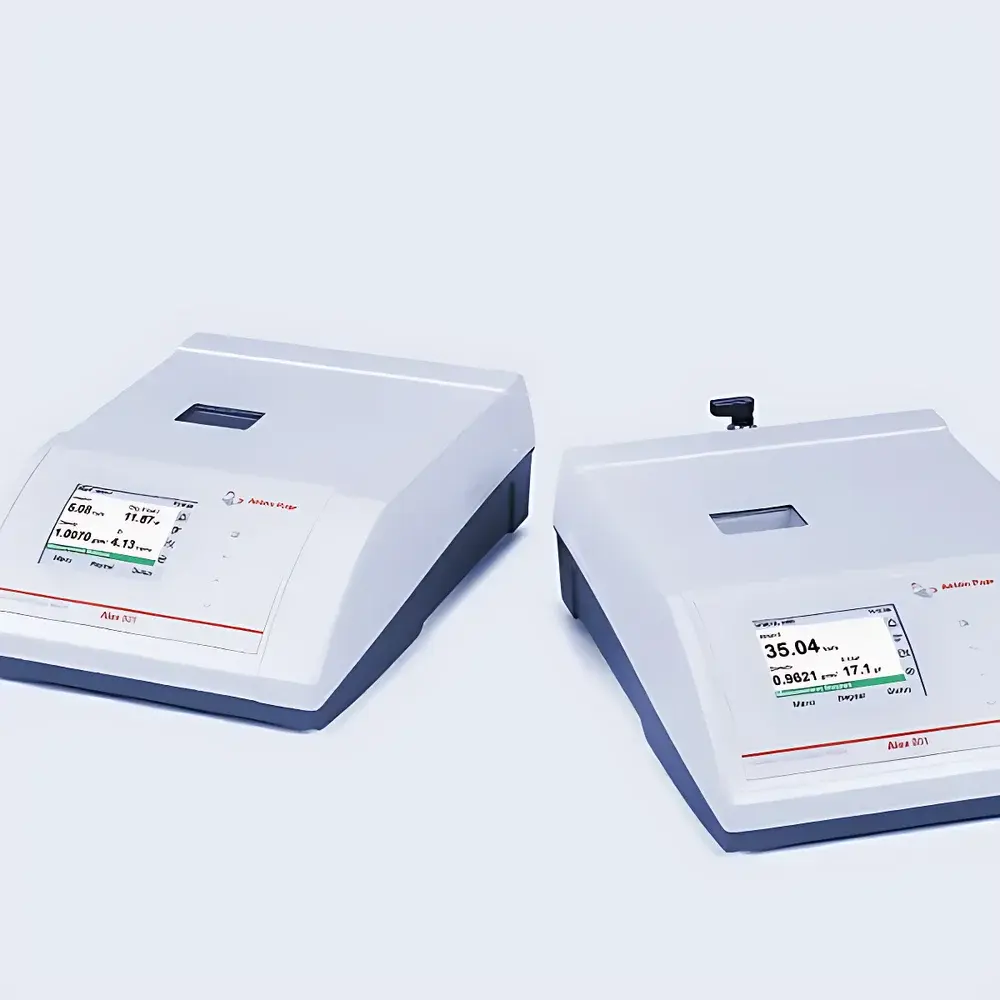
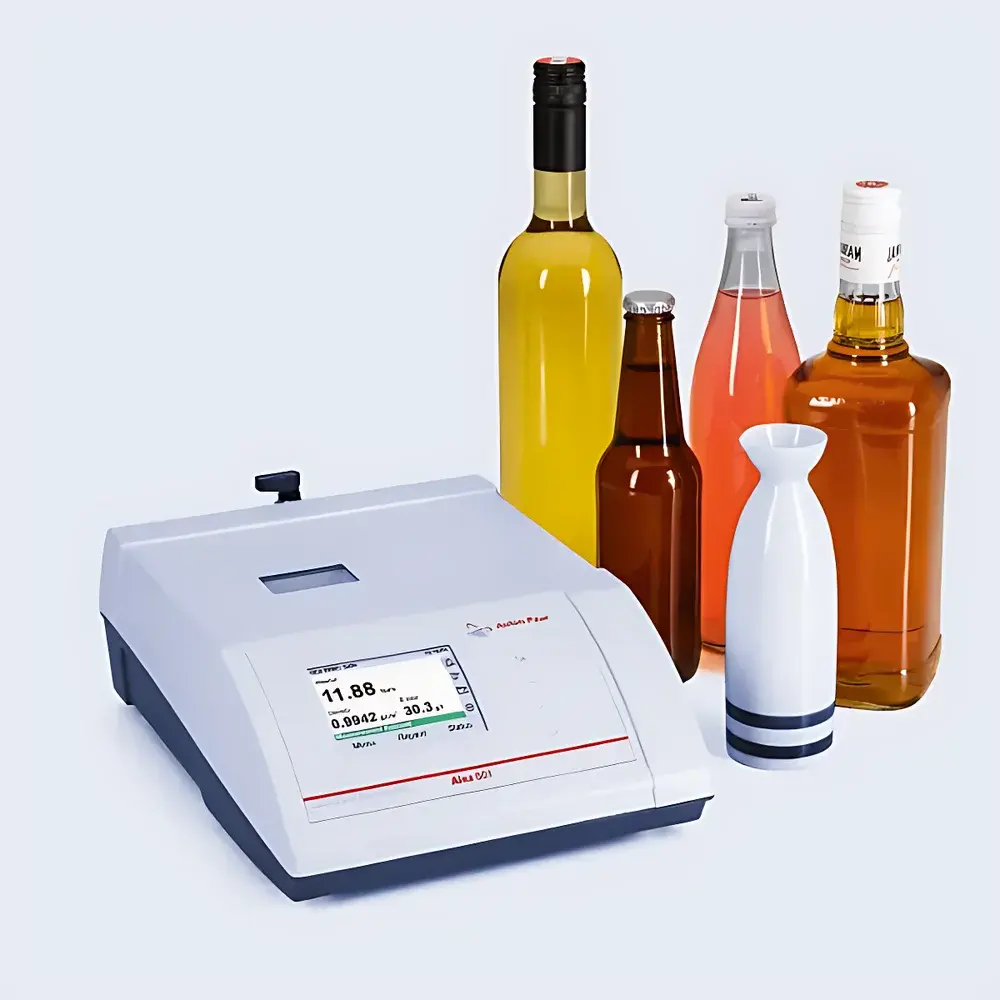
Anton Paar Alex 301/501 Alcohol and Extract Analyzer
| Brand | Anton Paar |
|---|---|
| Origin | Austria |
| Manufacturer Type | Original Equipment Manufacturer (OEM) |
| Product Origin | Imported |
| Model | Alex 301 / Alex 501 |
| Instrument Type | Brewery-Specific Analyzer |
| Application | Laboratory Use |
| Alcohol Range | Beer 0.5–15 % v/v |
| Density Measurement Range | 0.9500–1.200 g/cm³ |
| Accuracy (Alcohol) | ±0.25 % v/v (Alex 301), ±0.2 % v/v (Alex 501) |
| Repeatability (Alcohol) | 0.15 % v/v (Alex 301), 0.1 % v/v (Alex 501) |
| Density Accuracy | ±0.001 g/cm³ |
| Density Repeatability (Std. Dev.) | 0.0007 g/cm³ (Alex 301), 0.0005 g/cm³ (Alex 501) |
| Density Resolution | 0.0001 g/cm³ |
| Sample Volume | 40 mL |
| Dimensions (L × W × H) | 320 mm × 230 mm × 100 mm |
| Weight | ~2.4 kg |
| Operating Temperature | 10–32 °C |
| Sample Temperature Range | 15–25 °C (Alex 301), 10–30 °C (Alex 501) |
| Interfaces | 1× Bluetooth®, 1× RS-232 (9-pin D-sub), 1× USB-B |
| Power Supply | 100–240 V~, 50/60 Hz, ±10%, DC 15 V / 2.6 A |
| Power Consumption | 20 W |
Overview
The Anton Paar Alex 301/501 Alcohol and Extract Analyzer is a dedicated laboratory instrument engineered for precise, rapid, and fully automated determination of alcohol content (% v/v) and apparent extract (g/L) in fermented and distilled beverages. It integrates two complementary physical measurement principles: oscillating U-tube density determination (in accordance with ISO 15212-1 and ASTM D4052) and near-infrared (NIR) absorption spectroscopy. These measurements are fused via a proprietary multivariate calibration model—developed and validated across thousands of real-world beverage samples—to deliver direct, interference-resistant quantification without distillation, dilution, or manual calculation. Designed specifically for quality control and process monitoring in breweries, wineries, cideries, sake producers, and craft distilleries, the Alex platform eliminates reliance on time-consuming reference methods such as distillation-GC or pycnometry while maintaining metrological traceability to national standards.
Key Features
- Simultaneous dual-parameter output: Alcohol concentration (% v/v) and apparent extract (g/L) in a single 2–4 minute measurement cycle.
- Fermentation monitoring mode: Tracks up to 40 parallel fermentation batches in real time using density-derived apparent extract curves, with automatic timestamping and sample ID linkage to individual vessels.
- Integrated peristaltic pump and auto-filling system ensures consistent 40 mL sample introduction, minimizing operator variability and carryover risk.
- Onboard data storage for up to 1,000 measurements, including full fermentation profiles, with export capability via USB or Bluetooth® to AP Connect LIMS.
- Intelligent turbidity detection: Alerts users when sample clarity falls below defined optical thresholds, prompting optional filtration using the included sample preparation kit (optimized for hazy beers and unfiltered wines).
- User-definable method templates: Store instrument configurations—including temperature compensation settings, NIR integration time, and density cell rinse protocols—for beer, wine, cider, sake, spirits, and liqueurs.
- Calibration with deionized water only: No certified reference standards required for routine operation; factory-installed primary calibrations remain stable over extended intervals.
Sample Compatibility & Compliance
The Alex 301/501 accommodates a broad spectrum of alcoholic beverages without pretreatment: filtered and unfiltered lagers, stouts, and mixed-culture sour beers; still and sparkling wines (white, red, rosé); traditional and flavored ciders; undiluted sake; and non-turbid spirits (vodka, gin, whiskey) and high-sugar liqueurs (up to 450 g/L total extract). Its measurement validity is supported by conformance to key international standards: density results comply with ISO 15212-1 (determination of density of liquids by oscillating densitometry) and ASTM D4052; alcohol quantification aligns with OIV Method OIV-MA-AS313-01A (alcohol determination in wine by NIR/density fusion) and EN 13190 (alcohol in fermented beverages). The device meets IEC 61010-1 safety requirements for laboratory equipment and supports audit-ready data integrity under GLP and GMP frameworks when paired with AP Connect software enabling 21 CFR Part 11-compliant electronic signatures and full audit trails.
Software & Data Management
AP Connect serves as the central laboratory execution system (LES) for all Anton Paar analytical instruments. When connected to the Alex 301/501, it transforms raw measurements into auditable, contextualized quality records. Users can define SOP-driven workflows, assign measurements to specific batches or tanks, attach metadata (operator, location, raw material lot), and generate PDF reports compliant with internal QA protocols or external regulatory submissions. All data—including timestamps, environmental conditions, calibration logs, and raw sensor outputs—are stored immutably with cryptographic hashing. AP Connect supports role-based access control, automatic backup to network drives or cloud repositories, and seamless integration with enterprise LIMS or ERP systems via standardized APIs (REST/JSON). Manual transcription errors are eliminated, and full measurement traceability—from sample receipt to final release—is maintained throughout the product lifecycle.
Applications
- Brewery QC: Final gravity verification, alcohol-by-volume (ABV) labeling compliance, consistency checks across seasonal releases and pilot batches.
- Winery Operations: Monitoring alcoholic fermentation kinetics, predicting dryness, verifying residual sugar equivalence, and supporting appellation-specific alcohol declarations.
- Cider & Sake Production: Direct analysis of cloudy apple musts and rice-based fermentates without centrifugation or filtration artifacts.
- Distillery R&D: Rapid screening of spirit cuts, aging stability studies, and proof verification prior to bottling or blending.
- Tax & Regulatory Reporting: Generating legally defensible ABV values for excise duty calculations and label claims in EU, US TTB, and other jurisdictional frameworks.
- Process Troubleshooting: Early identification of stuck or sluggish fermentations via real-time deviation from expected density trajectories.
FAQ
Does the Alex 301/501 require distillation or chemical reagents?
No. It performs direct, reagent-free analysis using physical property measurements only.
Can it measure high-alcohol spirits like barrel-aged whiskey or fortified wines?
Yes—within specified ranges (up to 47 % v/v for clear spirits; up to 20 % v/v for wine and sake) and with appropriate method selection.
How is temperature controlled during measurement?
The alcohol measurement cell is thermostatted at 20 °C; the density cell operates at ambient temperature but applies digital thermal compensation to 20 °C reference conditions.
Is validation support available for regulated environments?
Yes—Anton Paar provides IQ/OQ documentation packages, calibration certificates traceable to NIST/PTB standards, and AP Connect validation kits aligned with FDA 21 CFR Part 11 and EU Annex 11 requirements.
What maintenance is required beyond routine cleaning?
Annual verification of density cell performance and NIR source stability is recommended; no user-serviceable optical or mechanical components require periodic replacement.






