
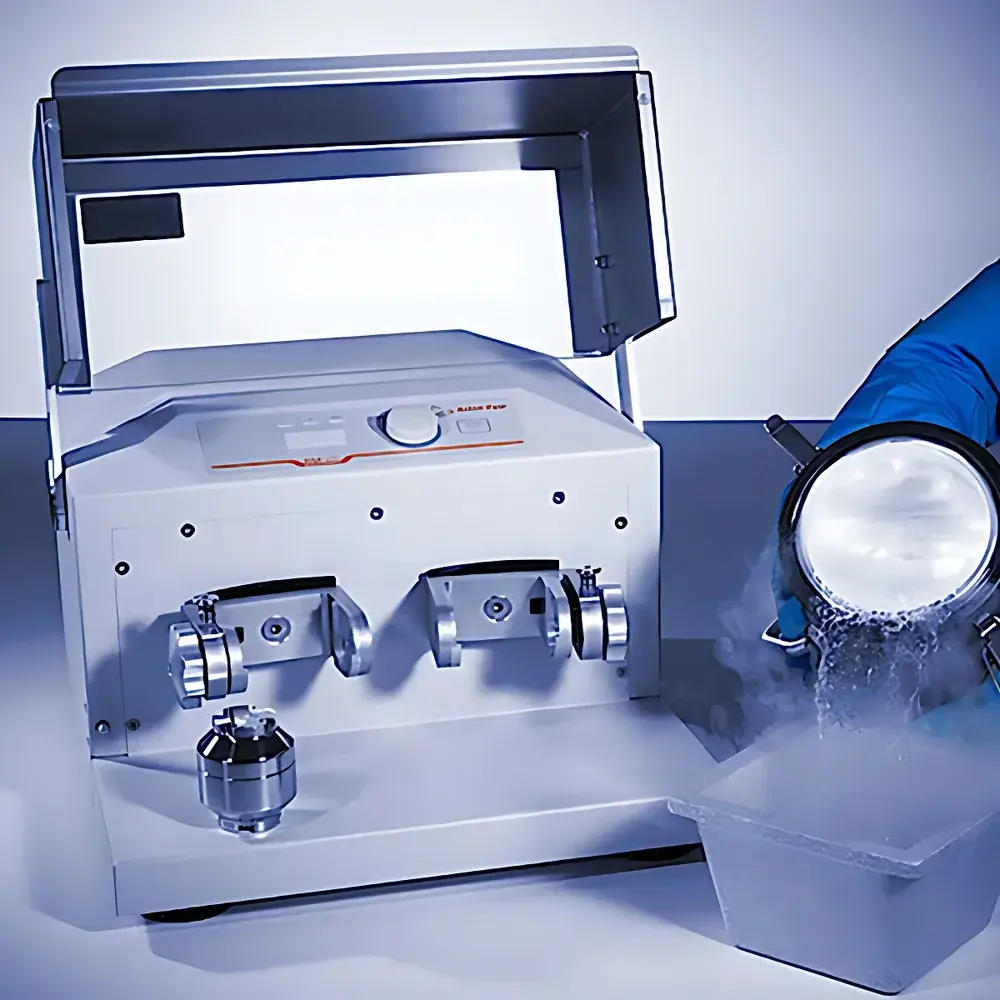
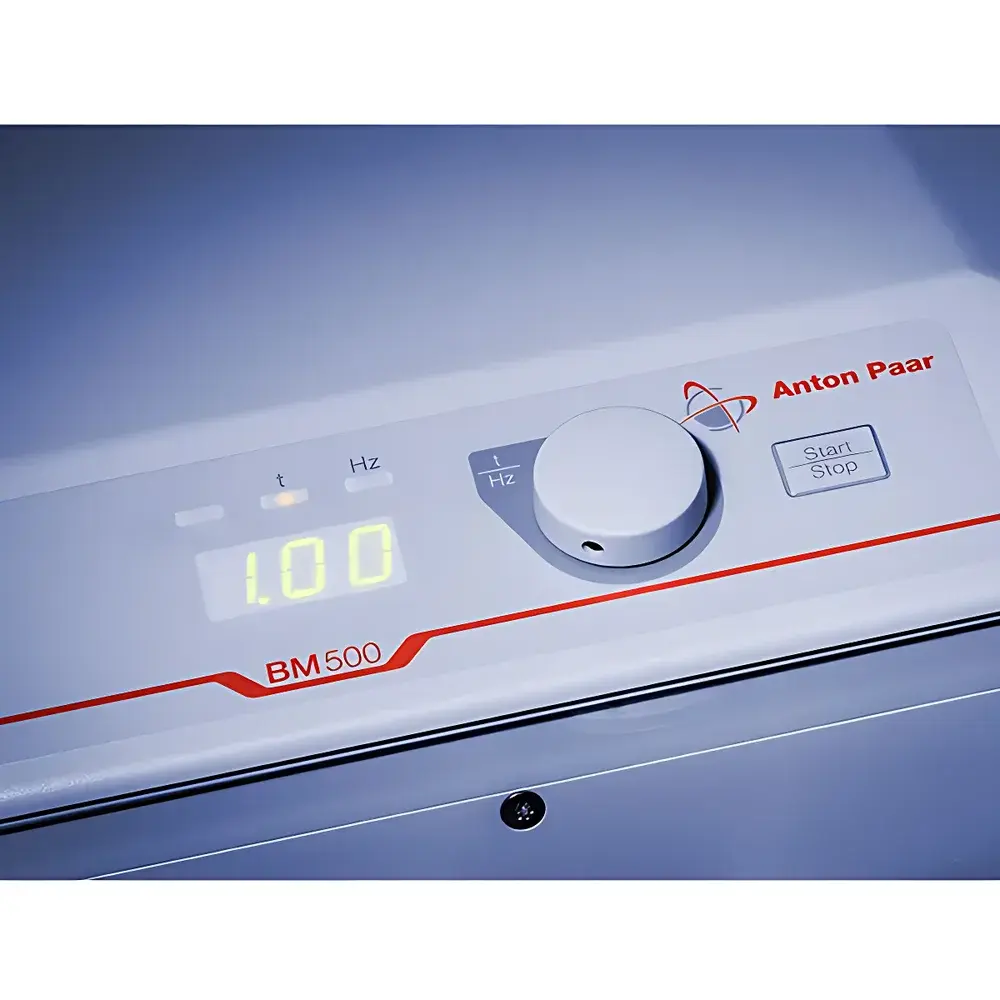
Anton Paar BM 500 Planetary Ball Mill with Zirconia Grinding Vials
| Brand | Anton Paar |
|---|---|
| Origin | Austria |
| Model | BM 500 |
| Instrument Type | Planetary Ball Mill |
| Sample Suitability | Hard, brittle, fibrous, and soft materials |
| Final Particle Size | ≤1 µm |
| Feed Size | ≤8 mm (e.g., grains), grinding balls ≤25 mm diameter |
| Batch Capacity | 2 × 50 mL |
| Vibration Frequency Range | 3–30 Hz (adjustable in 0.1 Hz increments) |
| Grinding Time | 5 s–99 min (1 s steps <10 min |
| Rated Power | 200 W |
| Operating Voltage | 230 V ±10 %, 50/60 Hz or 115 V ±10 %, 50/60 Hz |
| Ambient Temperature | 5–40 °C |
| Relative Humidity | <85 % RH (non-condensing) |
| Dimensions (W×D×H) | 385 × 420 × 240 mm (465 mm with lid open) |
| Weight | 42 kg |
Overview
The Anton Paar BM 500 is a high-precision planetary ball mill engineered for reproducible, controlled comminution and homogenization of diverse laboratory samples. It operates on the principle of high-energy impact and shear forces generated by the simultaneous rotation of grinding vials around their own axes and a central sun wheel — a configuration defined by ISO 17892-2 and ASTM D4294 for mechanical sample preparation prior to elemental or structural analysis. Designed for routine QC, R&D, and academic research, the BM 500 delivers sub-micron particle size reduction (down to ≤1 µm) across heterogeneous matrices including metals, geological specimens, pharmaceutical excipients, plant tissues, and ceramic precursors. Its brushless DC motor ensures stable torque delivery over extended duty cycles, while digital frequency control enables precise kinetic energy modulation — critical for preserving thermolabile compounds or avoiding amorphization during milling.
Key Features
- Planetary motion architecture with dual-vial symmetry, enabling true parallel processing of two independent 50 mL batches under identical mechanical conditions — essential for method validation, reference standard preparation, and statistical replication.
- Digital frequency regulation (3–30 Hz, 0.1 Hz resolution) coupled with programmable time control (5 s–99 min, step-adjustable) allows fine-tuned optimization of impact energy per unit time, directly influencing specific surface area and crystallinity changes.
- Zirconia grinding vials and media included as standard — chemically inert, non-contaminating, and resistant to wear, ensuring trace-level integrity for ICP-MS, XRF, or leaching studies where Zr, Al, or Si background interference must be minimized.
- Three-color LED status indicator (green = ready, yellow = active, red = error/pause) provides at-a-glance operational feedback without requiring interface interaction — supporting GLP-compliant documentation workflows.
- Integrated safety interlock system halts operation immediately upon lid opening, complying with EN 61000-6-2 (EMC immunity) and EN 61000-6-3 (emission) standards for laboratory equipment.
- Compact footprint (385 × 420 × 240 mm) and low acoustic emission (<65 dB(A)) permit installation in shared analytical labs without dedicated vibration-isolation infrastructure.
Sample Compatibility & Compliance
The BM 500 accommodates feed particles up to 8 mm in diameter (e.g., crushed rock fragments, cereal grains, polymer pellets) and grinding balls up to 25 mm. Its versatility extends to elastic, fibrous (e.g., cellulose, wool), hygroscopic, and volatile matrices — particularly when used with cryogenic adapters (optional) for liquid nitrogen-cooled milling. All wet and dry grinding protocols are compatible with ISO 13320 (laser diffraction particle sizing) and USP (uniformity of dosage units) sample prep requirements. The zirconia vial system meets FDA 21 CFR Part 11 expectations for material traceability and absence of extractables, supporting GMP-aligned pharmaceutical development.
Software & Data Management
While the BM 500 operates via intuitive rotary dial programming (no PC dependency), all parameter sets — frequency, duration, pause intervals, and sequence repeats — are retained in non-volatile memory. Each run logs timestamped metadata (start/stop time, setpoints, actual frequency deviation <±0.2 Hz) accessible via front-panel recall. For audit-ready environments, optional RS-232 or USB connectivity supports integration into LIMS platforms with configurable CSV export, fulfilling ALCOA+ data integrity principles (Attributable, Legible, Contemporaneous, Original, Accurate).
Applications
- Preparation of homogeneous powders for XRD phase quantification and Rietveld refinement.
- Reduction of metallurgical slags and ores to <1 µm for accurate Fe, Cu, Pb assay by ICP-OES.
- Cell disruption and matrix homogenization of plant biomass prior to metabolomic LC-MS profiling.
- Production of nanostructured catalyst precursors via mechanochemical synthesis (e.g., MoS₂, CoFe₂O₄).
- Stabilization of amorphous drug forms through controlled milling kinetics — validated against pharmacopeial dissolution testing (USP ).
- Generation of certified reference materials (CRMs) requiring inter-laboratory reproducibility per ISO Guide 35.
FAQ
What grinding media materials are compatible with the BM 500?
Stainless steel, tungsten carbide, agate, and zirconia vials and balls are supported; material selection must align with sample chemistry to prevent catalytic degradation or elemental contamination.
Can the BM 500 perform cryogenic milling?
Yes — with optional liquid nitrogen cooling jackets and insulated vial holders, enabling sub-ambient operation down to –196 °C for heat-sensitive polymers or biological tissues.
Is the BM 500 compliant with FDA 21 CFR Part 11 for electronic records?
When configured with optional data logging and external interface modules, full audit trail functionality (user ID, timestamp, parameter change history) satisfies Part 11 requirements for regulated pharmaceutical and clinical labs.
How is reproducibility ensured between dual-vial runs?
Mechanical synchronization of both vial carriers — including identical eccentricity, rotational inertia, and phase alignment — guarantees ≤±1.5% variance in specific impact energy, verified per ISO 17892-2 Annex B calibration procedures.
What maintenance is required for long-term accuracy?
Annual verification of frequency output (via calibrated tachometer) and torque response curve, plus inspection of vial clamping mechanism wear — documented in the included maintenance log template aligned with ISO/IEC 17025 clause 6.4.10.



