
Aolong X-ray Non-destructive Testing & Micro-CT Analysis Service
| Brand | Aolong |
|---|---|
| Origin | Liaoning, China |
| Manufacturer Type | Direct Manufacturer |
| Region of Origin | Domestic (China) |
| Model | AOLONG2 |
| Pricing | Upon Request |
Overview
Aolong X-ray Non-destructive Testing & Micro-CT Analysis Service is a comprehensive third-party analytical offering provided by Dandong Aolong Ray Group Co., Ltd., a certified manufacturer of industrial radiographic and computed tomography systems. This service leverages physics-based imaging modalities—including high-energy industrial CT, micro-focus CT (μCT), real-time X-ray radiography, and conventional X-ray film/digital radiography—to deliver quantitative, non-invasive structural and compositional characterization of solid materials. The core measurement principles include X-ray attenuation contrast for density mapping, geometric magnification for sub-micron feature resolution (down to ~1–5 µm depending on source focal spot size and geometry), and phase-contrast enhancement where applicable. Unlike benchtop instrumentation, this service-oriented model integrates instrument operation, image reconstruction (FDK, iterative algorithms), volumetric segmentation, defect quantification, and crystallographic analysis—enabling full metrological traceability in accordance with ISO/IEC 17025 requirements for testing laboratories.
Key Features
- Multi-modal imaging platform: Simultaneous support for high-energy CT (up to 450 kV), micro-focus CT (≤5 µm spatial resolution), and real-time digital radiography for dynamic process monitoring.
- Integrated metrology suite: Volumetric dimensional analysis (GD&T-compliant), porosity & inclusion quantification (ASTM E1559, ISO 15786), wall thickness mapping, and internal void distribution modeling.
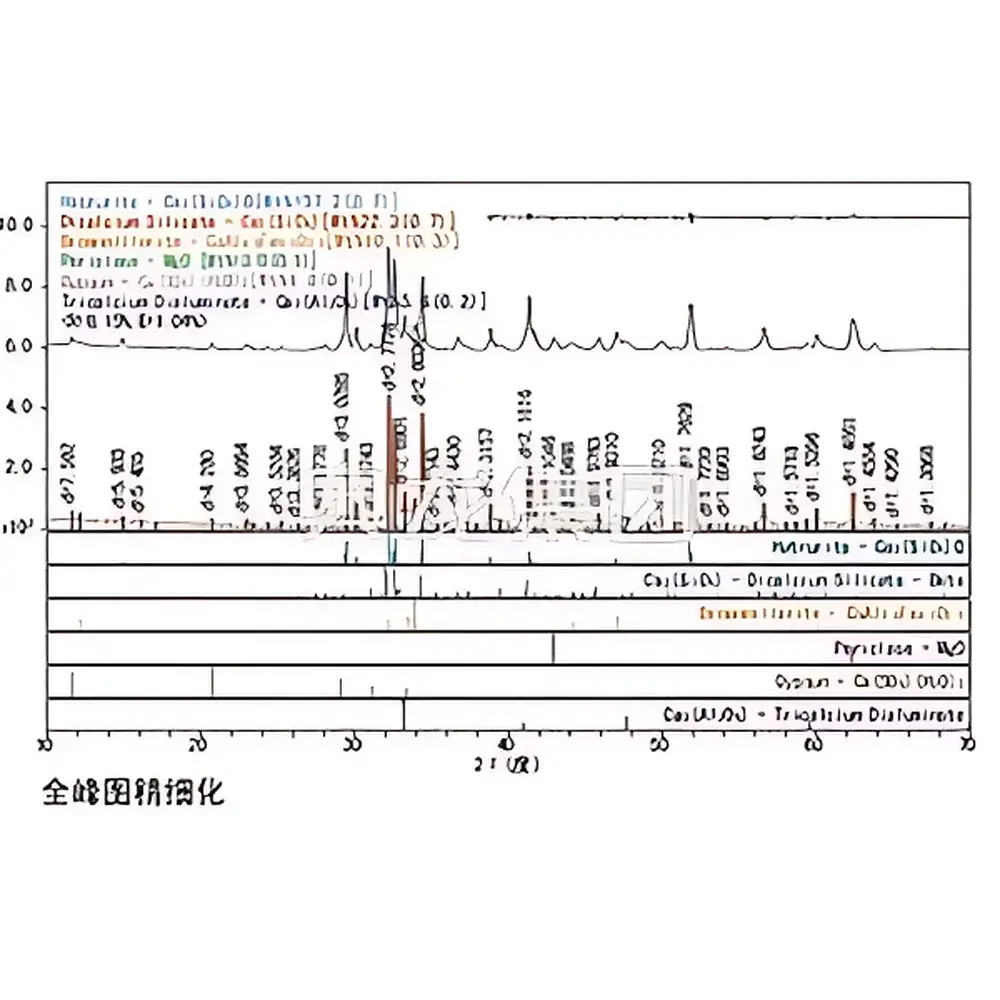
- Crystallographic extension capability: Equipped with laboratory-grade X-ray diffraction (XRD) modules for phase identification (ICDD PDF-4+ database), Rietveld refinement, lattice parameter determination, and residual stress evaluation via sin²ψ method.
- Material-agnostic sample handling: Accommodates specimens from 2 mm (electronic components) to 1200 mm (railway couplers, pressure vessels), with custom fixturing for high-precision alignment and thermal/mechanical stability during long-scan acquisitions.
- Regulatory-ready reporting: All analyses generate audit-trail-enabled reports compliant with ISO 9001, ASME BPVC Section V, and customer-specific QA/QC protocols (e.g., automotive PPAP Level 3).
Sample Compatibility & Compliance
The service accepts diverse sample types across industrial and research domains: metallic castings (Al, Mg, Cu alloys), ceramic composites, polymer matrix composites, geological specimens, pharmaceutical tablets, food packaging integrity samples, and archaeological artifacts. Samples are evaluated per ASTM E2737 (CT data quality metrics), ISO 15786 (porosity measurement), and EN 1435 (weld inspection). For regulated industries—including aerospace (AS9100), medical devices (ISO 13485), and nuclear components—the workflow incorporates documented calibration records, equipment qualification (IQ/OQ), and operator certification logs. All radiation safety procedures conform to national regulations (GBZ 138–2022) and IAEA Safety Standards Series No. GSR Part 3.
Software & Data Management
Data acquisition and processing utilize vendor-validated software stacks including Phoenix Datos|x (for CT reconstruction), VGStudio MAX (for volume rendering and defect analytics), and HighScore Plus (for XRD pattern indexing and quantitative phase analysis). Raw projection datasets, reconstructed volumes (DICOM, TIFF, NRRD), and final reports are archived in a secure, ISO 27001-aligned storage environment. Clients receive encrypted download links with SHA-256 checksum verification. Optional integration with LIMS or PLM systems is supported via RESTful API or CSV/Excel export, enabling traceable data ingestion into enterprise quality management frameworks. Audit trails meet FDA 21 CFR Part 11 requirements for electronic records and signatures when requested.
Applications
- Automotive & Mobility: Porosity analysis in aluminum die-cast wheel hubs; internal defect mapping in EV battery housings; assembly verification of brake calipers and turbocharger casings.
- Aerospace & Defense: In-service inspection of turbine blades; additive manufacturing part validation (powder bed fusion, EBM); residual stress profiling in welded airframe joints.
- Electronics & Semiconductors: Solder joint integrity assessment; wire bond pull-test correlation; delamination detection in stacked-die packages.
- Materials Science Research: In situ heating/cooling CT for phase transformation kinetics; grain boundary network reconstruction in polycrystalline ceramics; pore network modeling for catalyst substrates.
- Geosciences & Cultural Heritage: Pore structure quantification in shale cores; fossil internal morphology reconstruction; corrosion layer thickness measurement on ancient metal artifacts.
FAQ
What sample preparation is required prior to submission?
Minimal preparation is needed—samples must be clean, dry, and free of loose particulates. Metallic parts may require surface passivation if oxidation interferes with edge detection. No coating or sectioning is necessary.
How long does a typical CT scan and analysis take?
Standard turnaround is 5–7 business days for routine inspections (e.g., porosity quantification). Complex workflows—including multi-condition thermal CT or full Rietveld refinement—require 10–15 days, with expedited options available under contractual agreement.
Can you provide raw CT data and reconstruction parameters?
Yes. Clients receive full projection datasets, reconstruction metadata (voxel size, filter kernel, number of iterations), and segmented VOI files in open formats (NRRD, STL, CSV) for independent validation or further simulation input.
Do you offer method development support for novel applications?
Yes. Our application engineers collaborate on protocol design—including scan geometry optimization, contrast agent selection, and custom segmentation rule sets—for emerging use cases such as soft-tissue mimics or low-Z composite inspection.
Is your laboratory accredited to ISO/IEC 17025?
While the parent manufacturing facility holds ISO 9001:2015 certification, the analytical service division operates under an internal quality management system aligned with ISO/IEC 17025 principles. Full accreditation is pending; current scope includes CT-based dimensional metrology and XRD phase analysis per published SOPs.



