
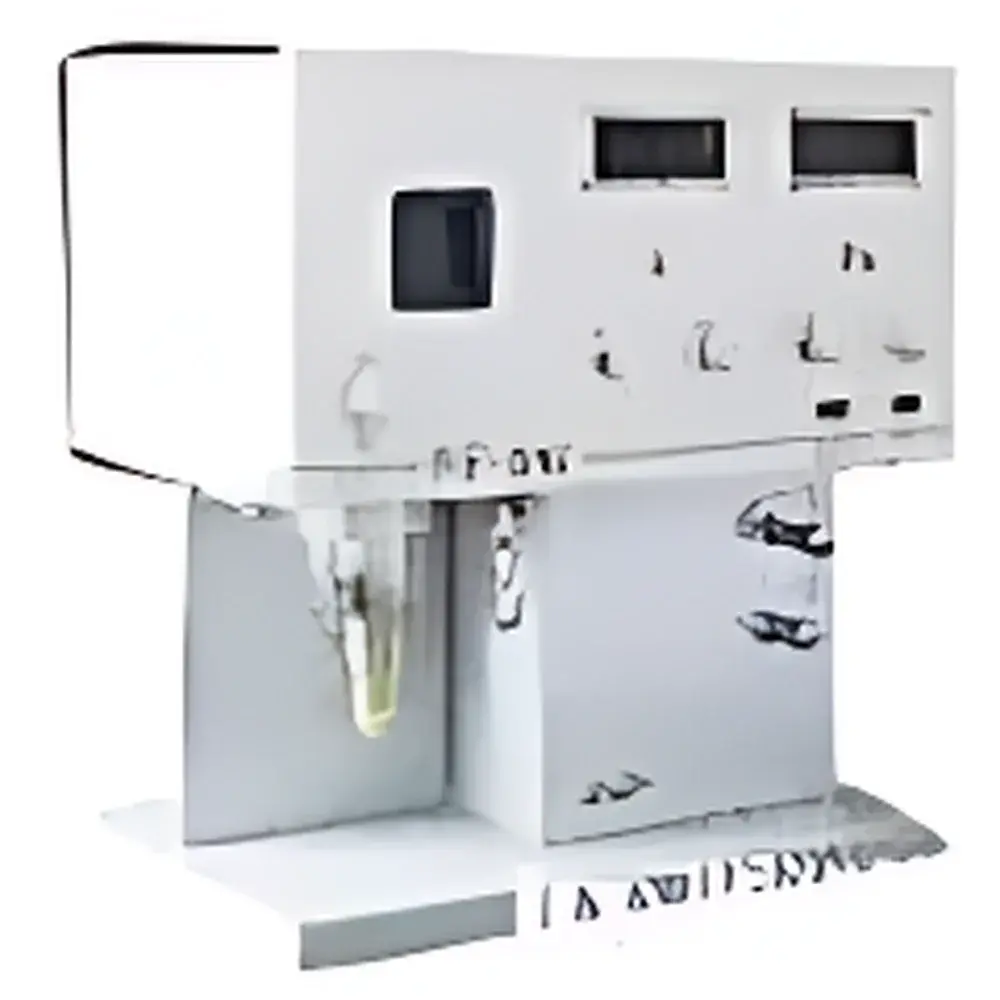
Aopu FP650 Cement-Specific Flame Photometer
| Origin | Shanghai, China |
|---|---|
| Manufacturer Type | Authorized Distributor |
| Origin Category | Domestic (China) |
| Model | FP650 |
| Price | USD 1,280 (FOB Shanghai) |
| Detection Range (Clinical Mode) | K: 0.0–9.9 mmol/L, Na: 0.0–199 mmol/L |
| Repeatability | CV ≤ 2% |
| Linearity Error | ≤ 5% |
| Low-Range Mode | K: 0.0–19.9 mmol/L / Na: 0.0–199 mmol/L |
| Extended-Range Mode | K: 0.0–80 mmol/L / Na: 0.0–800 mmol/L |
| Fuel Gas | Liquefied Petroleum Gas (LPG) |
Overview
The Aopu FP650 Cement-Specific Flame Photometer is a dedicated atomic emission spectrometer engineered for rapid, reliable quantification of alkali metals—primarily potassium (K) and sodium (Na)—in cement, clinker, raw meal, and supplementary cementitious materials (SCMs). Based on the principle of flame atomic emission spectroscopy (FAES), the instrument atomizes liquid samples in a stable LPG-fueled air–fuel flame, where thermally excited K⁺ and Na⁺ ions emit characteristic photons at 766.5 nm and 589.0 nm, respectively. These emissions are isolated via interference filters and measured by a low-noise silicon photodiode detector. Unlike general-purpose flame photometers, the FP650 incorporates hardware and calibration logic optimized for high-salt, high-calcium matrices typical of cement slurry digests (e.g., HCl/HNO₃ leachates), minimizing ionization suppression and inter-element spectral overlap. Its design adheres to core analytical requirements defined in ASTM C114 (Standard Test Methods for Chemical Analysis of Hydraulic Cement) and supports routine QC/QA workflows aligned with ISO 9001 and ISO/IEC 17025 laboratory accreditation frameworks.
Key Features
- Dedicated optical path architecture with dual-wavelength interference filters (766.5 nm ± 2 nm for K; 589.0 nm ± 2 nm for Na), pre-aligned and sealed against dust ingress
- Digital LED display with real-time concentration readout in mmol/L—no analog meter drift or parallax error
- Integrated LPG pressure regulation and air–gas mixing chamber ensuring consistent flame stoichiometry across ambient temperature variations (10–35 °C)
- Two calibrated range modes: standard (optimized for clinical-grade precision) and extended (for undiluted cement digestates up to 800 mmol/L Na)
- Robust stainless-steel nebulizer and corrosion-resistant burner head designed for repeated exposure to acidic sample solutions (pH < 2)
- No external PC required for operation—self-contained calibration storage for up to 5 user-defined standard curves
Sample Compatibility & Compliance
The FP650 accepts aqueous sample solutions prepared per ASTM C114 Section 7 (acid digestion followed by dilution to known volume). It accommodates sample viscosities up to 3.5 cP and suspended solids < 0.1% w/v—conditions routinely met after centrifugation or filtration of cement leachates. The instrument meets essential performance criteria referenced in EN 196-2 (Methods of testing cement — Chemical analysis) and supports GLP-compliant data integrity when operated with documented calibration logs and daily check standards. While not 21 CFR Part 11 certified as a standalone unit, its output (printed or manually recorded results) is fully traceable and suitable for inclusion in GMP-regulated batch release documentation under supervised procedural controls.
Software & Data Management
The FP650 operates without proprietary software—data acquisition and calculation are performed onboard using fixed-point arithmetic firmware. Concentration values are computed via linear or quadratic regression against stored calibration points (up to 5 standards per element). All calibration parameters—including slope, intercept, correlation coefficient (r²), and date/time stamp—are retained in non-volatile memory. Users may export results manually into LIMS or Excel via standardized reporting templates. For laboratories requiring electronic audit trails, integration with third-party lab notebooks (e.g., LabArchives, Benchling) is supported through manual entry or CSV import of printed reports. Firmware updates (if released) are delivered via USB flash drive with version-controlled release notes.
Applications
- Quantitative determination of total alkalis (Na₂O + 0.658 × K₂O) in Portland cement, slag cement, and pozzolanic blends per ASTM C114 and GB/T 176
- Routine monitoring of alkali content in kiln feed, clinker, and finished cement to prevent alkali–silica reaction (ASR) in concrete structures
- Verification of alkali limits in low-alkali cement specifications (e.g., ASTM C150 Type V, EN 197-1 SR)
- Quality control of industrial by-products used as SCMs—including fly ash, silica fume, and limestone fines
- Educational use in materials science labs for teaching fundamental principles of atomic emission and matrix effects in cement chemistry
FAQ
What sample preparation protocol is recommended for cement analysis?
Dissolve 1.000 g of dried, homogenized cement in 50 mL of 1:1 HCl, boil gently for 5 min, cool, filter through ashless filter paper, and dilute to 100.0 mL with deionized water. Analyze the filtrate directly in extended-range mode.
Can the FP650 measure lithium or calcium?
No—the FP650 is factory-configured exclusively for potassium and sodium detection. Its optical filters and calibration algorithms do not support other elements.
Is LPG the only approved fuel gas?
Yes. The burner geometry, air–gas mixing ratio, and flame temperature profile are validated solely for liquefied petroleum gas (propane/butane mixture). Natural gas or acetylene will produce unstable flames and invalid results.
How often should calibration standards be verified?
Calibration verification using a mid-level check standard is required before each analytical session. Full multi-point calibration is recommended daily or after any maintenance event affecting nebulization or flame stability.
Does the instrument include regulatory compliance documentation?
The FP650 ships with a Factory Calibration Certificate (traceable to NIST SRM 3185a), CE Declaration of Conformity (EMC & LVD), and a complete set of ASTM/ISO method adaptation guidelines—not a full 21 CFR Part 11 validation package.
Related Products






