
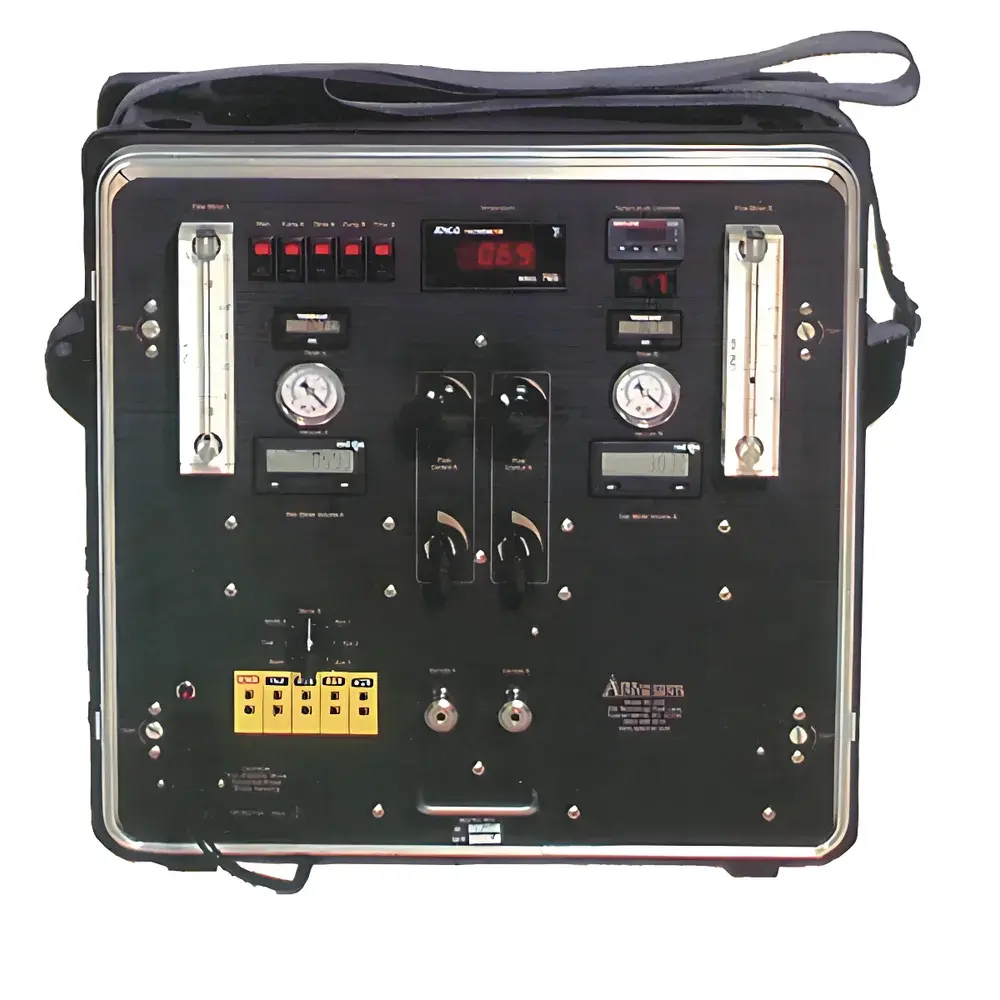
Apex XC-260 Manual Mercury Sampling System
| Origin | USA |
|---|---|
| Manufacturer Type | Authorized Distributor |
| Origin Category | Imported |
| Model | XC-260 |
| Price Range | USD 7,000 – 14,000 |
| Flow Range Options | 0.2–2.4 L/min or 100–1000 mL/min (XC-260A variant) |
| Dry Gas Meter | Positive-displacement diaphragm type, 0.7 L/rev, 8-digit LCD display, 1 mL resolution |
| Dual Diaphragm Pump | 12 V DC motor, max vacuum 20 inHg |
| Temperature Display | Digital, °C |
| Thermocouple Inputs | Five external K-type, two internal flowmeter temperature sensors |
| Dimensions | 50 × 53 × 30.5 cm |
| Weight | 17.7 kg |
Overview
The Apex XC-260 Manual Mercury Sampling System is a field-deployable, regulatory-compliant instrument engineered for accurate, gravimetric determination of elemental and oxidized mercury emissions from stationary combustion sources—including coal-fired power plants, waste incinerators, and cement kilns. Designed to meet the procedural requirements of U.S. EPA Method 30B (“Determination of Mercury Emissions from Stationary Sources Using Sorbent Trap Sampling”), the XC-260 operates on a manual, operator-controlled sampling protocol that eliminates reliance on complex automation while maintaining strict adherence to volumetric accuracy, thermal stability, and trace-level integrity. Its core measurement principle relies on isokinetic or non-isokinetic sorbent trap sampling—where mercury species are captured quantitatively on dual gold-coated or iodated carbon traps—followed by laboratory analysis via cold vapor atomic fluorescence spectrometry (CVAFS) or thermal desorption–ICP-MS. The system’s dry gas metering architecture ensures high reproducibility of sampled gas volume under variable backpressure conditions, a critical factor in achieving <±2% volumetric uncertainty per EPA 40 CFR Part 60, Appendix A–1.
Key Features
- Dual independent sampling channels with synchronized start/stop control, enabling parallel trap deployment for redundancy or method validation.
- Two calibrated positive-displacement diaphragm dry gas meters—each with 0.7 L/revolution displacement, 8-digit LCD readout, and 1 mL resolution—providing real-time, drift-free volumetric tracking without temperature/pressure correction assumptions.
- Proportional flow control valves supporting two selectable flow regimes: standard range (0.2–2.4 L/min) for high-concentration stacks and low-flow mode (100–1000 mL/min, XC-260A configuration) optimized for dilute emissions or extended-duration sampling.
- Stainless steel fluidic path components—including 1/4″ Swagelok®-compatible quick-connect fittings, solenoid valves, and sample line manifolds—ensuring corrosion resistance, low mercury adsorption, and compliance with ASTM D6784-22 material compatibility guidelines.
- Integrated digital temperature monitoring system with five external K-type thermocouple inputs (for stack gas, probe, and trap temperatures) plus two internal flowmeter sensor channels—supporting continuous thermal profiling required for EPA Method 30B Section 8.3.2.
- 12 V DC dual-diaphragm vacuum pump rated for sustained operation at up to 20 inHg vacuum, delivering stable flow across filter loading and sorbent breakthrough conditions.
Sample Compatibility & Compliance
The XC-260 is validated for use with standard EPA-approved sorbent traps—including gold-coated quartz, iodated carbon, and sulfided activated carbon configurations—as specified in Method 30B and aligned with ISO 19736:2020 (Stationary source emissions — Determination of mercury — Sorbent trap method). It supports both single-trap and dual-trap (front/back) sampling arrangements to assess breakthrough and calculate recovery efficiency. All wetted materials comply with USP Class VI biocompatibility standards and exhibit <0.05 ng/cm² mercury retention per ASTM D7622-21 surface testing. The system meets mechanical and electrical safety requirements per UL 61010-1 and IEC 61000-6-3 (EMC immunity). Documentation packages include factory calibration certificates traceable to NIST SRM 2710a, as well as IQ/OQ protocols suitable for GLP and 21 CFR Part 11–aligned QA/QC environments.
Software & Data Management
While the XC-260 operates manually without embedded firmware or onboard data logging, it is fully compatible with third-party audit-ready data acquisition systems. Field operators record time-stamped parameters—including elapsed time, cumulative volume, trap inlet/outlet temperatures, and pump vacuum—using standardized EPA Form 30B worksheets or certified electronic lab notebooks (ELN) compliant with 21 CFR Part 11. Optional USB-to-serial adapters enable direct connection to Windows-based acquisition software (e.g., LabVIEW™ or custom Python scripts) for automated timestamping and CSV export. All meter readings are designed for seamless transcription into EPA’s Electronic Reporting Tool (ERT) and subsequent submission to the Clean Air Markets Division (CAMD) database.
Applications
- Regulatory compliance monitoring for coal- and oil-fired utility boilers under MATS (Mercury and Air Toxics Standards), 40 CFR Part 63 Subpart UUUU.
- Performance testing of activated carbon injection (ACI) and flue gas desulfurization (FGD) systems for mercury removal efficiency assessment.
- Source characterization studies during startup, shutdown, and malfunction (SSM) events where automated samplers may be unavailable.
- Method validation and reference sampling during CEMS (Continuous Emission Monitoring Systems) certification per PS-12A.
- Research-grade mercury speciation trials requiring precise control over sampling duration, flow rate, and thermal gradient management.
FAQ
Is the XC-260 compliant with U.S. EPA Method 30B?
Yes—the XC-260 satisfies all hardware, calibration, and operational criteria defined in EPA Method 30B, including dual-trap capability, dry gas meter accuracy, temperature monitoring requirements, and flow stability specifications.
Can the XC-260 be used for both elemental and oxidized mercury sampling?
Yes—when paired with appropriate sorbent media (e.g., dual gold traps for Hg⁰, iodated carbon for Hg²⁺), the system captures both species with >95% efficiency across the 0.2–2.4 L/min range.
What calibration documentation is provided with the instrument?
Each unit ships with NIST-traceable calibration certificates for both dry gas meters and temperature sensors, valid for 12 months, along with a full metrology report detailing uncertainty budgets per ISO/IEC 17025.
Does the XC-260 support isokinetic sampling?
The system does not include automatic isokinetic control; however, it is routinely deployed with external pitot tubes and velocity calculations to achieve manual isokinetic adjustment per EPA Method 1 and Method 30B Section 7.2.
What maintenance intervals are recommended for field operation?
Dry gas meters require verification every 100 hours of cumulative operation; pump diaphragms should be inspected quarterly; stainless steel valves and fittings require cleaning after each sampling campaign using ASTM D7622-recommended solvent rinses.







