
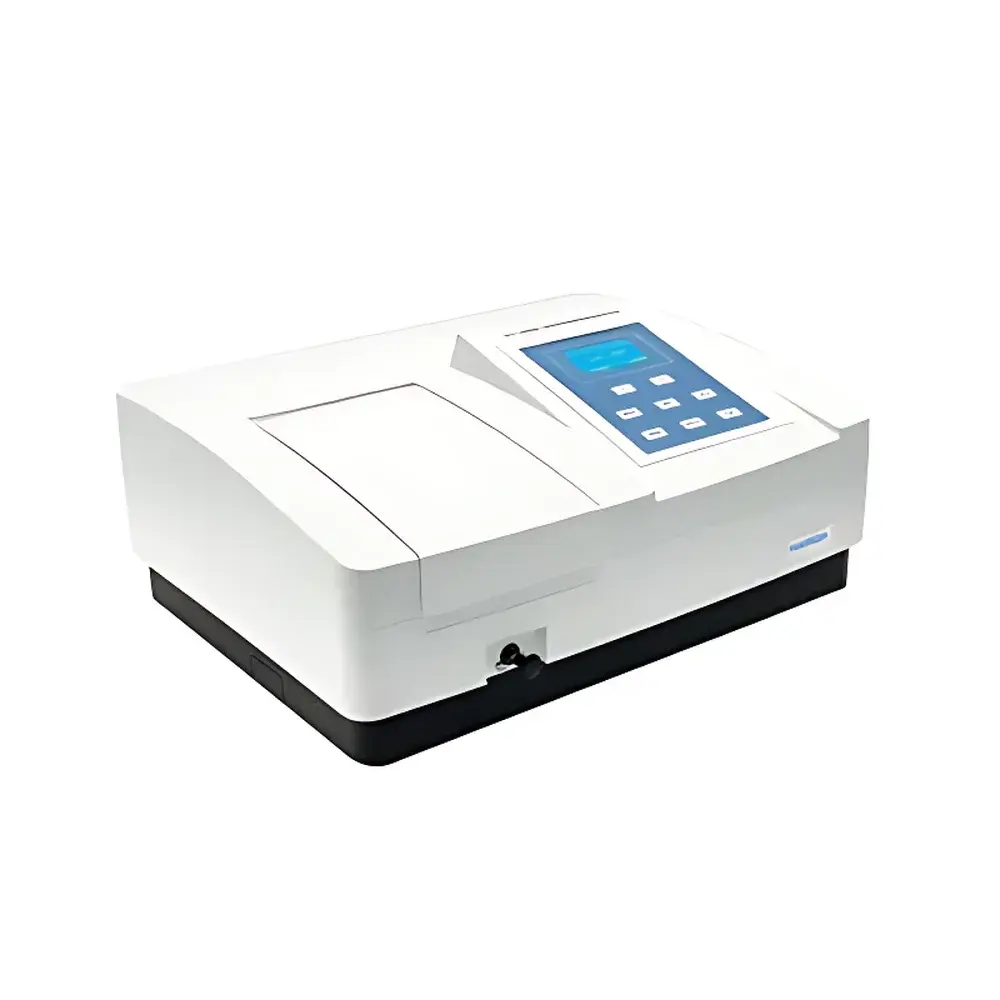
Mapada UV-1200 Single-Beam Ultraviolet-Visible Spectrophotometer
| Brand | Mapada |
|---|---|
| Origin | Shanghai, China |
| Manufacturer Type | Original Equipment Manufacturer (OEM) |
| Instrument Architecture | Single-Beam |
| Detector Type | Silicon Photodiode |
| Wavelength Range | 200–1000 nm |
| Spectral Bandwidth | 4 nm |
| Wavelength Accuracy | ±1 nm |
| Wavelength Repeatability | ±0.5 nm |
| Absorbance Range | −0.3 to 3.0 A |
| Transmittance Range | 0–200% T |
| Display | 128 × 64 Dot-Matrix LCD |
| Data Interface | USB 2.0 Standard Port |
| Printer Interface | Parallel Port |
| Power Supply | AC 220 V / 50 Hz or 110 V / 60 Hz |
| Dimensions (W × D × H) | 490 × 360 × 210 mm |
| Net Weight | 12 kg |
Overview
The Mapada UV-1200 is a single-beam ultraviolet-visible (UV-Vis) spectrophotometer engineered for routine quantitative and qualitative analysis in academic teaching laboratories, quality control environments, and industrial R&D settings. It operates on the fundamental principle of Beer–Lambert law-based absorption spectroscopy, measuring the attenuation of monochromatic light as it passes through a sample solution in the spectral region from 200 nm (deep UV) to 1000 nm (near-infrared). Its optical architecture integrates a 1200 lines/mm holographic grating, precision-aligned collimating optics, and a high-stability imported silicon photodiode detector—ensuring consistent photometric response across the full wavelength range. The instrument employs a dual-lamp system (deuterium lamp for UV; tungsten-halogen lamp for visible/NIR), with automatic lamp selection and real-time intensity monitoring to maintain optimal signal-to-noise ratio during spectral scanning.
Key Features
- Single-beam optical design optimized for cost-effective, high-reproducibility absorbance measurements in standardized protocols.
- Automatic wavelength calibration and positioning—eliminates manual alignment and reduces operator dependency.
- Dual-lamp control: independent on/off switching and intensity optimization for deuterium and tungsten lamps, extending lamp lifetime and minimizing warm-up drift.
- Large-format 128 × 64 dot-matrix LCD display supporting real-time visualization of absorbance, transmittance, energy, and concentration modes—including dynamic plotting of calibration curves and regression equations (e.g., y = mx + b) with correlation coefficient (R²) calculation.
- Internal memory stores up to 100 user-defined calibration curves and 200 measurement datasets—enabling traceable, audit-ready data retention without external storage.
- Modular lamp housing with socket-type installation—lamp replacement requires no optical recalibration or mechanical re-alignment.
- Spacious sample compartment accommodating cuvettes from 5 mm to 100 mm pathlength, compatible with standard quartz, glass, and plastic cells.
Sample Compatibility & Compliance
The UV-1200 supports liquid-phase analysis using conventional cuvette-based configurations. It complies with core performance criteria outlined in ISO 6425 (spectrophotometer verification), ASTM E275 (description of UV-Vis spectrophotometric terminology), and USP (Spectrophotometry and Light-Scattering). While not inherently 21 CFR Part 11 compliant in standalone mode, its USB interface enables integration with validated third-party laboratory information management systems (LIMS) that support electronic signatures, audit trails, and secure data archiving—facilitating GLP and GMP-aligned workflows when deployed in regulated QC/QA labs.
Software & Data Management
The instrument features native USB 2.0 connectivity for direct communication with Windows-based PCs. Mapada’s optional SpectraAnalysis Suite provides extended functionality including kinetic scan mode, multi-wavelength quantitation, derivative spectroscopy, and customizable report generation (PDF/CSV export). All data transfers are timestamped and include metadata such as instrument ID, operator login (if configured via host software), wavelength setpoint, slit width, and measurement mode—supporting traceability requirements under ISO/IEC 17025. Parallel port output enables compatibility with legacy thermal or dot-matrix printers for hardcopy record retention.
Applications
- Quantitative determination of analytes in pharmaceutical formulations (e.g., assay of paracetamol, ibuprofen, or vitamin B12 per USP monographs).
- Enzyme kinetics studies (e.g., NADH oxidation at 340 nm) and protein concentration estimation via Bradford or Lowry assays.
- Water quality testing—including nitrate (220 nm/275 nm dual-wavelength correction), phosphate (880 nm after molybdenum blue reaction), and COD assessment.
- Colorimetric analysis in food science (e.g., anthocyanin content in berries, chlorophyll in leaf extracts).
- Educational use in undergraduate chemistry and biochemistry labs for method validation, linearity assessment, and detection limit experiments.
FAQ
Does the UV-1200 support baseline correction or zeroing with solvent blanks?
Yes—the instrument allows real-time baseline subtraction using a reference cell containing blank solvent prior to sample measurement.
Is spectral scanning capability available?
Yes—manual or automated wavelength scanning across 200–1000 nm is supported, with data points recorded at user-defined intervals (1 nm, 2 nm, or 5 nm step size).
Can the UV-1200 be used with microvolume or fiber-optic accessories?
No—this model is designed exclusively for standard cuvette-based measurements; it does not support integrated microvolume stands or external fiber-optic probes.
What is the typical warm-up time required before stable photometric readings?
Under ambient conditions (20–25 °C), 20 minutes is recommended for full thermal stabilization of both lamps and detector electronics.
Are firmware updates available, and how are they installed?
Firmware upgrades are distributed by Mapada via encrypted USB flash drive and require guided installation through the host PC software—no field-service intervention is needed.




