
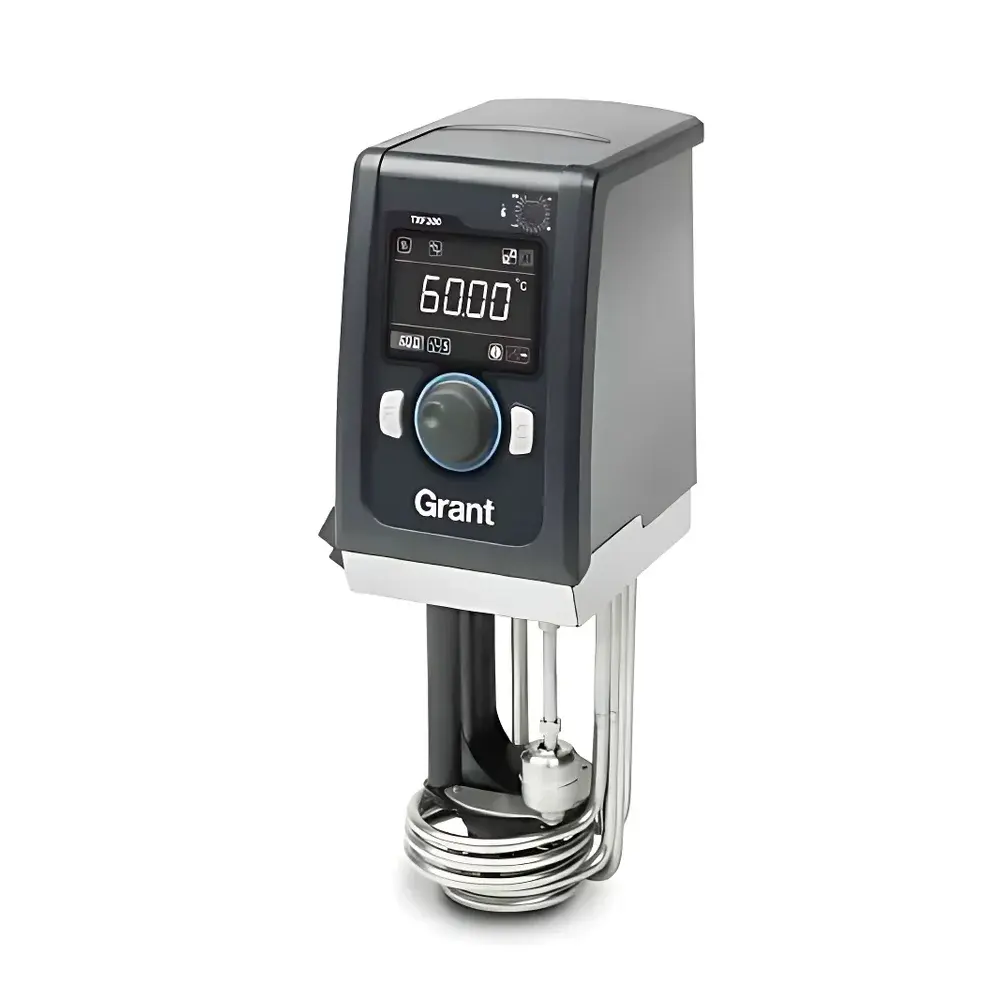
Grant Optima™ T100/TC120/TX150/TXF200 Circulating Temperature Controller
| Brand | Grant Instruments (UK) |
|---|---|
| Origin | United Kingdom |
| Model Series | T100, TC120, TX150, TXF200 |
| Bath Volume | 38 L |
| Temperature Range | 0–200 °C |
| Temperature Stability | ±0.005 °C (at setpoint, typical for TX150/TXF200 under optimal conditions) |
| Circulation Mode | Internal & External (T100 supports internal only) |
| Control Type | Refrigerated/Heating |
| Heating Power (230 V) | 1.3–1.9 kW |
| Max Flow Rate (Water) | 16–23 L/min |
| Max Pressure (Water) | 210–530 mbar |
| Interface | USB & RS232 (TC120/TX150/TXF200) |
| Display | 4-digit LED / QVGA TFT color screen |
| Setpoint Resolution | 0.1 °C (0.01 °C with Labwise™ software) |
| Calibration | Two-point user calibration supported (TX150/TXF200) |
| Safety Features | Over-temperature cutoff (adjustable/fixed), low-level float switch, programmable high/low temperature alarms |
| Compliance | DIN 12876-1 (Class I/II), CE, UKCA |
Overview
The Grant Optima™ Series Circulating Temperature Controllers (T100, TC120, TX150, and TXF200) are precision-engineered thermal management systems designed for demanding laboratory applications requiring stable, reproducible, and programmable temperature control of external baths or closed-loop systems. Operating on a dual-mode refrigeration/heating principle, these controllers utilize a hermetically sealed compressor combined with PID-controlled resistive heating elements to achieve rapid thermal response and exceptional stability across a broad operational range (0–200 °C). Unlike basic immersion heaters or non-circulating baths, the Optima™ platform integrates a high-efficiency internal circulation pump (except T100) and optional external recirculation capability—enabling uniform thermal distribution in stainless steel or polypropylene bath vessels, jacketed reactors, calorimeters, or material testing fixtures. Each model is constructed to meet DIN 12876-1 Class I or II specifications for laboratory thermostats, ensuring mechanical robustness, electrical safety, and long-term reliability under continuous operation.
Key Features
- Precision temperature stability down to ±0.005 °C (typical at 70 °C for TX150/TXF200, per DIN 12876-1 test protocol)
- High-uniformity performance: ±0.05 °C spatial homogeneity (DIN 12876-1, measured at 70 °C in 38 L bath)
- Programmable ramp-soak profiles: Up to 100 steps (TXF200), configurable via front-panel interface or Labwise™ PC software
- Dual communication interfaces: Standard USB and RS232 for integration into automated workflows and LIMS environments
- Two-point user calibration support (TX150/TXF200) with traceable offset adjustment for sensor drift compensation
- Configurable alarm system with relay output for external process interlock (e.g., shutdown of connected instrumentation upon deviation)
- Integrated safety architecture: Adjustable over-temperature cut-off, fixed thermal fuse, low-bath-level detection via float switch, and dry-run protection
- Variable-speed circulation pump (TX150/TXF200): Flow rate adjustable from 0–23 L/min; max pressure up to 530 mbar for high-backpressure applications
Sample Compatibility & Compliance
The Optima™ series accommodates standard 38 L stainless steel or chemically resistant plastic bath vessels (e.g., PP, PTFE-lined). Its external circulation port (6/11 mm ID/OD tubing) supports connection to jacketed glassware, flow cells, viscometers, or custom thermal manifolds. All units comply with EN 61010-1 (Safety Requirements for Electrical Equipment for Measurement, Control, and Laboratory Use) and carry CE and UKCA markings. DIN 12876-1 certification confirms conformance to European standards for laboratory thermostats—including requirements for temperature accuracy, uniformity, stability, and mechanical construction. For regulated environments (e.g., pharmaceutical QC labs), the TX150/TXF200 models support audit-trail-capable Labwise™ software compliant with FDA 21 CFR Part 11 when configured with electronic signature and user access controls.
Software & Data Management
Labwise™ software (included with TX150/TXF200) provides full remote control, real-time data logging (≥1 Hz sampling), and GLP-compliant reporting. It enables creation of multi-step temperature programs, export of timestamped CSV datasets, and generation of PDF calibration certificates. The software supports automatic detection of external PT100 probes (TXPEP/TXSEP), allowing distributed temperature monitoring within complex setups. All logged data include metadata such as operator ID, instrument serial number, ambient conditions, and calibration history—facilitating traceability during ISO/IEC 17025 or GMP audits. USB and RS232 ports allow seamless integration with SCADA systems or custom Python/Matlab automation scripts.
Applications
- Calibration of thermometers, RTDs, and thermocouples against NIST-traceable references
- Thermal conditioning of samples prior to rheological, viscometric, or spectroscopic analysis
- Temperature-controlled enzymatic assays and cell culture incubation support systems
- Stabilization of laser sources, detectors, and optical benches requiring sub-millikelvin thermal drift control
- Material testing: Coefficient of thermal expansion (CTE) measurements, polymer crystallinity studies, and heat capacity determinations
- Process validation: Thermal mapping of autoclaves, stability chambers, and cleanroom HVAC ducts
FAQ
What is the difference between internal and external circulation modes?
Internal circulation circulates fluid only within the integrated bath reservoir. External circulation pumps conditioned fluid through an external loop—ideal for jacketed reactors or inline sensors.
Can the T100 be used with an external bath?
No—the T100 lacks external circulation ports and is intended solely for use with its built-in reservoir.
Is Labwise™ software required to achieve 0.01 °C setpoint resolution?
Yes—0.01 °C resolution is enabled exclusively via Labwise™ software; front-panel input remains at 0.1 °C minimum increment.
Does the unit support PT100 probe input for external temperature feedback?
Only TX150 and TXF200 models support optional external PT100 inputs (TXPEP/TXSEP probes) for cascade or remote-sensor control modes.
How often should two-point calibration be performed?
Per ISO/IEC 17025 guidelines, calibration frequency depends on usage intensity and criticality—but quarterly verification is recommended for GLP/GMP environments.



