
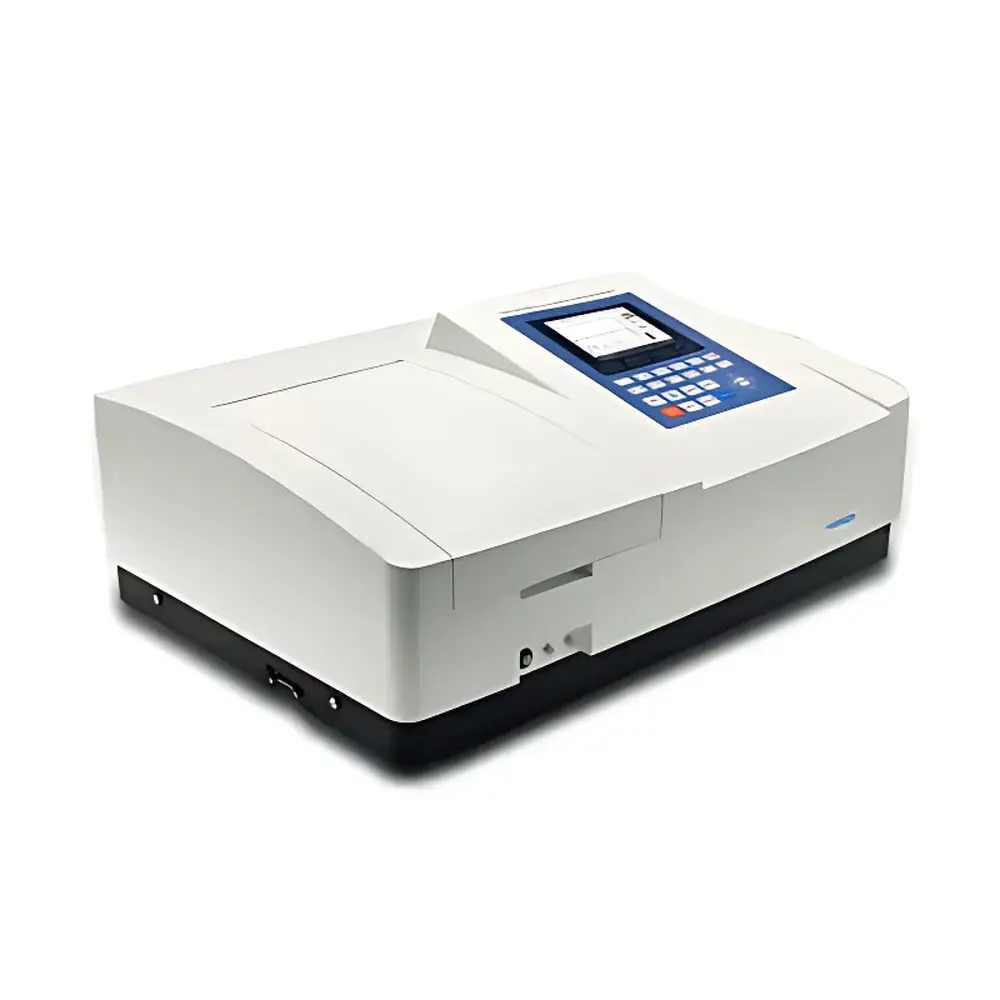
Mapada UV-6 Series Dual-Beam Scanning Ultraviolet-Visible Spectrophotometer
| Brand | Mapada |
|---|---|
| Origin | Shanghai, China |
| Manufacturer Type | Direct Manufacturer |
| Product Origin | Domestic (China) |
| Model | UV-6100 / UV-6300 / UV-6100S |
| Price Range | USD 4,200 – 7,000 (FOB Shanghai) |
| Optical Design | Dual-Beam |
| Detector | Silicon Photodiode Array |
| Wavelength Range | 190–1100 nm |
| Wavelength Accuracy | ±0.3 nm |
| Spectral Bandwidth | 0.5–5 nm (adjustable in five steps on UV-6100S), 1.0 nm (UV-6300), 1.8 nm (UV-6100) |
| Wavelength Setting | Motorized Auto-Scanning |
| Display | 320 × 240 Dot-Matrix LCD |
| Scan Speed | Up to 3800 nm/min (high-speed mode) |
| Photometric Modes | Transmittance (%T), Absorbance (A), Concentration (C), Energy (E) |
| Data Interface | USB 2.0 |
| Print Interface | Parallel Port |
| Power Supply | AC 220 V/50 Hz or AC 110 V/60 Hz |
| Dimensions (W×D×H) | 590 × 420 × 260 mm |
| Net Weight | 26 kg |
Overview
The Mapada UV-6 Series Dual-Beam Scanning Ultraviolet-Visible Spectrophotometer is engineered for high-precision quantitative and qualitative analysis across academic research laboratories, pharmaceutical quality control (QC), environmental monitoring, and industrial R&D environments. Utilizing a true dual-beam optical architecture with real-time reference beam compensation, the instrument eliminates baseline drift caused by source intensity fluctuation or detector thermal drift—ensuring exceptional photometric stability over extended measurement sessions. The core optical path integrates a high-efficiency 1200 lines/mm holographic grating, coupled with imported long-life deuterium and tungsten-halogen lamps, enabling continuous spectral coverage from 190 nm (deep UV) to 1100 nm (near-infrared). This broad range supports critical applications including nucleic acid quantification (260 nm), protein A280 analysis, colorimetric assays (e.g., Bradford, BCA), and UV-Vis characterization of nanomaterials and organic dyes.
Key Features
- Dual-beam optical design with real-time background correction for superior baseline reproducibility and reduced measurement variability
- Five-step adjustable spectral bandwidth (0.5 / 1 / 2 / 4 / 5 nm) on UV-6100S model—optimized for resolution/sensitivity trade-off per application requirement
- High-stability silicon photodiode array detector with low-noise analog signal processing and 12-bit ADC resolution
- Motorized wavelength drive system with ±0.3 nm certified wavelength accuracy (traceable to NIST-standard filters)
- Integrated lamp life monitoring: real-time hour-counting and status alerts for both deuterium and tungsten sources
- Plug-and-play lamp module design—no optical realignment required after replacement—reducing downtime and technician dependency
- Spacious sample compartment accommodating cuvettes from 5 mm to 100 mm pathlength, including microvolume adapters and temperature-controlled holders (optional)
- Onboard 320 × 240 pixel monochrome LCD with intuitive menu navigation and full photometric mode support (T, A, C, E)
Sample Compatibility & Compliance
The UV-6 Series accommodates standard quartz, glass, and plastic cuvettes (10 mm default), as well as specialized cells for turbid samples, flow-through configurations, and solid-sample reflectance accessories (sold separately). All models comply with ISO 9001 manufacturing standards and meet essential electromagnetic compatibility (EMC) requirements per IEC 61326-1. For regulated environments, the instrument supports GLP-compliant operation through built-in self-diagnostic routines—including automated wavelength and photometric accuracy verification using certified reference standards. While not inherently 21 CFR Part 11 compliant, audit trail functionality (user log, method timestamping, data integrity flags) is enabled via the optional Mapada SpectraPro software suite—facilitating alignment with FDA-aligned QC workflows in pharmaceutical and contract testing labs.
Software & Data Management
Supplied with Mapada SpectraPro v3.x—a Windows-based PC application supporting full instrument control, spectral acquisition, kinetic time-course analysis, multi-wavelength quantitation, and DNA/protein concentration calculation (using user-defined or preloaded extinction coefficients). Data export is supported in CSV, TXT, and JCAMP-DX formats for interoperability with LIMS, MATLAB, and OriginLab. USB 2.0 interface ensures plug-and-play connectivity without driver installation on Windows 10/11 systems. Raw absorbance/time datasets include embedded metadata (date, operator ID, method name, instrument serial number), enabling traceable data lineage. Optional password-protected method libraries and electronic signature modules are available for GMP-aligned deployment.
Applications
- Pharmaceutical: Assay validation per USP , excipient purity screening, dissolution profile analysis
- Life Sciences: dsDNA/ssDNA quantification (A260/A280 ratio), Bradford/Lowry protein assays, enzyme kinetics (e.g., NADH oxidation at 340 nm)
- Environmental: Nitrate/nitrite detection (220/275 nm), COD determination, heavy metal complexation studies
- Materials Science: Bandgap estimation of semiconductors (Tauc plot), nanoparticle surface plasmon resonance (SPR) characterization
- Food & Beverage: Color index (CIE L*a*b*), antioxidant capacity (FRAP assay), preservative concentration (sorbic acid at 265 nm)
FAQ
What is the difference between UV-6100, UV-6300, and UV-6100S models?
The UV-6100 features fixed 1.8 nm bandwidth; UV-6300 offers higher resolution with 1.0 nm fixed bandwidth; UV-6100S provides five-step adjustable bandwidth (0.5–5 nm), making it suitable for method development and regulatory flexibility.
Does the instrument support compliance with pharmacopeial methods (e.g., USP, EP)?
Yes—the 190–1100 nm range, ±0.3 nm wavelength accuracy, and programmable scan parameters enable direct implementation of USP , EP 2.2.25, and JP 17 protocols when paired with validated reference materials and SOPs.
Can the UV-6 Series be integrated into an automated lab workflow?
Via USB command protocol (SCPI-compatible subset), the instrument supports remote triggering and data retrieval from third-party automation platforms—though no dedicated Ethernet or RS-232 interface is included in base configuration.
Is lamp alignment required after replacement?
No—socket-mounted lamps feature mechanical and optical registration pins, ensuring repeatable positioning without manual collimation or calibration recalibration.
What maintenance is recommended for long-term photometric stability?
Biannual verification using NIST-traceable holmium oxide and neutral density filters is advised; desiccant replacement in the optical chamber every 12 months prevents humidity-induced grating degradation.




