
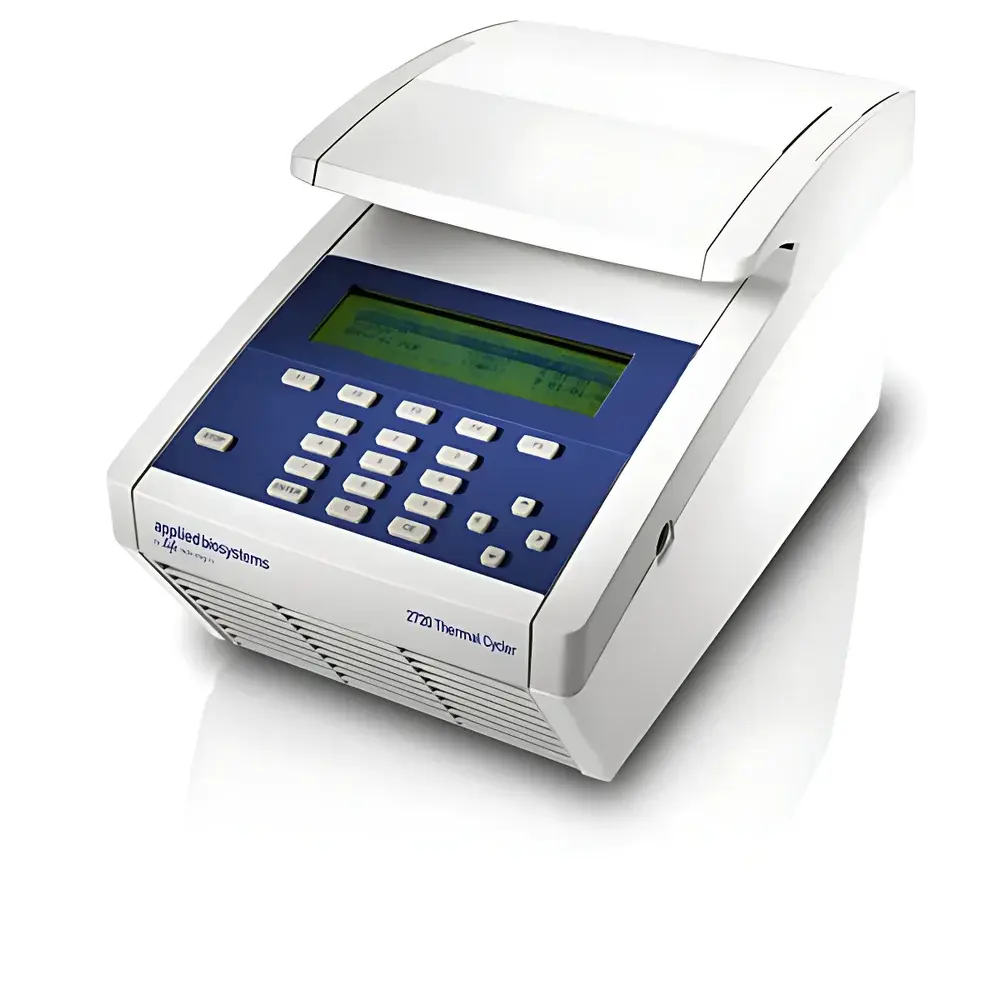
Applied Biosystems® 2720 Thermal Cycler
| Brand | Thermo Fisher Scientific |
|---|---|
| Origin | Singapore |
| Model | 2720 |
| Instrument Type | Standard PCR Thermal Cycler |
| Sample Capacity | 96-well format |
| Ramp Rate | 2.7 °C/s |
| Temperature Accuracy | ±0.25 °C |
| Well-to-Well Uniformity | ±0.5 °C (measured 30 s after reaching 95 °C) |
| Dimensions | Compact benchtop design |
| User Interface | Graphical LCD with intuitive navigation |
Overview
The Applied Biosystems® 2720 Thermal Cycler is a compact, entry-level PCR instrument engineered for reproducible nucleic acid amplification in routine molecular biology laboratories. Based on the proven thermal control architecture of the GeneAmp® PCR System 9700, the 2720 delivers consistent performance across standard PCR protocols—including endpoint amplification, colony PCR, and Sanger sequencing template preparation—while optimizing footprint and operational cost. Its core operation relies on precise Peltier-based heating and cooling of an aluminum block, calibrated to maintain tight thermal accuracy and uniformity across all 96 wells. Designed for laboratories requiring reliable, no-frills thermal cycling without advanced gradient or fast-ramp capabilities, the 2720 supports robust protocol execution under standard ambient conditions (15–30 °C) and meets fundamental requirements for ISO/IEC 17025-compliant environments where traceable temperature validation is performed periodically.
Key Features
- Compact benchtop form factor: Minimal footprint (24.8 × 32.5 × 24.1 cm) enables deployment in space-constrained hoods, shared core facilities, or teaching labs without compromising accessibility or ventilation.
- Precise thermal control: Achieves ±0.25 °C absolute temperature accuracy across the full operating range (4–99.9 °C), verified via NIST-traceable calibration procedures during factory qualification.
- High well-to-well uniformity: Maintains ±0.5 °C consistency across all 96 positions at 95 °C (measured 30 seconds post-equilibration), minimizing inter-well variation critical for reproducible amplification efficiency.
- Controlled ramp kinetics: Delivers a maximum heating rate of 2.7 °C/s and symmetric cooling profile, enabling predictable cycle timing and compatibility with conventional Taq-based and hot-start polymerase chemistries.
- Intuitive graphical interface: Features a backlit monochrome LCD with menu-driven navigation, allowing direct protocol creation, editing, and recall without external software or PC dependency.
- Robust mechanical architecture: Aluminum heating block with gold-plated contact surfaces ensures long-term thermal stability and resistance to corrosion from repeated condensation and reagent exposure.
Sample Compatibility & Compliance
The 2720 Thermal Cycler accepts standard 0.2 mL thin-wall PCR tubes and 96-well plates conforming to ANSI/SBS dimensional specifications. It is compatible with all major commercial PCR master mixes, including those formulated for high-fidelity, multiplex, or RT-PCR applications—provided thermal profiles remain within its specified operating envelope. While not certified for clinical diagnostic use under FDA 510(k) or CE-IVD directives, the instrument supports Good Laboratory Practice (GLP) workflows through user-accessible protocol logging and manual audit trail documentation. Routine verification per ASTM E2234 (Standard Practice for Verification of Thermal Cyclers) is recommended for laboratories adhering to ISO 15189 or CAP accreditation standards.
Software & Data Management
The 2720 operates independently of computer connectivity; all protocols are stored onboard (up to 100 user-defined programs). No proprietary software installation is required for basic operation. For laboratories integrating instrument data into electronic lab notebooks (ELNs) or LIMS, exported run logs (via optional RS-232 or USB-to-serial adapter) provide timestamped cycle parameters, block temperature history, and completion status. Although the device does not support 21 CFR Part 11-compliant electronic signatures or automated audit trails, its deterministic behavior and stable firmware versioning (v3.1.x series) facilitate retrospective validation and change control under GxP-aligned quality systems.
Applications
- Routine genotyping and allele-specific amplification
- Preparation of templates for Sanger sequencing and restriction digestion
- Amplification of cDNA from reverse transcription reactions
- Verification of cloning constructs and plasmid integrity
- Teaching laboratory instruction in molecular biology techniques
- Quality control testing in non-regulated R&D settings
FAQ
Is the 2720 Thermal Cycler suitable for quantitative real-time PCR (qPCR)?
No—it lacks optical detection modules, excitation sources, and fluorescence signal acquisition hardware required for qPCR. It is designed exclusively for endpoint amplification.
Can I use 384-well plates with this instrument?
No—the block geometry and thermal calibration are validated only for 96-well formats. Use of non-standard plates may compromise temperature uniformity and reproducibility.
Does the 2720 support gradient PCR?
No—this model does not include thermal gradient functionality. Gradient capability is available in the Veriti® and ProFlex™ series instruments.
What maintenance is required for long-term reliability?
Annual verification of block temperature accuracy and uniformity using a calibrated thermocouple probe array is recommended. Clean the block surface regularly with 70% ethanol to prevent residue buildup.
Is firmware upgrade supported?
Yes—Thermo Fisher provides verified firmware updates via official technical support channels. Upgrades must be performed using the designated utility and original USB cable to ensure integrity and avoid corruption.




